Showing posts with label choice. Show all posts

Friday, April 06, 2018

Plagued hearts

TODAY'S SPECIAL: 1 Kings 8-10; Psalm 96

TO CHEW ON: "... when each one knows the plague of his own heart, and spreads out his hands toward this temple, then hear in heaven Your dwelling place, and forgive and act, and give to everyone according to all his ways whose heart You know (for You alone know the hearts of all the sons of men)" 1 Kings 8:38,39


In his prayer at the dedication of the temple, Solomon covered a myriad of scenarios for when the Israelites would need God's answered prayers from that building. He prayed that:
  • when someone was forced to take an oath before the altar because of an accusation, God would hear and judge rightly.
  • when Israel was defeated because of backsliding, God would hear, forgive and bring her back.
  • when the consequences of their sin led to drought, God would forgive sin and send rain.
  • when there was famine, blight, mildew, locusts, grasshoppers, enemy oppression ...

It's as if Solomon was trying to think of every instance and reason they could need God, and he lands finally on the picturesque: "when each one knows the plague of his own heart..."

That is still the heart of the matter for us. The plague of our hearts is the sinful condition into which we're born. It evidences itself in rebellion against God and friction between us and others as we give in to our self-centered bent. Want to diagnose it in yourself? Just compare your life to the ideal in Matthew 5, 6 & 7, or 1 Corinthians 13.

There is only one cure for our chronic, terminal heart condition. It's Jesus:

Isaiah: "But He was wounded for our transgressions, He was bruised for our iniquities. The chastisement for our peace was upon Him and by His stripes we are healed" - Isaiah 53:5.


Peter: "Who Himself bore our sins in His own body on the tree, that we having died to sins, might live for righteousness—by whose stripes you were healed" - 1 Peter 2:24.

Jesus: "'The Spirit of the Lord is upon Me, because He has anointed Me to preach the gospel to the poor; He has sent Me to heal the brokenhearted, to proclaim liberty to the captives, and recovery of sight to the blind. to set at liberty those who are oppressed'" - Luke 4:18.

PRAYER: Dear God, with Solomon I bring to You the plague of my heart. Thank You for making me healed and clean in Your sight because of Jesus, who paid  my sins' penalty. Help me to deal with my sin-sick heart practically every day, as I bend my will and actions to Your Spirit. Amen.

PSALM TO PRAY: Psalm 96

MORE: Original pollution

Wayne Grudem talks about the plague of our hearts in the Sin chapter of his Systematic Theology.

He defines sin: "Sin is any failure to conform to the moral law of God in act, attitude or nature" - p. 490.

He makes two points in the section called "The Doctrine of Inherited Sin," stating and discussing in detail how we are born with:
"1. Inherited Guilt: we are counted guilty because of Adam's sin - Romans 5:12-21... 
2. Inherited corruption: we have a sinful nature because of Adam's sin. ...This inherited sinful nature is sometimes simply called 'original sin,' and sometimes more precisely called 'original pollution (Psalm 51:5)'" which Grudem  calls "inherited corruption."

Mr. Grudem comes to this sobering conclusion:

"But if we have a total inability to do any spiritual good in God's sight, then do we still have any freedom of choice? Certainly, those who are outside of Christ do still make voluntary choices—that is, they decide what they want to do, then they do it. ... Yet because of their inability to do good and to escape from their fundamental rebellion against God and their fundamental preference for sin, unbelievers do not have freedom in the most important sense of freedom—that is freedom to do right, and to do what is pleasing to God.

The application to our lives is quite evident: if God gives anyone a desire to repent and trust in Christ, he or she should not delay and should not harden his or heart heart (cf. Hebrews 3:7-8; 12:17). This ability to repent and desire to trust in God is not naturally ours but is given by the prompting of the Holy Spirit, and it will not last forever. 'Today, when you hear his voice, do not harden your hearts' - Hebrews 3:15"
  - Wayne Grudem, Systematic Theology, pp. 494, 496, 498 (emphasis added).  
***********
Unless otherwise noted all Scripture quotations are taken from the New King James Version®. Copyright © 1982 by Thomas Nelson, Inc. Used by permission. All rights reserved.

Monday, February 26, 2018

Awaken the Dawn

Image: Pixabay
TODAY’S SPECIAL: Deuteronomy 13,14; Psalm 57

TO CHEW ON: “Awake my glory!
Awake lute and harp!
I will awaken the dawn.” Psalm 57:8


An introductory line in my Bible identifies the occasion for the writing of this psalm: “A Michtam of David when he fled from Saul into the cave.”

I imagine David beginning to write this psalm in the evening. He’s bone-weary, discouraged, feeling surrounded and overwhelmed by the forces coming against him, and very scared:

“My soul is among lions;
I lie among the sons of men
Who are set on fire,
Whose teeth are spears and arrows,
And their tongue a  sharp sword…
They have prepared a net for my feet…
They have dug a pit before me” - Psalm 57: 4,6.

Then, at verse 7 the feeling changes:

“My heart is steadfast O God…
I will sing and give praise.”

Here’s my guess about why the change: I imagine David resuming the writing of the psalm in the morning, after a night of sleep. He’s made it through the night. The sun will soon rise on another day and he shifts his perspective from his troubles to God.

Since he’s hiding from Saul in a cave, you’d expect he’d be extra careful that no noises echoed through the cave’s chambers and to the outside. But no. He wants his praise to be so loud it will “awaken the dawn.”

There are several lessons for me—for us—in this passage.

1. It’s a good idea to sleep on our problems.
For example, it’s a good plan to  leave making difficult decisions to when we’re rested and have gained perspective by giving the situation a little time and distance and we’re in better physical shape.

2. Praise changes the atmosphere.
From Psalm 57:7 on, when David shifts his focus from his problems to God, there’s not another hint of gloom. It’s all about God’s greatness, attributes and abilities.

3. It’s a good thing to express praise aloud.
David’s praise is loud. It’s expressed with musical instruments and voice, into the open air and to people (Psalm 57:8, 9). I know I tend to praise silently, mentally. I need to do more praising aloud, with my voice, maybe even visit the piano or get out the keyboard.


PRAYER: Dear Father, it’s easy to let problems overwhelm me. Help me to make a habit of meeting with You each morning and to begin the day with intentional focus on and praise to You. Amen.

PSALM TO PRAY: Psalm 57

The Bible Project VIDEO: LEV: Heart (Shema word study series)


 *********
Unless otherwise noted all Scripture quotations are taken from the New King James Version®. Copyright © 1982 by Thomas Nelson, Inc. Used by permission. All rights reserved.

Thanks for reading! This year we are using The Bible Project "Timeless Reading Plan" to read through the Bible in 2018. If you'd like to read along in your own Bible, you can download a pdf of the reading plan HERE.

Saturday, April 29, 2017

Being with Jesus—it’s a choice

Image: Pixabay

TODAY’S SPECIAL: Luke 24:13-35

TO CHEW ON: “Then they drew near to the village where they were going, and He indicated that He would have gone farther. But they constrained Him, saying, ‘Abide with us, for it is toward evening, and the day is far spent.’ And He went in to stay with them.” Luke 24:28,29.

This is one of my favourite stories in the whole Bible. There is much to love in it:
  • The irony of the disciples walking and talking to the One they grieved but never recognized.
  • Jesus opening Torah to them and showing how His own life was its fulfillment.
  • Jesus leaving the moment after they recognized Him.
  • Their “Aha” moment of understanding their own spiritual response: “‘Did not our heart burn within us while He talked with us on the road, and while He opened the Scriptures to us’?” (Luke 24:32).  And there’s more.

Disciple Crossroads

Our pastor recently pointed out a story detail I never dwelt on before—the fact that the disciples had a choice here. They could have let Jesus travel on. But in their desire to spend more time with Him, they pushed past His apparent intention to walk further by begging Him to stop and stay with them.

This wasn’t the only time Jesus put such a crossroad before His disciples.
  • Way back when He walked across windy Galilee to them, “straining at the oars,” we read, “He … would have passed them by”—but they cried out to Him and He responded by coming over - Mark 6:48-50.
  • Another time, after He gave His controversial ultimatum:‘I am the living bread … unless you eat the flesh of the Son of Man and drink His blood, you have no life in you,’many disciples left Him. Jesus then confronted His close followers with: "'Does this offend you … Do you also want to go away?’ Peter’s answer “‘Lord, to whom shall we go?” reflected their sentiments. They wanted to stay (John 6:51-68).

Whether we choose to spend time with Jesus or not is a decision we also face every day. He didn’t force Himself on the Emmaus disciples and doesn’t force Himself on us.

May we respond with Peter and these disciples: “‘Lord, to whom shall we go? You have the words of eternal life…” and “Abide with us” - John 6:68; Luke 24:29.


PRAYER: Dear Jesus, help me to recognize the times I could be spending with You but choose other things. May I respond to the burning in my heart for You. Amen.

 *********
Unless otherwise noted all Scripture quotations are taken from the New King James Version®. Copyright © 1982 by Thomas Nelson, Inc. Used by permission. All rights reserved.


Thursday, February 23, 2017

A daily choice

Sapphire
Sapphire - Image: Pixabay
TODAY’S SPECIAL: Exodus 24:1-18

TO CHEW ON: "Then Moses went up, also Aaron, Nadab and Abihu, and seventy of the elders of Israel, and they saw the God of Israel. And there was under His feet as it were a paved work of sapphire stone, and it was like the very heavens in its clarity.” Exodus 24:9,10

Yesterday we saw that God’s Kingdom is not only talk but also action. It comes in power—signs, wonders, and miracles - 1 Corinthians 4:20.

In Exodus 24 we have an example of one such supernatural phenomenon. Moses, Aaron, his sons Nadab and Abihu, and the 70 elders Moses had appointed to help him, went up Mount Sinai for a leadership retreat.

What happened there no doubt blew their minds. They saw God in a setting so beautiful it practically defied describing, though Moses tried: “And there was under His feet as it were a paved work of sapphire stone, and it was like the very heavens in its clarity” - Exodus 24:10. That day they ate and drank together with their heavenly Host. In recounting this, Moses seemed incredulous that they had survived - Exodus 24:11.

We would think that such an experience would change these men forever—that they would be staunchly loyal to Yahweh and would never give Moses another moment of trouble. But that’s not what happened.

At the institution of Tabernacle worship, Aaron’s sons Nadab and Abihu were careless about God’s instructions, “offered profane fire,” and died as a result - Leviticus 10:1,2.

The elders were swayed, along with the rest of the congregation, by the discouraging report of the ten spies who insisted they could never take Canaan (Numbers 13:27-14:30). They may well have been among the 250 leaders who joined Korah, Dathan, and Abiram’s rebellion and met their demise then - Numbers 16:1,2,35.

All that to say, the sight of God’s gory, the witnessing of signs and wonders is not a guarantee either that people will stay loyal to God.

Contrast their falling away with Joshua, one of the faith-filled spies who became Israel’s leader after Moses died. He stayed the course. At the end of his life, he left Israel with a challenge that we today can still rise to: Choose for yourselves this day whom you will serve” - Joshua 24:15 (emphasis added).

Though he spoke to them on a particular day of decision, “this day” is always our day of decision. May we choose God each day of our lives!

PRAYER:
Dear Father, help my faith in You to stay strong whether I “see” You or whether I don’t. Amen.

 *********
Unless otherwise noted all Scripture quotations are taken from the New King James Version®. Copyright © 1982 by Thomas Nelson, Inc. Used by permission. All rights reserved.


Wednesday, February 08, 2017

What we already know

Worn Bible with Spurgeon quote

TODAY'S SPECIAL: Deuteronomy 30:1-20

TO CHEW ON: "But the word is very near you in your mouth and in your heart, that you may do it." Deuteronomy 30:14

There is within us humans a thirst for novelty. We get bored with the old ways of handling life and want to try something new—a new diet, a new way of organizing life, a new way of staying fit. There's nothing wrong with this thirst for newness unless it threatens to draw us away from the true and tested. Perhaps this tendency accounted for Israel's habit of straying from God in trying out new religions.

Here, in one of his final addresses to Israel before they enter Canaan, Moses warns the people against making such novel but idolatrous choices.  The commands I'm giving you today, he says to Israel (my paraphrase), are not hard to understand, not something you need to search for, not a secret of heaven (Deuteronomy 30:11-13). Rather, they are "… very near you, in your mouth, and in your mind and in your heart" - Deuteronomy 30:14 AMP.

Those of us who have been Christ-followers for a long time do well to take to heart Moses' warning to the Israelites  for ourselves. If we, over a lifetime of being disciples, have read God's word, hidden it in our hearts by memorizing it and meditating on it, and tried to live by it, God's instructions are also near us. We don't need to search out the latest book, subscribe to the hottest new speaker's podcasts, or keep up with the theological blogs to discover how to live.

Let's follow Moses' advice to Israel here, and do/obey/live according to what we already know.

PRAYER: Dear God, it's so easy to look for shortcuts or jump on the bandwagon of the latest spiritual craze. Help me to trust and obey Your familiar word. Amen.
***********

Unless otherwise noted all Scripture quotations are taken from the New King James Version®. Copyright © 1982 by Thomas Nelson, Inc. Used by permission. All rights reserved.

Scripture quotations marked AMP are taken from the Amplified® Bible, Copyright © 1954, 1958, 1962, 1964, 1965, 1987 by The Lockman Foundation. Used by permission." (www.Lockman.org)

Thursday, September 01, 2016

Life choices

Image: pixabay
TODAY'S SPECIAL: Deuteronomy 30:1-20

TO CHEW ON:
"Now choose life so that you and your children may live and that you may love the LORD your God, listen to His voice, and hold fast to Him. For the LORD is your life." Deuteronomy 30:19,20

The Israelite's choices with their resultant consequences are spelled out clearly here. It's hard to understand why they habitually turned away from right actions that would lead to God's favour, choosing instead to defy and offend Him.

Were these black-and-white choices just for them? Or do we face the same challenge? In other words, does the way we live and love God impact not only our eternal destiny but our life on earth?

My experience tells me we will never be able to predict or control God's actions (we've all seen what we consider to be bad things happen to good people). But we do have choices and control what we do. We can do what is required: "Love the LORD your God."

I love the cross-reference given to expand on "love the LORD your God" in the NIV Study Bible:
"Love the LORD your god with all your heart, and with all your soul and with all your strength" - Deuteronomy 6:5.

That's loving Him with our emotions (heart), intellect (soul) and strength (our physical selves). That's pretty much all of us!

When we "hold fast' to God with all of our being in those ways, I believe we can have every confidence that God will deal with us in ways that are best for us.

PRAYER: Dear God, please help me to continually choose to love You with all of my being, even when I don't understand the happenings in my life. Amen.

 *********
Unless noted otherwise, all Scriptures quoted in this meditation are taken from THE HOLY BIBLE, NEW INTERNATIONAL VERSION®, NIV® Copyright © 1973, 1978, 1984, 2011 by Biblica, Inc.® Used by permission. All rights reserved worldwide.


Saturday, May 21, 2016

The Hope - Love connection

Image: Pixabay.com
TODAY'S SPECIAL: Romans 5:1-11

TO CHEW ON:
"Now hope does not disappoint, because the love of God has been poured out in our hearts by the Holy Spirit who was given to us." Romans 5:5


Hope cannot only exist but thrive in us because of the quality of God's love. It is the agapé love that Paul describes so beautifully in 1 Corinthians 13:1-8. A sidebar article in my Bible explains this love:
"Agapé denotes an undefeatable benevolence and unconquerable good will that always seeks the good of the other person, no matter what he does. It is the self-giving love that gives freely without asking anything in return, and does not consider the worth of its object. Agapé is more a love by choice than philos which is love by chance; and it refers to the will rather than the emotions. Agapé describes the unconditional love God has for the world" - Dick Mills, Word Wealth, New Spirit-Filled Live Bible, p. 1556. (Emphases added.)

This love, Paul says, "… has been poured out in our heart."

I see two implications:

1. We receive this love from God.
The quality of this love means we can have hope because God's intentions toward us are always and only for our good. This love is not contingent on how loveable we are or on us doing anything to earn or keep it.

Paul lists some of our inadequacies to earn or achieve this love further on:
  • "...when we were still without strength" Christ demonstrated this love by dying for us - Romans 5:6. 
  • "... while we were still sinners, Christ died for us" - Romans 5:8. 
  • "... when we were enemies, we were reconciled to God..." - Romans 5:10. (Emphases added.)

2. We give this love to others.
Doesn't that follow? If our hearts are full of this love, won't it flow out to others, and back to God. John, in his letters, kneads the necessity of our love for each other into the dough of everyday life.
  • "He who loves his brother abides in the light and there is no cause for stumbling in him" - 1 John 2:10. 
  • "In this the children of God and the children of the devil are manifest: whoever does not practice righteousness is not of God, nor is he who does not love his brother - 1 John 3:10. 
  • "Beloved, let us love one another, for love is of God; and everyone who loves is born of God and knows God" - 1 John 4:7. 
  • By this we know that we love the children of God, when we love God and keep His commandments" - 1 John 5:2. (Emphases added.)

So, if we're wanting more of that agapé love in our lives, how do we get it?

I believe as we read about, meditate on, and accept by faith God's love for us, our ability to love Him and others will expand. And, we need to remember that while agapé love is supernatural, we have a part to play in it. It is also loving by choice. It is a love of the will rather than the emotions. It is a love we choose to nourish in our lives.

PRAYER:
Dear Father, please grow hope in me by helping me to understand the breadth of Your love for me, and by choosing to love all those around me in the way You love me. Amen.

 *********
Unless otherwise noted all Scripture quotations are taken from the New King James Version®. Copyright © 1982 by Thomas Nelson, Inc. Used by permission. All rights reserved.


Tuesday, April 19, 2016

Faith food

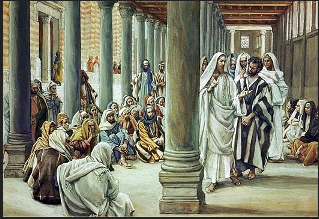
Jesus at the Feast of Dedication - James Tissot
TODAY’S SPECIAL: John 10:22-42

TO CHEW ON: ‘I told you and you do not believe…. But you do not believe because you are not My sheep, as I said to you. My sheep hear My voice and I know them and they follow me.’” John 10:25-27

When the Jews surrounded Jesus in the temple during the Feast of Dedication demanding “'If you are the Christ tell us plainly,'” they had one goal – to get Jesus to incriminate Himself. They were not asking for proof of His deity in order to reassure themselves that He was God and believe in Him. They were not even looking to Him as a potential Messiah to free their nation from the Romans. They completely overlooked the miracles that pointed to the fact He was no ordinary man. All they wanted was proof (again) from His own mouth, of blasphemy. Then they planned to arrest Him and get rid of Him as a rival.

The same teachings and miracles of Jesus referred to when talking to the Jews had a far different effect on the “many who came to Him… and believed in Him.” The difference: a willingness to believe.

The same is true for people of our generation. Though we don’t have Jesus in person as they did, we have the Bible. I’m sure you’ve noticed its different effects on people. Some laugh it off as a collection of archaic writings that have nothing at all to say to them. Others read it with reservations and attempt to twist it to say what they want it to say. Still others consider it truth, the very words of God. To them it is direction for life and hope in death. Whatever one’s perception of Jesus and what He said according to the Bible, it hinges on one thing: a decision to believe - or not.

How do we come to that point of belief? How do we encourage it in others? Through exposure to the Bible. John Piper says:
“The Word of God begets and sustains spiritual life because it begets and sustains faith: “These are written,” John says, “so that you may believe that Jesus is the Christ, the Son of God, and that by believing you may have life in his name (John 20:31). “Faith comes from hearing,” writes the apostle Paul, “and hearing through the word of Christ” (Romans 10:17). The faith that starts our life in Christ and by which we go on living comes from hearing the Word of God.” - John Piper, Desiring God, p. 146 (emphasis his).

If you are having trouble believing in and hearing the voice of your Shepherd, spend time in the Bible. Read it, memorize it, think about it, do it. Your exposure to God’s word will plant the seed of faith and grow it into the desire and ability to live an obedient life.

PRAYER: Dear God, I want to hear Your voice. Help me to read, understand and obey Your Word. Amen

MORE: At the age of 19 Abraham Piper, son of John Piper, was an avowed atheist. He came to faith one morning by reading the book of Romans. His advice to parents with prodigal kids:
"When you read something in the Bible that encourages you and helps you love Jesus more, write it up in a couple of lines and send it to your child. The best exhortation—better than any correction—is for them to see Christ’s joy in your life.


Don’t stress out when you’re composing these as if each one needs to be singularly powerful. Just whip them out and let the cumulative effect of your satisfaction in God gather up in your child’s inbox. God’s Word is never useless."

Read his story: “Let Them Come Home.

*********
Unless otherwise noted all Scripture quotations are taken from the New King James Version®. Copyright © 1982 by Thomas Nelson, Inc. Used by permission. All rights reserved.

Do your 8-12-year-olds have daily devotions? Point them to Bible Drive-Thru.

Sunday, March 06, 2016

Our terrible freedom

Departure of the Prodigal Son - Alexandre Bida
Departure of the Prodigal Son - A. Bida
TODAY'S SPECIAL: Luke 15:11-32

TO CHEW ON:
" 'Father, give me…' The younger son journeyed to a far country … 'I will arise and go to my father…' But he was angry and would not go in…" Luke 15:12,13,18, 28.


In her book Prodigals and Those Who Love Them, Ruth Bell Graham relates the following:

"Dad, I'm not at all sure I can follow you any longer in your simple Christian faith," stated the clergyman's son when he returned from the university for the holidays with a fledgling scholar's assured arrogance.

The father's black eyes skewered his young son, who was "lost," as C.S. Lewis put it, "in the invincible ignorance of his intellect."

"Son, the father said, "that is your freedom. Your terrible freedom."

- Told at our supper table by a friend - p. xvii

Our reading today, Jesus' Prodigal Son story, is full of evidences of "terrible freedom" by the many choices made in it:

  • The younger son chose to ask for his inheritance early.
  • The father chose to give it (to both sons - Luke 15:12).
  • The younger son chose to leave home, spend his inheritance on pleasure, then get a job in a piggery.
  • From there he chose to come home.
  • When he came home, he chose to come with a humble, "I was wrong," attitude.
  • The father chose to keep an open heart toward his son.
  • He chose to meet him with open arms and throw a party to celebrate his return.
  • The older brother chose to stay home.
  • He chose to be dutiful and helpful.
  • He chose to be bitter about his father's happiness and the party Dad was throwing on his younger brother's return.
  • He chose not to attend the party.
And that's where we leave him—still outside the party…another prodigal, really, in his own home.

No matter what our personality or what our life circumstances, we have choices. Choices about what our relationship with the Father will be, how we'll handle our resources, and what sort of attitude we'll have toward others. Let's let this story be a call to examine the multitude of our everyday choices and consider where they may be taking us.


PRAYER:
Dear Father, help me to make wise choices at each fork in the road, so I don't end up in a place I had never planned to be. Amen.


 *********
Unless otherwise noted all Scripture quotations are taken from the New King James Version®. Copyright © 1982 by Thomas Nelson, Inc. Used by permission. All rights reserved.


Friday, October 16, 2015

Pay attention to what happens between your ears

Image of brain
Brain image from Pixabay.com
TODAY'S SPECIAL: Hebrews 8:7-9:10

TO CHEW ON: "… I will put My laws in their mind and write them on their hearts ..." Hebrews 8:10


Here in our reading in Hebrews, the writer explains about the new covenant that resulted from Jesus' death and resurrection. He recalls the prophecy Jeremiah made about a time when obedience to God would no longer be a matter of just outward observance but of deep inner change and compliance as well.

"I will put My laws in their mind and write them on their heart" - Hebrews 8:10 quoting Jeremiah 31:33.

How beautiful and desirable! And this is the new mind and heart covenant under which we live. This thought got me searching for other passages that speak of the spiritual mind (that is "spiritual" as in aligned with the principles of the Bible):

One of the first questions we might ask is, How do we get this mind?
  • Paul answers that in 1 Corinthians where he tells us how the Holy Spirit knows and reveals the mind of Christ, we have received that Spirit (at salvation), and can now claim "We have the mind of Christ" - 1 Corinthians 2:19,12,16. See also Philippians 2:5.

Possessing the "mind of Christ" has great benefits:
  • It is the basis for deep-rooted peace because we live life in the posture of trust - Isaiah 26:3; Philippians 4:6,7.
  • Its end is life (not death) - Romans 8:6.

However, having and maintaining the mind of Christ also involves effort on our part. We don't get saved and find ourselves in the next moment with a mind transplant.
  • Peter tells us to "gird up the loins of your mind." In our day we'd say, buckle your belt, or roll up your sleeves. In other words, get your mind dressed and ready for action - 1 Peter 1:13.
  • "Set your mind on things above, not on the earth," Paul tells the Colossians - Colossians 3:2.
  • "Let us be of the same mind," he encourages the Christians in Philippi in a plea for church unity - Philippians 3:16.
  • We need to resign our minds to the fact that suffering is inevitable—and good, in that it purifies, says Peter in 1 Peter 4:1.
  • Paul alerts us to the reality that there will be times our minds are downright busy as we "...cast down arguments and every high thing that exalts itself against the knowledge of God and bring every thought captive to the obedience of Christ' - 2 Corinthians 10:5.

The battle for our thoughts and the minds that generate them hasn't changed in the 2000+ years since Bible writers penned these words. We still need to give what happens between our two ears our first attention because, as Bible teacher Joyce Meyer reminds us, the rest of our lives proceed from what we think:

"The mind is the leader or forerunner of all actions … Our actions are a direct result of our thoughts" - Joyce Meyer, Battlefield of the Mind, p. 3.


PRAYER: Dear Jesus, help me have the mind of Christ today. Amen.

 *********
Unless otherwise noted all Scripture quotations are taken from the New King James Version®. Copyright © 1982 by Thomas Nelson, Inc. Used by permission. All rights reserved.

Wednesday, September 02, 2015

Enticing desires

Twisted ladder-like structure
Photo from RGBStock.com
TODAY'S SPECIAL: James 1:1-18

TO CHEW ON: "But each one is tempted when he is drawn away by his own desires and enticed." James 1:14


In North America's new-world climate of celebrating practices the Bible condemns, one thing bothers me especially: the young age at which these proclivities apparently manifest themselves. When people say they knew at age five or six that they are the wrong sex—when little elementary school boys and girls say they feel they should really be little girls and vice versa, I find myself asking—weren't they born this way? They don't really have a choice, do they?

James answers these questions in today's reading.

Yes, they were born that way. We were all born twisted by a sinful nature. Each one of us has our set of "own desires" by which we are easily enticed to stray from God's revealed ways—that is, enticed to sin.

The enticements we give in to may be less socially controversial—like the desire to be noticed (pride) or to have lots of stuff (covetousness), etc. But their end is just as much sin  as sexual rebellion.

But yes also to the choice question. We do have a choice as to whether we give mental assent and eventually outward expression to those sin-enticing desires. My Bible's study notes explain it this way:

"When inner desires respond to outward enticement, sin is spawned. James does not mention Satan's role in temptation. His purpose is not to discuss the origin of sin but to explain that enticement to evil is not from God. In stressing the outward nature of temptation, James leaves sinners no excuse. Satan is indeed the external source of temptation, but no one can blame him for the roots of sinful deeds, which lie within the individual. See Mark 7:1-23" - John Mark Ruthven, study notes on James, New Spirit-Filled Life Bible, p. 1751.

So as we consider the society in which we live, let's pause for a personal reality check. We're in the same boat—born sin-twisted, not by the same enticements perhaps, but needing God's grace as much as anyone.

PRAYER: Dear God, please help me to see myself as someone needing Your grace, even as I attempt to uphold standards of morality given in the Bible within a society that flaunts breaking them. Amen.

 *********
Unless otherwise noted all Scripture quotations are taken from the New King James Version®. Copyright © 1982 by Thomas Nelson, Inc. Used by permission. All rights reserved.


Related Posts Plugin for WordPress, Blogger...