Saturday, September 09, 2017

Children matter

Image: Pixabay
TODAY’S SPECIAL: Matthew 18:1-14

TO CHEW ON:'Whoever receives one little child like this in My name receives Me.'” Matthew 14:5


Has it ever happened that as you sat quietly in your seat in church one Sunday, a family with children came and sight right beside you or behind you? Suddenly your peaceful morning became restless with those wee ones not able to sit still, asking for snacks, kicking the back of your seat with their little shoes.  (And I’m talking here about someone else's children, not your own or your grand-kids.)

How did you feel? Be honest. Was there not a glimmer of irritation? At the least a tiny a sigh of annoyance? At such times Matthew 18:1-14 would be a good bit to read and remember. In it Jesus invited a child to join him at center stage. Then He gave a little talk based on this living illustration. Some of His points:
  • You need to become humble like a child to be great in the kingdom of heaven - Matthew 18:3,4.
  • Receiving a child in My (Jesus’) name is equivalent to welcoming Me - Matthew 18:5.
  • Enticing a believing child to sin is super-serious - Matthew 18:6-9.
  • Despising one of these little ones puts you at odds with the paradigm of heaven where their angels have continuous access to Father God - Matthew 18:10.
  • Lost children are worth going to great lengths to save—God doesn’t want even one to stay lost - Matthew 18:11-14.

I’m going to remind myself of Matthew 18:1-14 next time I’m tempted to be irritated by kids racing down church corridors, leaving a mess, making too much noise, just being kids. Will you join me? Jesus loves them; let’s love them too!

PRAYER: Dear Father, I need to remember what it felt like to be a child. I need patience, kindness and Your point of view about children. Help me to see and love them as You do. Amen.

 *********
Unless otherwise noted all Scripture quotations are taken from the New King James Version®. Copyright © 1982 by Thomas Nelson, Inc. Used by permission. All rights reserved.


Friday, September 08, 2017

Government and you

The legislative buildings in Victoria, BC,
outlined in lights. - Photo © 2013 by V. Nesdoly

TODAY'S SPECIAL: Romans 13:1-14

TO CHEW ON: "Let every soul be subject to the governing authorities. For there is no authority except from God and the authorities that exist are appointed by God." Romans 13:1

If you listen to talk shows on radio or watch news channels on TV, you'll know that one of the favourite topics is to criticize the government. People have made careers out of it! Our practice of second-guessing political decisions and freely offering our opinions — often in strong language — has made serving as an elected official an often thankless and unattractive job.

What a different attitude toward government Paul tells Christians to take in Romans 13. Some ideas he puts forward that should impact our behaviour:

1. Governing authorities are actually "appointed by God" (Romans 13:1 - see also Daniel 4:32; Psalm 75:6-7).
Even evil governments, we ask? The footnotes in my study Bible comments:
"Paul does not suggest that God approves corrupt government, ungodly officials or unjust legislation. Sometimes, however, in punishment for the sins of a people or for other reasons known to Him, God allows evil rulers to have authority for a time, as the Old Testament prophets frequently testify" (New Spirit Filled Life Bible, p. 1570).

2. We should be subject to authorities (Romans 13:2).
If they are there by God's permission, even appointment, they are, in effect, God's government of us. Being subject means that we obey the laws of a particular government's jurisdiction (federal, provincial or civic).

However, we can make the case for civil disobedience. If obeying the laws of the land causes us to sin, our first loyalty is to God (Esther 4:16; Daniel 3:12-18; 6:10; Matthew 2:12; Acts 5:29; Hebrews 11:23).

3. Killing done by the state — to keep order and to hand out retribution — is different from murder (Romans 13:4).
Paul talks about the government officials who "bear the sword" (and why would one bear a sword unless to kill, or as a threat to kill?) as "God's minister" and "avenger." My Bible's footnotes explain:
"The fact that God authorizes governments as His servants to use force even to the point of taking human life does not contradict the command 'You shall not murder' in Exodus 20:13. The word used in that commandment refers to criminal murder and does not include judicial taking of life or killing in war, for which the OT uses other words. The same is true of the Greek word translated "kill" or "murder' in such NT passages as Matthew 5:21" - New Spirit Filled Life Bible, p. 1570.

4. We should obey government as a matter of good conscience toward God and not only because we're in danger of getting caught and punished if we don't, (Romans 13:5-7). This includes paying taxes without complaining (...ouch!).

In a democratic society, it's often hard to submit meekly to government as Paul tells us we should. To be fair, we need to utilize all the ways our democratic freedoms give us to get a government we can support (like vote, give feedback to our representatives, even join and support the political party of our choice). But if we really believed that our government was there by God's ordaining, and we spent as much time praying for our authorities as we do criticizing them, we'd probably find them much easier to obey.

PRAYER: Dear God, please help me to have an attitude toward government that pleases You. Today I bring before You Prime Minister Trudeau, Premier Horgan and the mayor of my town. May Your will be done in their lives and, through them, in my country, province and city today. Amen.

***************
Unless otherwise noted all Scripture quotations are taken from the New King James Version®. Copyright © 1982 by Thomas Nelson, Inc. Used by permission. All rights reserved.


Do your 8-12-year-olds have daily devotions? Point them to Bible Drive-Thru.

Thursday, September 07, 2017

Treasure Book

TODAY'S SPECIAL: Psalm 119:161-176

TO CHEW ON: "I rejoice at Your word
As one who finds great treasure." Psalm 119:162


Has this ever happened to you? You consider not renewing a magazine subscription because you don't read it a lot anyway. Then, as you think about whether you really should let it lapse, you go through back issues and notice interesting articles that you missed. You realize that it really is a helpful and interesting publication and your life would be poorer without it. So you change your mind. As you walk home from the mailbox after mailing in the renewal form and cheque, you take a deep breath. That was close! The next issue that comes, you read cover to cover. Pondering that magazine's absence has made you realize its worth.

As those who have never been without the Bible and who have most English translations of it on our shelves or at our fingertips online, we can find it as easy to take for granted as a publication that is delivered to our mailbox each month. Do we think of it in the same way as the psalmist describes it — "great treasure"? Probably not, until we consider the ramifications of its absence.

Suppose, for a minute, that all the Bibles on our bookshelves and on the internet disappeared. Think of all the things we would miss.
  • No longer could we read the story of Jesus' birth at Christmas or His passion at Easter.
  • No longer could we get comfort from Psalm 23 or 139.
  • No longer could we refresh our minds with the picture of genuine love from 1 Corinthians 13, or challenge ourselves to bear the fruits of the Spirit from Galatians 5.
  • All we would have of Jesus' interesting parables would be what we could remember of them.
  • No longer could we get up every morning to read a bit of it as spiritual nourishment for the day...

I think I would feel as if someone had taken the foundation from under my life.

But, I ask myself, If it's worth that much, why don't I spend more time in it?

And so I challenge myself — all of us — to spend more time discovering, exploring, examining, analyzing, and putting into use and practice this Treasure Book!


PRAYER: Dear God, thank You for the Bible. Thank You for how accessible it is in my culture. Help me not to take it for granted but to read it more and to store more of it in my memory as if I were in danger of no longer having it. Amen.


MORE: "TREASURE BOOK" Wordsearch

(Click on puzzle to open in a new browser and print).

Find the bold words in the verses below in the word search puzzle above:

I have treasured the words of His mouth
More than my necessary food - Job 23:12.

The judgments of the Lord are true and righteous altogether
More to be desired are they than gold
yea than much fine gold
Sweeter also than honey and the honeycomb - Psalm 19:10.

I have rejoiced in the way of Your testimonies
as much as in all riches - Psalm 119:14.

The law of Your mouth is better to me
than thousands of coins of gold and silver - Psalm 119:72

How precious also are your thoughts to me O God!
How great is the sum of them - Psalm 139:17.

She is more precious than rubies
And all thing things you may desire cannot compare with her - Proverbs 3:15.

Puzzle made by Puzzlemaker at Discovery Education.


"Treasure Book" solution:

(Click on Solution to enlarge/open in a new browser)


***********
Unless otherwise noted all Scripture quotations are taken from the New King James Version®. Copyright © 1982 by Thomas Nelson, Inc. Used by permission. All rights reserved.

Bible Drive-Thru


Wednesday, September 06, 2017

Three basics of Revival

Image: Pixabay
TODAY’S SPECIAL: Psalm 119:145-160

TO CHEW ON: “Revive me…” Psalm 119:154, 156, 159

Do you ever hear comments like, “We need a revival in Canada, the U.S., Europe”, or “Oh, for the revivals of the old days”?

The quest for spiritual revival isn’t new. The prayer “Revive me” occurs three times in an eight verse section of our reading (Psalm 119:153-160).

"Revive" is chayah in Hebrew. It means to live, to have life, remain alive, sustain life, live prosperously, be quickened, be restored to life or health.
The psalmist names three possible catalysts of revival:

“Your word” (vs. 154): "word" = imrah - the word of God, Torah.
“Your judgments” (vs. 156
): "judgments" =  mishpat - judgment, justice, ordinance, legal decision.
“Your lovingkindness” (vs. 159): "lovingkindness" = chesed - goodness, kindness, faithfulness.

How might these things be catalysts for revival in our own time?

- Revived by the Word (Psalm 119:154):
For us this is the Bible. We need to read it, get it into us as much as and more than we allow TV, the news, political pundits, movies, etc. get into us. God’s word puts an entirely different slant on life than does our culture. It tells us what's important to God; what He values.

- Revived by God’s judgments (Psalm 119:156):
God, as revealed especially in the Old Testament, often appears harsh, a God of black-and-white, of judgment. David, the writer of many psalms (perhaps even this one?) discovered that when he tried to move the ark to the tabernacle in Jerusalem (a good thing) in the wrong way (on a cart instead of secured with poles and carried on priests’ shoulders). The man who reached out to steady the ark from falling, touched it (something God had expressly forbidden - Numbers 4:15), and died on the spot. Read the story in 1 Chronicles 13:1-14.

God’s judgment side carries on in the New Testament where He allows His own Son to present Himself as a sacrifice for sin on our behalf.

I think if there is any aspect of the Gospel we moderns have watered down, it is the fact of God’s holiness, His hatred of sin, and the inevitability of sin’s judgment. We easily live with a mindset of “cheap grace.” The picture we have of God is a version of ourselves (Psalm 50:21).

- Revived by God’s lovingkindness:

 We also see the merciful, kind, faithful side of God throughout the Bible and highlighted in the cross. In the words of Paul:
“…God was in Christ, reconciling the world to Himself, not imputing their trespasses to them. … we implore you on Christ’s behalf, be reconciled to God. For He made Him who knew no sin to be sin for us that we might become the righteousness of God in Him” - 2 Corinthians 5:19,21.

I’m also reminded of the verse: “Or do you despise the riches of His goodness, forbearance, and longsuffering, not knowing that the goodness of God leads you to repentance?’ Romans 2:4 (emphasis added).

In our quest for revival, let’s not miss going deep into these three basics!

PRAYER:
“Revive me” I pray with the psalmist. Please use Your word, an awareness of Your holiness, and the deep inner experience of Your love in this process. Amen.

 *********
Unless otherwise noted all Scripture quotations are taken from the New King James Version®. Copyright © 1982 by Thomas Nelson, Inc. Used by permission. All rights reserved.


Tuesday, September 05, 2017

Spiritual weapons for spiritual battles

Image: Pixabay
TODAY’S SPECIAL: Exodus 12:1-14

TO CHEW ON:
“‘For I will pass through the land of Egypt on that night, and will strike all the firstborn in the land of Egypt, both man and beast; and against all the gods of Egypt I will execute judgment: I am the LORD.’” Exodus 12:12

What I find interesting in this passage is that this night was to be a night of judgment “against all the gods of Egypt.” God’s pronouncement here reminds us of the war between God and Satan declared in Genesis 3:15 when God told Satan:
"'And I will put enmity
Between you and the woman,
And between your seed and her seed;
He shall bruise your head
And you shall bruise His heel.'”

I believe that spiritual battling continues to be present in the conflicts around us in greater measure than we realize or like to admit. From petty arguments between individuals to national riots and international wars, there is a “gods of Egypt” (read ‘spirit of whatever country and age we’re in with its accompanying deities’) element involved.

God judged these spiritual “gods of Egypt” with spiritual weapons—a slaughtered animal, blood, food prepared in a prescribed way, eaten within a time frame, and then the leftovers burned. Who would predict victory from this? It makes no logical sense.

Are there spiritual weapons we can use to oppose the “Gods of Canada” (or whatever place you live)?

Yes there are. Here are some of the verses that speak of the weapons we use to confront the spiritual foes in our lives and the world system around us, collected from the “Victory” section of my recipe card verse collection:

"For the weapons of our warfare are not carnal but mighty in God for pulling down strongholds, casting down arguments and every high thing that exalts itself against the knowledge of God, bringing every thought into captivity to the obedience of Christ”- 2 Corinthians 10:4,5

"For whatever is born of God overcomes the world. And this is the victory that has overcome the world—our faith. Who is he who overcomes the world, but he who believes that Jesus is the Son of God?" - 1 John 5:4,5.

"But put on the Lord Jesus Christ, and make no provision for the flesh, to fulfill its lusts" - Romans 13:14

"Finally, my brethren, be strong in the Lord and in the power of His might. Put on the whole armor of God, that you may be able to stand against the wiles of the devil.  Ephesians 6:10,11,13-18.

"Therefore submit to God. Resist the devil and he will flee from you. Draw near to God and He will draw near to you. Cleanse your hands, you sinners; and purify your hearts, you double-minded.  James 4:7,8

And finally, here’s one that takes us right back to today’s passage:

"And they overcame him by the blood of the Lamb and by the word of their testimony, and they did not love their lives to the death" - Revelation 12:11

PRAYER: Dear Father, please open my eyes to the spiritual battle behind the conflicts in my life and world. Help me to habitually pick up spiritual weapons to fight these battles. Amen.

 *********
Unless otherwise noted all Scripture quotations are taken from the New King James Version®. Copyright © 1982 by Thomas Nelson, Inc. Used by permission. All rights reserved.


Monday, September 04, 2017

Prayer and wildfire

Image: Pixabay
TODAY’S SPECIAL: Exodus 3:1-17

TO CHEW ON: “And the Angel of the Lord appeared to him in a flame of fire from the midst of a bush…” Exodus 3:2

This summer has been devastating for the province where I live. Wildfires, many of which began in early July, continued burning through most of July and August destroying vast forests, grasslands, and driving people from their homes. We’ve seen in pictures and firsthand the power of fire. We also know that each one was started by something--a lightning strike, a cigarette butt, a spark from a nearby fire...

If you ask Google what fire is, you’re answered with a variety of articles explaining its physical process. "How Fire Works" (on How Stuff Works), is one of the easier ones to understand. It makes the points:
  • Fire is a chemical reaction between flammable substances and oxygen.
  • Fires don’t start spontaneously; to ignite, a fire need its fuel to rise to “ignition temperature.”
  • Once a fire does ignite, the heat it generates sustains the fire and keeps it burning.

Yesterday we read about the Israelites groaning and calling out to God because of their bondage and slavery. We read that God heard, remembered, looked, and acknowledged their cries (Genesis 2:24,25).

Today we see that answer. It began with a fire—with Moses noticing a bush burning. He looked, must have watched, for he realized that the bush was staying the same size so he went closer to investigate. Then God spoke to him from that bush. The answer to the Israelites’ prayer was put in motion. Their prayers had ignited God’s fire.

God answered prayers with fire in other places as well:
  • God sent fire to consume Abram’s offering the day He made His covenant with Abram - Genesis 5:17.
  • He sent fire in response to prayers of dedication at the consecration of the tabernacle (Leviticus 9:24) and the temple (2 Chronicles 7:1).
  • He answered the prayers of Gideon and Elijah with offering-consuming fires (Judges 6:21; 1 Kings 18:24,38-39).
  • And in the New Testament, in response to the “one accord in prayer and supplication…” of the believers (Acts 1:14), God sent the Holy Spirit who appeared like “tongues as of fire and one sat on each of them” (Acts 2:3).

Combining what we know of physical fire with these instances of God’s fire, would it be too much of a stretch to suggest:
- That our prayers are needed to ignite the fire of God’s answers?

- That it is our persistent, persevering prayers that bring the fuel of our life’s issues to ignition temperature?

- That the fire of God, wherever it flares up on earth will sustain and grow that fire even bigger?

That the fire of the Holy Spirit within us will continue to devastate Satan’s plans for Earth?

PRAYER: Dear Father, help me to pray with more consistency, persistence, and perseverance. The wildfire of Your working would be a fire I would welcome!  Amen.

 *********
Unless otherwise noted all Scripture quotations are taken from the New King James Version®. Copyright © 1982 by Thomas Nelson, Inc. Used by permission. All rights reserved.


Sunday, September 03, 2017

Is prayer really necessary?

Image: Pixabay
TODAY’S SPECIAL: Exodus 2:11-25

TO CHEW ON:
“So God heard their groaning, and God remembered His covenant with Abraham, Isaac, and with Jacob. And God looked upon the children of Israel and God acknowledged them.” Exodus 2:24,25

Meanwhile back in Egypt, where we left the Israelites a week ago, the people were getting desperate  Under their cruel slave masters they “groaned” and “cried out” - Exodus 2:23.

Then God heard, remembered, looked and acknowledged - Exodus 2:24,25. I looked up each of these words in the Hebrews. Their meanings are pretty straightforward:

Heard - Shama
Remembered - Zakar
Looked - Ra’ah
Acknowledged - Yada


It appears the Israelites got God’s attention But they did something to get it: they groaned and cried out.

This isn’t the only time such a thing is mentioned. Notice what Abraham’s divine visitor said about why God chose to act over the situation in Sodom and Gomorrah: “‘I will go down now and see whether they (the citizens of Sodom and Gomorrah) have done altogether according to the outcry against it that has come to me…’” Genesis 18:21.

The word for “outcry” is tsaqah. The same word is used in God’s conversation with Moses to describe Israel’s present condition in the next chapter - Exodus 3:7.

That outcry was also the action of the Israelites that God responded to when He gave them a king - 1 Samuel 9:16.

To me this speaks of the necessity of prayer. Here is how some of history’s prayer warriors have described the importance of prayer:

“Prayer is the contact of a living soul with God. In prayer, God stoops to kiss man, to bless man, and to aid in everything that God can devise or man can need” - E. M. Bounds
“Prayer is the slender nerve that moveth the muscles of omnipotence” - Charles Spurgeon.
“In prayer you align yourselves to the purpose and power of God and He is able to do things through you that He couldn’t do otherwise. For this is an open universe, where some things are left open, contingent upon our doing them. If we do not do them, they will never be done. For God has left certain things open to prayer—things which will never be done except as we pray” - E. Stanley Jones.
- All quotes taken from the “Introduction” to The Hour that Changes the World by Dick Eastman, emphasis added.

What things distress us to the point of crying out? What issues in our lives need God’s hearing, remembering, looking, and acknowledging? Let’s keep crying out in prayer over these things.


PRAYER: Dear Father, thank You for the privilege and responsibility of prayer. Help me to pray with faith that You will, in Your time, hear, remember, look, and acknowledge. Amen.

 *********
Unless otherwise noted all Scripture quotations are taken from the New King James Version®. Copyright © 1982 by Thomas Nelson, Inc. Used by permission. All rights reserved.


Friday, September 01, 2017

The only appropriate response

Image: Pixabay
TODAY’S SPECIAL: Romans 11:19-36

TO CHEW ON: “Oh, the depth of the riches both of the wisdom and knowledge of God! How unsearchable are His judgments and His ways past finding out!” Romans 11:33

Paul has just made a long theological argument (my Bible’s study notes: “… the longest extended theological argument in the NT—Romans 1:16-11:33” - Wayne Grudem, Notes on Romans, New Spirit-Filled Life Bible p. 1568).

Paul ends this treatise with an outbreak of praise to God for His “unsearchable judgments” and His “ways past finding out.” He praises God as the source and receptacle of all knowledge, the creator and sustainer of all things - Romans 11:33-36.

I love how Romans 11:33 is expanded in the Amplified:
“O the depth of the riches and wisdom and knowledge of God! How unfathomable (inscrutable, unsearchable) are His judgments—His decisions! And how untraceable (mysterious, undiscoverable) are His ways—His methods, His paths!” - Romans 11:33 AMP.

I can’t say I understand all the theological points Paul makes in Romans. I admit that my understanding of God’s person and ways may be superficial when it comes to what some (like Paul) grasp. But what I do know of Him—His wisdom and creativity in nature; the beauty, complexity yet simplicity of His plan for humanity as laid out in the Bible; the multitude of ways He draws people to Himself; the way He coordinates my little life—is reason enough for me to break out in praise

And so I join Paul in the only appropriate response to God and His greatness by exclaiming “To Him be glory forever! Amen—so be it” - Romans 11:36 AMP.

PRAYER: Dear Father God, words fail to capture the bigness of who You are and what You can do. As the source and sum of wisdom, creativity, justice, goodness, love… I give you glory. Amen.

 *********
Unless otherwise noted all Scripture quotations are taken from the New King James Version®. Copyright © 1982 by Thomas Nelson, Inc. Used by permission. All rights reserved.

Scripture quotations marked AMP are taken from the Amplified® Bible, Copyright © 1954, 1958, 1962, 1964, 1965, 1987 by The Lockman Foundation. Used by permission." (www.Lockman.org)


Thursday, August 31, 2017

4 reasons for hardening of the hearteries

TODAY'S SPECIAL: Romans 11:1-18

stony heart
TO CHEW ON: "What then? What the people of Israel sought so earnestly they did not obtain. The elect among them did, but the others were hardened, as it is written: 'God gave them a spirit of stupor, eyes that could not see, and ears that could not hear to this very day.'" Romans 11:7,8 NIV


When Paul speaks here about the Israelites being "hardened" and their "spirit of stupor,"  he's hearkening back to several references in the Old Testament that speak of a similar dullness.

Moses describes the Israelites' spiritual hardness when they are about to enter Canaan. Their minds don't understand, their eyes don't see, and ears don't hear despite the miraculous way God has cared for them during their 40-year wilderness wander - Deuteronomy 29:4.

Three prophets make a similar charge. Isaiah talks about Israel's "calloused' hearts" (Isaiah 6:9,10). Jeremiah calls them "foolish and senseless" (Jeremiah 5:21).  Ezekiel identifies an attitude of rebellion behind their spiritual hardness (Ezekiel 12:2). 

Though here in Romans Paul brings up this topic primarily to explain how Israel's spiritual state opened the door of salvation to the Gentiles, I see in the description of Israel's hardness of heart a yellow light for all believers, Jews or Gentiles. I believe we can become similarly blind, deaf, calloused, hardened, dull, and stuporous. Some ways:
  • When we fail to see and be grateful for the way God is caring for us as the Israelites did in the wilderness.
  • When we don't allow the spiritual truths of God's word penetrate our hearts ("...ever hearing but never understanding; ever seeing but never perceiving" - Isaiah 6:9).
  • When we make up or own way to come to God as Paul here implies Israel had done ("What the people of God sought so earnestly they did not obtain" - Romans 11:7. "Having failed to obtain the right standing with God, they had sought by their own efforts, they have been hardened..." - Wayne Grudem, commentary on Romans, New Spirit-Filled Life Bible, Kindle location 260,148).
  • When we allow rebellion to creep in
Do we sense in ourselves some hardening of the hearteries (like the physical hardening of the arteries, where blood flow to the heart becomes impeded, even blocked ending in death)? Let's ask God for healing of sight, hearing, and a restoration of sensitivity to Him. He can do it!

 I will give you a new heart and put a new spirit within you; I will take the heart of stone out of your flesh and give you a heart of flesh - Ezekiel 36:26.

PRAYER: Dear God, please tenderize my heart. Soften it towards You and the things that matter to You. Amen.

********
All Scripture quotations are taken from THE HOLY BIBLE, NEW INTERNATIONAL VERSION®, NIV® Copyright © 1973, 1978, 1984, 2011 by Biblica, Inc.® Used by permission. All rights reserved worldwide.

********
Subscribe to my newsletter coming September 1st. 

Get book recommendations, Bible study tips, author news.

Sign up below:


Wednesday, August 30, 2017

Would Jesus call your words satanic?

"Get thee behind Me, Satan" - by James Tissot

TODAY'S SPECIAL: Matthew 16:21-28

TO CHEW ON: "Then Peter took Him aside and began to rebuke Him, saying, 'Far be it from You, Lord; this shall not happen to you!' But He turned and said to Peter, 'Get behind Me Satan! You are an offense to Me, for you are not mindful of the things of God but the things of men.'" Matthew 16:22,23


What a shock Peter must have felt when Jesus called him "Satan" and described his words as an offense (trap). Perhaps he thought, But Jesus, I was only trying to encourage You and draw You from these pessimistic thoughts about death.

Jesus, however, recognized the oily tone, the sneaky lie in Peter's words. (Compare what Peter said to what the serpent said to Eve way back: "'You shall not surely die…'" - Genesis 3:4.) Jesus scolded him for being unmindful of the things of God while mindful of the things of men. What are those things?

A word the Bible uses for the "things of men" is "carnal." Some things that characterize the carnal mind are:
  • Preoccupation with this life - Psalm 49:11.
  • Unwillingness to acknowledge God or bow to Him - Romans 1:28; 8:7.
  • Living by our intellect alone - Ephesians 4:17.
  • Pursuing different forms of spirituality - Colossians 2:18.
  • Allowing the outlook of the world to taint and sully our thoughts and consciences - Titus 1:15.
  • In Peter's case here it was denying the necessity of Jesus' death and resurrection—a temptation to abort God's plan of salvation.

Jesus told Peter he should be mindful of the "things of God." What are those things? They include:
  • Preoccupying ourselves with God's word—what it says and how we can live it out - Joshua 1:8; Psalm 119:99.
  • Recognizing and being thankful for God's "lovingkindness" - Psalm 48:9.
  • Viewing ourselves realistically and through eyes of faith - Romans 12:3.
  • Taking our thoughts in hand; directing them along routes of what is true, noble, just, pure, lovely, virtuous, praiseworthy - Philippians 4:8.
  • For Peter the things of God in this situation would have been to hear what Jesus was saying, and grasp the necessity of God's big plan and Jesus' role in it. With these insights he might have been better prepared for what was coming.

As I compare my thoughts and words with the two lists, I see that I often have a carnal, Satan-influenced mindset. Oh to recognize the difference and avoid these traps of thought that too often exit my mouth in words!


PRAYER: Dear God, please show me today where I am living by the "things of men." Help me to steer my focus toward the "things of God." Amen.

 *********
Unless otherwise noted all Scripture quotations are taken from the New King James Version®. Copyright © 1982 by Thomas Nelson, Inc. Used by permission. All rights reserved.


Tuesday, August 29, 2017

An evil mother's influence

Herodias - Artist unknown
Herodias and her daughter - Artist unknown
TODAY'S SPECIAL: Matthew 14:1-12

TO CHEW ON:
"So she, having been prompted by her mother, said, 'Give me John the Baptist's head on a platter.'" Matthew 14:8


If a closet full of new gowns, a shiny chariot, or spirited horse popped into Herodias' daughter's head when Herod said she could have whatever she wanted, they would never materialize. For her mother told her to ask for John the Baptist's head and the girl listened to her mother!

Eeeuw!  I wonder what that did for the girl's ability to sleep without nightmares. I wonder what kind of woman she grew up to become.

Like wives have the power to influence a husband spiritually, so mothers (and fathers) influence their children. Some examples from the Bible:

  • Moses' mother Jochebed must have influenced Miriam well, for Miriam was the one who suggested to Pharaoh's daughter that she get Jochebed as a nurse for baby Moses.
  • Samuel's instant obedience when he heard who he thought was Eli call his name was, I would suggest, the result of early training by Hannah.
  • Of Ahaziah the king of Samaria and the son of Ahab and Jezebel it was said, "He did evil in the sight of the Lord and walked in the way of his father and in the way of his mother - 1 Kings 22:52.
  • Timothy, who became Paul's assistant, had a grandmother and mother to thank for launching him on the path of faith - 1 Timothy 1:5.

Let's take seriously our power to influence our children. Let's face the fact that our requests of them, our actions, and example will bear fruit. If we ask our kids to tell the person on the phone we're not home when we are, if we sample food in the grocery store without paying, if we gossip behind peoples' backs, or whatever, we're telling our kids it's okay to lie, steal, slander…

The classic advice in Proverbs bears out a parent's or caregiver's life-long influence:
"Train up a child in the way he should go
And when he is old he will not depart from it." - Proverbs 22:6

PRAYER: Dear God, help us as parents and grandparents to be aware that we are being watched, listened to, and copied; that our influence can change the course of a life. Amen.

 *********
Unless otherwise noted all Scripture quotations are taken from the New King James Version®. Copyright © 1982 by Thomas Nelson, Inc. Used by permission. All rights reserved.


Monday, August 28, 2017

God's conundrums

Image: Pixabay
TODAY’S SPECIAL: Matthew 11:2-15

TO CHEW ON: “And when John had heard in prison about the works of Christ, he sent two of his disciples and said to Him, ‘Are you the Coming One, or do we look for another?’ 
‘... blessed is he who is not offended because of Me’” Matthew 11:2,3,6


Why do you suppose John sent disciples to Jesus asking if He were the “Coming One” in the context of all the “works” he was hearing about? Do you suppose it was a subtle way of reminding Jesus—Hey, I’m here in prison. I could use one of those works right about now?

Jesus didn’t come through with a prison escape, though. Instead He made this curious statement: 'Blessed is he who is not offended because of Me.'"

Why would John be offended (skandalizo from which we get scandalized: "to cause a person to begin to distrust and desert one whom he ought to trust and obey")?

Perhaps because what happened here (or didn’t happen) didn’t make sense to him?  The ways of God often don’t make sense to us either. The couple on the mission field have to return when their children are diagnosed with autism. At the peak of his career, a gifted musician gets cancer and dies. A young wife and mother suffers a stroke, becomes brain damaged, and needs 24-hour care in an institution.I’m sure you could name more. It’s quite possible you’ve experienced one of these God conundrums.

I love how Oswald Chambers riffs on this theme:

“We are not taken up into conscious agreement with God’s purpose, we are taken up into God’s purpose without any consciousness at all” - Oswald Chambers, My Utmost for His Highest, August 3 reading).

“As long as you think there is something in you He cannot choose you because you have ends of your own to serve; but if you have let Him bring you to the end of your self-sufficiency, then He can choose you to go with Him to Jerusalem, and that will mean the fulfillment of purposes which He does not discuss with you” - Chambers, Op. Cit, August 4 reading.

His call is to be in comradeship with Himself for His own purposes… If we have a purpose of our own, it destroys the simplicity and the leisureliness which ought to characterize the children of God” - Chambers, Op. Cit, August 5 reading (emphases added).

PRAYER: Dear Jesus, help me to avoid becoming offended when Your ways don’t make sense to me. Teach me to trust You in every circumstance. Amen.

 *********
Unless otherwise noted all Scripture quotations are taken from the New King James Version®. Copyright © 1982 by Thomas Nelson, Inc. Used by permission. All rights reserved.


Sunday, August 27, 2017

It costs to fight for life

Shiphrah and Puah allow male
children to live

Shiphrah and Puah allow male children to live - Exodus 1:17
TODAY'S SPECIAL: Exodus 1:15-2:10


TO CHEW ON: "But the midwives feared God and did not do as the king of Egypt commanded them, but saved the male children alive." - Exodus 1:17

Imagine the anguish and soul-searching these women must have wrestled with when they heard Pharaoh's command to kill each male Israelite baby on delivery. With all their instincts and training shouting "Live!" I wonder if they, for even a moment, considered obeying Pharaoh's demonic order?

There's no doubt Pharaoh and his law sparked a smoulder of fear within them. But there was One they feared more: "... the midwives feared God..."

["Feared - yare'means to fear, be afraid of someone or something, to stand in awe of something or someone possessing great power; to revere someone. ... The fear of God is not a terror that He is against us or will strike without cause or warning. Rather, the fear of the Lord produces wise, healthy actions, as in the present reference; the midwives were more afraid of angering God by destroying innocent babies than they were of disobeying Pharaoh" - Dick Mills & David Michaels, "Word Wealth - Feared," New Spirit-Filled Life Bible, p. 78.]

I can't help but see the similarities between the situations of these midwives and people who work in the medical profession in Canada. Here the practice of abortion is widespread with no law against it regardless of how far along the mother is.

Canada has also passed right-to-die legislation, so people can request that their life be ended.

I would suggest we are well on our way down a proverbial "slippery slope."  With state-paid-for medical costs rising, it's easy to foresee the day when it will be the law to abort any child that could be a potential drain on the medical system while the pressure to euthanize those that are becoming too expensive to maintain (the elderly, those with disabilities) will be overwhelming.

And so the question comes to us who are in these situations, indeed, to people in any place where convictions clash with the state's rules: Who do we fear more, Pharaoh or God?


PRAYER: Dear God, thank You for the example of these Hebrew women who feared You to the extent of putting their careers and lives in jeopardy. Help me to fear You above any human custom or law. Amen.

MORE: LifeCanada

An organization which has taken on the task of fighting for and educating on the Pro-Life position is LifeCanada. From their "About" page:

"LifeCanada was established in 2000 to operate as a national association of local and provincial educational pro-life groups across Canada in order to promote the value of human life, to serve our members, and to advocate for the most vulnerable members of society."

Check out their "Articles" for news and opinion on life and death issues in Canada.

****************
Unless otherwise noted all Scripture quotations are taken from the New King James Version®. Copyright © 1982 by Thomas Nelson, Inc. Used by permission. All rights reserved.
Bible Drive-Thru


Saturday, August 26, 2017

Living well in the big picture

TODAY’S SPECIAL: Exodus 1:1-14

TO CHEW ON: “And Joseph died, all his brothers, and all that generation. But the children of Israel were fruitful and increased abundantly, multiplied, and grew exceedingly mighty; and the land was filled with them …
And they (Egyptians) made their (Israelites) lives bitter with hard bondage—in mortar, in brick, and in all manner of service in the field. All their service in which they made them serve was with rigor” - Exodus 1:6,7,14


Our reading today continues telling the story of Jacob’s family in broad strokes. Two short verses (Exodus 1:6,7) take us through over 400 years of time: “The book of Exodus is a continuation of the Genesis account, dealing with the 430-year development of a family group of 70 into a large nation” - J.C. Tollett, study notes on Exodus, New Spirit-Filled Life Bible, p. 77.

The Israelites had, for all intents and purposes, become Egyptians. Or at least they had lived in Egypt long enough to identify that way. But God had other plans for them, plans hinted at in a promise made to Abraham centuries earlier (Genesis 15:18). And so began the discomfort of hard labor and slavery for Israel, that would eventually dislodge them permanently from Egypt.

The tricky thing about living in time is we don’t understand the times we’re in and the significance of day-to-day events as we’re living them. “Life can only be understood backwards; but it must be lived forwards” - Søren Kierkegaard.

Like the oppression of the Egyptians no doubt vexed and puzzled the Israelites, so many happenings in our time vex and puzzle us too. We won’t know, in the near term, the significance of the 2016 American election of Donald Trump as president of the U.S. or the recent defeat of a long-governing political party in my province. Only time will tell how current events affect history.

But we take comfort in knowing that history never gets away from God. As He declared through Isaiah:
Remember the former things of old,
For I am God, and there is no other;
I am God, and there is none like Me,
Declaring the end from the beginning,
And from ancient times things that are not yet done,
Saying, ‘My counsel shall stand,
And I will do all My pleasure,’

Calling a bird of prey from the east,
The man who executes My counsel, from a far country.
Indeed I have spoken it;
I will also bring it to pass.
I have purposed it;
I will also do it. - Isaiah 46:9-11 (my emphasis)


We can also, pray and trust God for wisdom to understand and live well during our short span of years on earth. Let's aspire to have the reputation of the "Sons of Issachar" in David's army who were known as those "who had understanding of the times, to know what Israel ought to do" - 1 Chronicles 12:32.

PRAYER:

Dear God, thank You that You know the end from the beginning and will bring about the things You have purposed. Please give me insight into my time and wisdom to live well in it. Amen.

 *********
Unless otherwise noted all Scripture quotations are taken from the New King James Version®. Copyright © 1982 by Thomas Nelson, Inc. Used by permission. All rights reserved.


Thursday, August 24, 2017

The call of His presence

Philip: "We have found Him..." John 1:45
TODAY’S SPECIAL: John 1:35-51

TO CHEW ON: Then Jesus turned, and seeing them following, said to them, ‘What do you seek?’ They said to Him, ‘Rabbi,” (which is to say when translated, Teacher), where are you staying?”
He said to them, ‘Come and see.’
They came and saw where He was staying, and remained with Him that day (Now it was about the tenth hour)” John 1:38,39


John’s gospel starts out telling the story of Jesus quite differently from Matthew, Mark, and Luke. There is no record of His birth. There is no mention of the 40 days of fasting in the desert that culminated in His temptation. We don’t see Him preaching in Galilee, calling the disciples from their boat, or teaching in the Caperaum synagogue

We do see him with John the Baptist who identifies and baptizes Him, and then on the next day, as Jesus walks by, speaks of Him to two of his own disciples - John 1:36.

On their own initiative those disciples follow Jesus who turns out to be a man of mystery and few words: “'What do you seek?… Come and see.'”

I like what the IVP Commentary says about this aspect of John 1:

John puts a great emphasis on Jesus' almost mysterious silence...
Jesus in John appears as one hidden and aloof. These first disciples, therefore, are characterized by initiative and willingness to examine claims they have heard concerning this silent one. Most importantly, they are not put off by his silence, nor do they seek to break it. Rather they are humbly receptive, seeking only to be where Jesus is staying….

…here at the outset John gives us a glimpse of the enormous depths of silence that lay behind all that Jesus does. Jesus is fully engaged in his historical circumstances, but he is not centered in them nor controlled by them. …

These disciples, who will shortly be so full of words, opinions and activity, are characterized at the outset by a desire for the presence of Jesus more than for answers to questions. Their immaturity will become evident immediately, but the crucial issue in discipleship is not whether we are mature but whether we desire to come and see and then abide in the divine presence, the only source of eternal life and growth in grace and truth (IVP Commentary on John 1:35-51 accessed through Biblegateway.com) - emphasis added.

Nathanael illustrates this desire so beautifully. He goes from skepticism about this Man, that his friend is so high on, to outright worship in a heartbeat (John 1:46,49). What brings about the change?

The Bible doesn’t clearly tell us. But we infer from Jesus' and Nathanael’s back-and-forth that Nathanael recognizes Jesus is supernatural from His personal knowledge of a specific moment (“under the fig tree”) and what it meant to him.

I would submit that that is often the way Jesus still calls us to himself… not with many words but in the stillness of personal encounters that tell us He sees us, knows our deepest secrets and invites us to be with Him.

PRAYER:
Dear Jesus, help me to hear You over the noise of everyday life and live in Your presence. Amen.

MORE: Feast of St. Batholomew

Today the church celebrates the Feast of St. Bartholomew (another name for Nathanael).

The liturgy for the day begins with this prayer:
Almighty and everlasting God, who gave to your apostle Bartholomew grace truly to believe and to preach your Word: Grant that your Church may love what he believed and preach what he taught; through Jesus Christ our Lord, who lives and reigns with you and the Holy Spirit, one God, for ever and ever. Amen.

 *********
Unless otherwise noted all Scripture quotations are taken from the New King James Version®. Copyright © 1982 by Thomas Nelson, Inc. Used by permission. All rights reserved.


Wednesday, August 23, 2017

Unifiers, not dividers

Image: Pixabay
TODAY’S SPECIAL: Psalm 132:1-134:3

TO CHEW ON:
“Behold how good and pleasant it is
For brethren to dwell together in unity!” Psalm 133:1


Psalms 132,133, and 134 are all Songs of Ascents—Jewish liturgy of pilgrimage. Pilgrims to Jerusalem, on their way to celebrate the thrice-yearly feasts (spring: Feast of Passover; summer: Feast of Pentecost; autumn: Feast of Tabernacles) would sing these fifteen songs (Psalm 120-134) as they ascended to the city—the high point of Palestine. How fitting that the second-last, Psalm 133, was a reminder to them to get along.

Eugene Peterson, in his chapter about this psalm in A Long Obedience in the Same Direction, makes the point that the moment we confess Jesus as Lord and Saviour, we become a member of the Christian church even though we never attend one physically or attach our names to the membership roll of one formally. “We can no more be a Christian and have nothing to do with the church than we can be a person and not be in a family” - Eugene Peterson, A Long Obedience, p. 175. In other words, church is to Christian what family is to person.

How then, do we get along with our church siblings? Peterson lists some ways we might live in this community of faith. Who are you on his list?

  • Some run away from it and pretend that the family doesn’t exist.
  • Some move out and get an apartment… from which they return to make occasional visits.
  • Some would never dream of leaving but cause others to dream it for them, for they are always criticizing what is served at meals, quarrelling with the way the housekeeping is done, complaining that the others in the family are either ignoring or taking advantage of them.
  • Some determine to find out what God has in mind by placing them in this community … learn how to function harmoniously and joyously, develop maturity that shares and exchanges God’s grace, even with the nuisances - Peterson, Op. Cit., p. 176 (formatting and emphasis added).

If we’re not there already, let’s work to be in that last set. Let’s be unifiers, not dividers.


PRAYER: Dear Jesus, help me to be a family member who doesn’t think of myself first but who works for the good of others and the body. Amen.

 *********
Unless otherwise noted all Scripture quotations are taken from the New King James Version®. Copyright © 1982 by Thomas Nelson, Inc. Used by permission. All rights reserved.


Tuesday, August 22, 2017

Cooperating with God

Image: Pixabay
TODAY’S SPECIAL: Matthew 15:21-39

TO CHEW ON: “And He took the seven loaves and fish and gave thanks, broke them and gave them to His disciples, and the disciples gave to the multitude. So they all ate and were filled…” Matthew 15:36,37

Where did this multiplication of bread and fish take place? In Jesus’ hands or in the baskets and trays of the disciples?

The Bible doesn’t say. But I imagine Jesus giving each disciple a similar small amount of fish and bread. It may have looked puny, inadequate to feed a dozen let alone hundreds. Then they started passing it out and they passed it out and passed it out … and it never ran out! I imagine that multiplication occurring when the bread and fish were in the disciples’ hands (for they wouldn’t have been able to carry a receptacle loaded with food enough for hundreds!)

I can imagine my reaction if I had been one of those disciples, getting my portion to hand out: “But this small amount is ridiculous. How many will this feed? These hungry people will beat me up when some get fed and others don't …”

Of course the disciples didn’t say anything like that. They had been with Jesus through enough emergencies to realize He was dependable to come through. And His work through them kept happening:

“And they went out and preached everywhere, the Lord working with them, confirming the word through accompanying signs and wonders” - Mark 16:20.

God in His wisdom continues to use people to accomplish His work with Him:"
"For we are God’s fellow workers; you are God’s field, you are God’s building” - 1 Corinthians 3:9.

“We then as workers together with Him also plead with you not to receive the grace of God in vain.” 2 Corinthians 6:1.

I love how the Blackabys, in the book Experiencing God, challenge us to put this principle into practice:
“God never asks people to dream up something to do for Him. We do not sit down and dream what we want to do for God and then call God in to help us accomplish it. The pattern in Scripture is that we submit ourselves to God. Then we wait until God shows us what He is about to do, or we watch to see what God is already doing around us and join Him” Henry & Richard Blackaby, Claude King, Experiencing God p. 34.

“Every conversation with God has limitless possibilities attached to it, because He is 
‘able to do immeasurably more than all we ask or imagine, according to his power that is at work within us.’ - Ephesians 3:20” - Ibid, p. 89 (emphases added).

PRAYER: Dear Father, help me to work with You. Help me distribute what is in my hands and trust You to use it in the needed way. Amen.

 *********
Unless otherwise noted all Scripture quotations are taken from the New King James Version®. Copyright © 1982 by Thomas Nelson, Inc. Used by permission. All rights reserved.


Saturday, August 19, 2017

"... in whom is the Spirit of God"

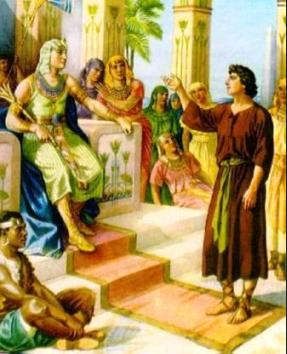
Pharaoh & Joseph - Artist unknown
TODAY'S SPECIAL: Genesis 41:-25-52

TO CHEW ON: "And Pharaoh said to his servants, 'Can we find such a one as this, a man in whom is the Spirit of God?'" - Genesis 41:38


The answer to Pharaoh's rhetorical question—'No we can't find another man like this'—led to Joseph rising in one day from a prisoner to Pharaoh's assistant. Pharaoh recognized there was something different about this man. He identified it as "the Spirit of God" (some scholars say that the correct translation should be "the spirit of a god").

The possibility of God's Spirit living in people is a theme that runs through both Old and New Testaments.

  • The prophet Ezekiel promised it for help in keeping God's laws - Ezekiel 36:27.
  • Like Joseph, Daniel's ability to tell the meanings of dreams came from the Spirit of God - Daniel 4:8.
  • Jesus called Him the Spirit of truth who dwells with and in disciples - John 14:17.
  • Paul talked about how we can overcome the carnal nature through the Spirit's indwelling presence - Romans 8:9.
  • The Spirit helps us to do the good we know we should - 2 Timothy 1:14.
  • He teaches us - 1 John 2:27.
  • In fact, He lives in us. We are His "temple" - 1 Corinthians 3:16; 6:19.

What an awesome privilege to welcome into the home of our feeble, failing bodies the Spirit of the living God. Let's meditate on, claim, and live in this amazing truth as we go through this day!

PRAYER: Dear God, thank You for making possible this way of experiencing You. Help me not to quench or inhibit Your work in my life through Your Spirit today.  Amen.

 *********
Unless otherwise noted all Scripture quotations are taken from the New King James Version®. Copyright © 1982 by Thomas Nelson, Inc. Used by permission. All rights reserved.

**********
Subscribe to my newsletter. Next one coming September 1st. 

Get book recommendations, Bible study tips, and author news.

Sign up below:


Friday, August 18, 2017

Who gets the glory?

TODAY'S SPECIAL: Genesis 41:1-24


TO CHEW ON: "So Joseph answered Pharaoh, saying, 'It is not in me; God will give Pharaoh an answer of peace'" - Genesis 41:16

Joseph had no illusions about where he got his unusual wisdom and insight into dreams. "It is not in me," he told Pharaoh plainly. "God will give Pharaoh an answer."

He reminds me of another dream interpreter. The young exile Daniel had a similar ability to interpret dreams. When he came before King Nebuchadnezzar to not only interpret his dream but to tell him what he had dreamed in the first place, Daniel too reflected the glory back to God:

"...There is a God in heaven who reveals secrets, and He has made known to King Nebuchadnezzar what will be in the latter days..." Daniel 2:28.

When we experience success, how easy it is to accept praises and compliments never giving a thought or word to deflecting the glory back to God. Let's follow the example of Joseph, making it very clear that God is the source of any wisdom, or insight or special skill. Let's give Him the glory and not take it for ourselves.

PRAYER: Dear God, please forgive me for accepting praise for myself when it rightfully belongs to You. Help me to habitually give You glory for the abilities and successes You have made possible. Amen.


MORE: God delights in His glory
"...God's own glory is uppermost in His own affections. In everything He does, His purpose is to preserve and display that glory. To say that His own glory is uppermost in His own affections means that He puts a greater value on it than on anything else. He delights in His glory above all things. ...


This is the same as saying: He loves Himself infinitely. Or He Himself is uppermost in His own affections. A moment's reflection reveals the inexorable justice of this fact. God would be unrighteous (just as we would) if He valued anything more than what is supremely valuable. But He Himself is supremely valuable. If He did not take infinite delight in the worth of His own glory, He would be unrighteous. For it is right to take delight in a person in proportion to the excellence of that person's glory" - John Piper, Desiring God, p. 41-43.
********
Unless otherwise noted all Scripture quotations are taken from the New King James Version®. Copyright © 1982 by Thomas Nelson, Inc. Used by permission. All rights reserved.

********
Subscribe to my newsletter. Next one coming September 1st, with book recommendations and author news.

Sign up below:


Related Posts Plugin for WordPress, Blogger...