Saturday, April 07, 2018

Love and hate


TODAY'S SPECIAL: 1 Kings 11-13; Psalm 97

TO CHEW ON:  "You who love the Lord, hate evil." Psalm 97:10

Henry Blackaby's Experiencing God course is  challenging and inspiring. While going through the study some years ago, I marked up my workbook by underlining statements like:

"Obedience is the outward expression of your love for God" p. 74.


"If you have an obedience problem, you have a love problem" p. 75.

Though our focus verse from Psalm 97  doesn't contain the word "obey" or "obedience" isn't that what hating evil is all about? It's obedience in reverse. It's our negative response to evil which helps bring about our positive obedient response to God. And it's the litmus test of our love for God. (A footnote in my Bible says about this verse: "This is an extremely simple but an extremely accurate means of evaluating our regard for God" - New Spirit Filled Life Bible, p. 761),

What, then, is this evil we are to hate?

The Hebrew word for evil is Ra and is loaded with badness. In English the word evil is defined: "morally bad, wicked deeds causing injury, damage or any other undesirable result, wrongdoing, wickedness."

It is interesting that sin in relation to evil is a cousin word, a once-removed synonym. One of the definitions of sin in Hebrew  is to "miss the mark." This implies there is a mark or an objective standard to miss. I'm sure the psalmist had that at the back of his mind as he spoke of evil. For him evil included the sin of worshiping idols instead of God, neglecting to keep the ten commandments, and ignoring the rules of feasts and sacrifices.

As we read today's 1 Kings chapters we see just such a falling away in Israel. It started with Solomon and his thousand wives and concubines who drew his heart away from worshiping Yahweh to the worship of Ashtoreth, Chemoch and Milcom (1 Kings 11:5,6). It continued with Jeroboam, who led ten tribes to split from Judah and Benjamin then set up worship centers in Bethel and Dan with golden calf images, new feast days, and a rogue priesthood (1 Kings 12:31-33).

The evil we are to hate isn't all that different. Our obedience in keeping the ten commencements is a good start. But when we truly love God, we will go deeper, following the example of Jesus as we examine even the motives from which our actions spring (Matthew 5:21-32). We will begin to recognize sin's subtlety as it tempts us to wrest controls of our lives from the Holy Spirit, back into our own hands.

Blackaby has an interesting definition of sin:
"The essence of sin is a shift from God-centredness to self-centredness. The essence of salvation is denying self instead of affirming self. We must deny ourselves and return to God-centredness in our lives" Experiencing God, p. 32.

I ask myself, do I love God to the extent that I see loving and serving myself — with my seemingly legitimate plans, ambitions and desires — above loving and obeying Christ, as sin. It's sobering to realize that not my words  but the quickness with which I obey when He interrupts my day with a phone call or an emergency is the real demonstration of my love for Him.

PRAYER: Dear God, please help me to recognize selfishness/self-centredness as evil, and to hate it. Help me to prove my love for You with quick and enthusiastic obedience. Amen.

PSALM TO PRAY: Psalm 97

**********
Unless otherwise noted all Scripture quotations are taken from the New King James Version®. Copyright © 1982 by Thomas Nelson, Inc. Used by permission. All rights reserved.

Friday, April 06, 2018

Plagued hearts

TODAY'S SPECIAL: 1 Kings 8-10; Psalm 96

TO CHEW ON: "... when each one knows the plague of his own heart, and spreads out his hands toward this temple, then hear in heaven Your dwelling place, and forgive and act, and give to everyone according to all his ways whose heart You know (for You alone know the hearts of all the sons of men)" 1 Kings 8:38,39


In his prayer at the dedication of the temple, Solomon covered a myriad of scenarios for when the Israelites would need God's answered prayers from that building. He prayed that:
  • when someone was forced to take an oath before the altar because of an accusation, God would hear and judge rightly.
  • when Israel was defeated because of backsliding, God would hear, forgive and bring her back.
  • when the consequences of their sin led to drought, God would forgive sin and send rain.
  • when there was famine, blight, mildew, locusts, grasshoppers, enemy oppression ...

It's as if Solomon was trying to think of every instance and reason they could need God, and he lands finally on the picturesque: "when each one knows the plague of his own heart..."

That is still the heart of the matter for us. The plague of our hearts is the sinful condition into which we're born. It evidences itself in rebellion against God and friction between us and others as we give in to our self-centered bent. Want to diagnose it in yourself? Just compare your life to the ideal in Matthew 5, 6 & 7, or 1 Corinthians 13.

There is only one cure for our chronic, terminal heart condition. It's Jesus:

Isaiah: "But He was wounded for our transgressions, He was bruised for our iniquities. The chastisement for our peace was upon Him and by His stripes we are healed" - Isaiah 53:5.


Peter: "Who Himself bore our sins in His own body on the tree, that we having died to sins, might live for righteousness—by whose stripes you were healed" - 1 Peter 2:24.

Jesus: "'The Spirit of the Lord is upon Me, because He has anointed Me to preach the gospel to the poor; He has sent Me to heal the brokenhearted, to proclaim liberty to the captives, and recovery of sight to the blind. to set at liberty those who are oppressed'" - Luke 4:18.

PRAYER: Dear God, with Solomon I bring to You the plague of my heart. Thank You for making me healed and clean in Your sight because of Jesus, who paid  my sins' penalty. Help me to deal with my sin-sick heart practically every day, as I bend my will and actions to Your Spirit. Amen.

PSALM TO PRAY: Psalm 96

MORE: Original pollution

Wayne Grudem talks about the plague of our hearts in the Sin chapter of his Systematic Theology.

He defines sin: "Sin is any failure to conform to the moral law of God in act, attitude or nature" - p. 490.

He makes two points in the section called "The Doctrine of Inherited Sin," stating and discussing in detail how we are born with:
"1. Inherited Guilt: we are counted guilty because of Adam's sin - Romans 5:12-21... 
2. Inherited corruption: we have a sinful nature because of Adam's sin. ...This inherited sinful nature is sometimes simply called 'original sin,' and sometimes more precisely called 'original pollution (Psalm 51:5)'" which Grudem  calls "inherited corruption."

Mr. Grudem comes to this sobering conclusion:

"But if we have a total inability to do any spiritual good in God's sight, then do we still have any freedom of choice? Certainly, those who are outside of Christ do still make voluntary choices—that is, they decide what they want to do, then they do it. ... Yet because of their inability to do good and to escape from their fundamental rebellion against God and their fundamental preference for sin, unbelievers do not have freedom in the most important sense of freedom—that is freedom to do right, and to do what is pleasing to God.

The application to our lives is quite evident: if God gives anyone a desire to repent and trust in Christ, he or she should not delay and should not harden his or heart heart (cf. Hebrews 3:7-8; 12:17). This ability to repent and desire to trust in God is not naturally ours but is given by the prompting of the Holy Spirit, and it will not last forever. 'Today, when you hear his voice, do not harden your hearts' - Hebrews 3:15"
  - Wayne Grudem, Systematic Theology, pp. 494, 496, 498 (emphasis added).  
***********
Unless otherwise noted all Scripture quotations are taken from the New King James Version®. Copyright © 1982 by Thomas Nelson, Inc. Used by permission. All rights reserved.

Thursday, April 05, 2018

Loudest praise

TODAY'S SPECIAL: 1 Kings 4-7; Psalm 95

TO CHEW ON: "O come let us sing to the Lord!
Let us shout joyfully to the Rock of our salvation
Let us come before His presence with thanksgiving
Let us shout joyfully to Him with psalms." Psalm 95:1-2


When were you last at a sporting event or concert where you restrained yourself from shouting? Probably not for a while.

"If we can shout at other public events, surely we can give loud and enthusiastic praise to God when with His people," says Dick Iverson, in a footnote to Psalm 95 (New Spirit-Filled Life Bible, p. 770).

According to the psalmist, we come into God's presence with thanksgiving. [It is the word todah  derived from the verb yadah: 'To give thanks, praise.' The root of yadah is yad - "hand.] "Thus to thank or praise God is to lift or extend one's hands in thanks to Him" - New Spirit-Filled Life Bible, p. 760.

The psalm-writer tells why we would do that - "For (or because):
  • God is superior - "The King above all gods."
  • God is creator and holds in His hands every segment of creation. Whether the day ahead involves activity in the earth's depths, or the mountains, on the water or anywhere on land, God is present and directs destinies in all those places.
  • God is "our God." Even though He is the great creator, He also sees and knows us as personally as a shepherd knows the members of his flock.

If you're like me just transporting yourself to church doesn't eliminate the preoccupations that fill the mind and drown out those songs of thanksgiving and shouts of praise. Let's join the writer of the old hymn and ask God to "tune my heart to sing Thy grace" by ordering our thoughts along the lines of this psalm. And then let's enter in wholeheartedly, joyfully, thankfully, and physically with "...songs of loudest praise."

PRAYER: Dear God, thank You for inspiring Bible psalmists to turn our eyes toward You with reminders of Your greatness and personal care. Help me to worship You today with enthusiastic songs and shouts of praise. Amen.

PSALM TO PRAY: Psalm 95


***********
Unless otherwise noted all Scripture quotations are taken from the New King James Version®. Copyright © 1982 by Thomas Nelson, Inc. Used by permission. All rights reserved.

Wednesday, April 04, 2018

"Ask! What shall I give you?"

Solomon's Dream - 1 Kings 3:5-15
TODAY'S SPECIAL: 1 Kings 1-3; Psalm 94

TO CHEW ON:
"At Gibeon the Lord appeared to Solomon in a dream by night; and God said, 'Ask! What shall I give you?'" 1 Kings 3:5

I love the story of Solomon's requested granted! How can one help but be drawn to a king who has the humility to admit, 'I don't know how to do this'? How many times hasn't a similar cry come from my lips, perhaps yours too?

We can learn some lessons for our lives from Solomon's encounter with God.

1. We see earlier that Solomon wasn't perfect. At the beginning of his reign he was taken up with finishing kingly business for David, a bloody business, making an expedient political alliance with Egypt by marrying an Egyptian princess, and a few verses farther on, sacrificing at heathen "high places," though the writer assures us  "Solomon loved the LORD" - 1 Kings 3:1,3). Yet still God came through to help him.
  • Similarly, we don't need to wait until we're perfect to ask for God's help.

2. God brought Solomon to a point of articulating his deepest thoughts, feelings, and anxieties. Perhaps God chose to come to Solomon in a dream because of how uninhibited we are while dreaming. 
  • God can also help us come to a place of understanding where, exactly, we need His help. (Although we might also ask, where don't we need His help, we just don't realize it.)

3. Solomon asked for help to do his job—ruling Israel—in a just way.
  • Though none of us has this assignment, we can ask God for help with the jobs we do have—raising our kids, performing at work as bosses or underlings, serving in church, perhaps leading a committee or as a member of a board or executive where things can get contentious...

4. On waking Solomon probably felt no different than on any other morning. But he went straight to Jerusalem and to 'church,'  "stood before the ark of the covenant of the Lord," sacrificed offerings and feasted with his servants. By faith he celebrated God's answer to his request (1 Kings 3:15). 
  • We too can expect God to answer our deepest requests. To solidify what these are, it helps if we write them down. Then in faith we can begin thanking God for His answers even as we watch how over the weeks, months, and years they become reality. We will see the proof in the feedback others give us and the fruit of our own lives!

PRAYER: Dear God, I need Your wisdom for ____. Please work in my life to help me do the tasks and shoulder the responsibilities You have given me. Amen. 

PSALM TO PRAY: Psalm 94

The Bible Project VIDEO: 1 & 2 Kings (Read Scripture series)


*********
Unless otherwise noted all Scripture quotations are taken from the New King James Version®. Copyright © 1982 by Thomas Nelson, Inc. Used by permission. All rights reserved.

Tuesday, April 03, 2018

Whose word is on my tongue?

colorful swirls
Graphic courtesy Pixabay.com
TODAY'S SPECIAL: 2 Samuel 22-24; Psalm 93

TO CHEW ON:
"The Spirit of the Lord spoke by me,
And His word was on my tongue." 2 Samuel 23:2


Today our reading contains a couple of magnificent passages attributed to David. 2 Samuel 22 is a psalm titled, in my Bible, "Praise for God's Deliverance." It's full of affirmations and testimony of God's excellence, goodness, help, and faithfulness.

The section from which our focus verse is taken is titled "David's Last Words"—a heading that makes us sit up and take notice.

In this last speech one of the things David emphasized was the fact that he was God's mouthpiece: "The Spirit of the Lord spoke by me…" It's a claim that seems proven by the longevity of the many poems and psalms he wrote. Across the ages till today they communicate deep truths about God and our relationship with Him.

[The Hebrew word for "Spirit" is rauch. A sidebar article in my Bible explains that this word occurs nearly 400 times in the Bible. It is translated "spirit, wind, breath" and can refer to the breath of life (Genesis 6:17), "spirit" as in human spirit (1 Samuel 16:23) or the Spirit of God (Isaiah 42:1; 44:3; 48:16; 61:1-3) - Dick Mills, Word Wealth, New Spirit-Filled Life Bible p. 431.]

This Spirit of God's inspiration makes many appearances in the Old Testament.

  • The seventy elders commissioned to help Moses were inspired to prophesy (albeit only once) - Numbers 11:25.
  • For the prophet Balaam, who King Balak hoped would curse Israel for him, God's Spirit put in his mouth only words of blessing - Numbers 23:5, 12, 16.
  • Likewise the Spirit came on many Old Testament prophets - Zechariah (2 Chronicles 24:20), Jeremiah (Jeremiah 1:9), Ezekiel (Ezekiel 3:17) and Micah (Micah 3:8).
  • Of course we recall the story of the Day of Pentecost when that Spirit wind blew into the Jerusalem upper room:
"And suddenly there came a sound from heaven, as of a rushing mighty wind, and it filled the whole house where they were sitting. Then there appeared to them divided tongues, as of fire, and one sat upon each of them. And they were all filled with the Holy Spirit and began to speak with other tongues, as the Spirit gave them utterance" Acts 2:2-4 (emphasis added).

There was a shift that day in how and where the Spirit worked. No longer was His presence limited to select individuals as it was in the Old Testament. From that day on, His presence and working was and is available to all who put their faith in Christ for salvation (1 Corinthians 6:19).

The question then becomes, are we available to Him? Does the wind of His words blow through us? Does it issue from our mouths and pens and keyboards? Will we be able to say someday: "The Spirit of the Lord spoke by me. / And His word was on my tongue"?
 

PRAYER: Dear Spirit, please blow into and through my life. May my actions and words be Spirit-inspired. Amen. 

PSALM TO PRAY: Psalm 93 
 
 *********
Unless otherwise noted all Scripture quotations are taken from the New King James Version®. Copyright © 1982 by Thomas Nelson, Inc. Used by permission. All rights reserved.


Monday, April 02, 2018

Staying green

TODAY’S SPECIAL: 2 Samuel 19-21; Psalm 92

TO CHEW ON: "Those who are planted in the house of the Lord
Shall flourish in the courts of our God.
They shall still bear fruit in old age;
They shall be fresh and flourishing (green)." Psalm 92:13-14.


As I was cleaning tables after the last Alpha session of the season, one of the leaders came up to me and began talking about the testimonies of the people who had attended. “Even women your age were telling how they came to the Lord,” he said. My thought was: I wonder how old he thinks I am!

In our culture which so values youth, beauty and vitality, aging is not something we eagerly await. Retirement – maybe, if we are weary of work. More free time, a slower pace, the excuse to migrate south, and the seniors’ discounts may awaken some sense of anticipation. But generally we dread growing old.

It’s hard to avoid the physical realities – graying hair, lines and wrinkles, aches and pains. The social facts are even more sobering. We’re shunted off to a siding at work. More and more of our friends die. We realize we’re no longer the generation that’s pushing society’s limits but rather the one that longs to hold onto tradition. How did that happen?!

The comforting thing is that God still values us in old age. Here are some things the Bible says about aging:
  • Gray hair is a crown of glory (Proverbs 16:31; 20:29)
  • God promises to carry us, bear us, and deliver us “even to your old age.” (Isaiah 46:4)
  • The way we act and conduct ourselves can give our lives dignity and impact. (Titus 2:2-3).

I find this comforting – exciting even. I’m not about to be put in the compost bin. I can still look forward to useful, productive years. May it be so!

PRAYER: Lord, I claim Your promise of greenness and fruitfulness for all my days. Amen.

PSALM TO PRAY: Psalm 92

MORE: Chris Tomlin sings “All the Way My Savior Leads Me”


************

Unless otherwise noted all Scripture quotations are taken from the New King James Version®. Copyright © 1982 by Thomas Nelson, Inc. Used by permission. All rights reserved.

Sunday, April 01, 2018

Bit players in God's story

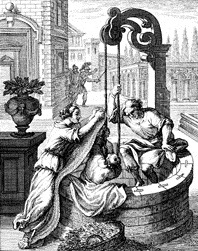
Jonathan and Ahimaaz - Johann Christoph Weigel
Jonathan and Ahimaaz - J.C. Weigel
He is risen; He is risen indeed. Happy Easter!

TODAY'S SPECIAL: 2 Samuel 16-18; Psalm 91

TO CHEW ON: "Now Jonathan and Ahimaaz stayed at En Rogel, for they dared not be seen coming into the city; so a female servant would come and tell them, and they would go and tell King David." 2 Samuel 17:17

David's plan was working! Absalom chose to follow Husahi's advice instead of Ahithophel's This bought David some time.

Hushai sent word of this to the priests' sons Jonathan and Ahimaaz (who had promised to be the snail-mail between Jerusalem and on-the-run David - 2 Samuel 15:27-28). However, even getting the word to Jonathan and Ahimaaz was now a two-step process as Absalom had eyes and ears everywhere. So Hushai gave the message for Jonathan and Ahimaaz to a "servant girl" to take to En Rogel where the runners were hiding.

A youngster saw them get the message, though and told Absalom. J. & A., realizing they'd been sighted, took refuge in a well in Bahurim, where the householder's wife covered their hiding place and spread ground grain on top of it. When Absalom's servants came to search they didn't find anyone. (Whew!)

Jonathan and Ahimaaz eventually got the message to David. He followed Hushai's advice, left the area and crossed over the Jordan to the wilderness.  There, before he even had time to worry about how he was going to take care of his army, three locals, Shobi, Machir, and Barzillai came laden with supplies because, "The people are hungry and weary and thirsty in the wilderness" - 2 Samuel 17:27-29.

Though it's customary for us to focus on the big-name players in the Bible's story—the Davids, Absaloms, Hushais, and Ahithophels—these narratives are also often full of bit players, some named, like Jonathan and Ahimaaz, but many unnamed as well, who are really as vital to bringing about the end result as the main players. In this story there are at least seven. Each one needed to play his or her part in order for God to accomplish His plan of preserving David's life.

Being a bit player is often our role. While we're not the big name speaker or the worship leader, when we do our part to make the phone calls, send the emails, set up the sound system, visit the sick, bring the food, open up our homes etc., things roll along smoothly. God's story plays out. Ours may seem like small, unimportant roles, but they are no less important than the role of the main characters to allow God's story to unfold in the way He has planned.

PRAYER: Dear God, help me to be willing to play whatever part You have for me in Your story. Amen. 

PSALM TO PRAY: Psalm 91

MORE: Easter Sunday
Carrying on with our theme of noticing insignificant characters, how many can you find in the story of Jesus' passion? Are we not among them—sinners for whom Christ's death paid our sins' penalty, and whose resurrection guarantees our life? 

 *********
Unless otherwise noted all Scripture quotations are taken from the New King James Version®. Copyright © 1982 by Thomas Nelson, Inc. Used by permission. All rights reserved.


Saturday, March 31, 2018

Three relationship lessons from David and Absalom

Absalom - James Tissot
TODAY'S SPECIAL: 2 Samuel 13-15; Psalm 90

TO CHEW ON: And Absalom answered Joab, "Look, I sent to you, saying, 'Come here, so that I may send you to the king, to say, "Why have I come from Geshur? It would be better for me to be there still." ' Now therefore, let me see the king's face; but if there is iniquity in me, let him execute me." 2 Samuel 14:32


The story of David and his sons is full of relationship game-playing.

It starts with David and two of his sons—half brothers Amnon and Absalom. When Amnon rapes Absalom's sister Tamar, David doesn't do anything about it even though there is a specific law against and punishment prescribed for incest (death) (2 Samuel 13:1-22; Leviticus 20:17). So Absalom takes revenge for the sin against his sister, kills Amnon, and flees to Geshur (2 Samuel 13:23-37). David us understandably heartbroken, and upset with Absalom.

Three years pass. When Joab, captain of David's army, sees that David is pining for Absalom, he devises a scheme whereby David's conversation with a wise woman gets him to recall Absalom to Jerusalem (2 Samuel 14:1-24).

That brings us to our today's reading where, after two years of David and Absalom living in the same town, David still hasn't called Absalom to see him or given him any indication that he's forgiven. When Absalom requests Joab come to him, Joab ignores him too. Absalom, in desperation, lights Joab's field on fire and that finally brings them face to face.

The result is a clear request for a meeting from Absalom to David (via Joab). When they meet, Absalom bows before his father, gets his dad's kiss (forgiveness) and things are good between them again… well, not quite.

For somehow, all this relationship drama has nurtured the thought in Absalom that he is more fit to be king than David is. And so we leave him conspiring to take over the throne.

I see in this story some relationship mistakes. They show us some things we can learn and apply as we interact within our families and communities:

1. David is lax in the way he handles Amnon's incest. This causes Absalom to distrust his father, who no longer appears to be acting righteously and justly.

David's failure here underlines the need for justice and integrity in us as parents and leaders—in front of our children and everyone who watches us.

2. Joab and David send mixed messages to Absalom. David calls him back to Jerusalem but then they never get together. Joab is instrumental in getting Absalom to return but then he ignores Absalom's request for an audience. Absalom is justifiably confused. Why has he been recalled? Has David forgiven him, or is he planning to kill him in revenge for Amnon's death?

We too need to give clear messages with our words and actions: " 'Let your yes be yes and your no, no' " Jesus says in Matthew 5:37.

3. Finally, Absalom lets his hurt and confusion fester into a plan to hurt his father back. If David is remiss in delaying his expression of forgiveness, Absalom is wrong in cultivating bitterness toward his dad.

When we've been wronged, we too need to forgive—completely and without secret plans to retaliate.

PRAYER: Dear God, please help me to live out these relationship qualities of justice transparency and forgiveness. Amen. 

PSALM TO PRAY: Psalm 90


 *********
Unless otherwise noted all Scripture quotations are taken from the New King James Version®. Copyright © 1982 by Thomas Nelson, Inc. Used by permission. All rights reserved.


Friday, March 30, 2018

Secret?

Nathan Confronts David
TODAY'S SPECIAL: 2 Samuel 9-12; Psalm 89

TO CHEW ON: "But what David had done was evil in the Lord's eyes .... 'You did what you did secretly, but I will do what I am doing before all Israel in the light of day.'" 2 Samuel 11:27b, 12:12.

On the day of Nathan the prophet's visit, at least nine months, perhaps a year or more had passed since David had begun his affair with Bathsheba, been foiled in his attempt to cover it up with a visit from the front by her husband Uriah, and then had Uriah murdered. Now, with his relationship to Bathsheba legitimized by marriage, he probably thought that he'd gotten away with what he'd done. Not so fast, David!

Nathan told David of God's deep displeasure. This showed David that his attempt to be sneaky with God was useless. No wonder David penned the words:

"If I say, 'Surely the darkness shall fall on me,'
Even the night shall be light about me;
Indeed, the darkness shall not hide from you,
But the night shines as the day;
The darkness and the light are both alike to You'" - Psalm 139:11,12.

Other Bible incidents remind us of God's all-seeing ability:
  • Adam and Even couldn't hide from God - Genesis 3:18
  • The garment and the gold and silver Achan secretly took from Jericho were uncovered - Joshua 7:18
  • Ananias's and Sapphira's lie to Peter came to light - Acts 5:1-11
And there are many more Bible examples of secrets becoming public knowledge.

Our attempts to sneak around behind God's back will prove just as futile. He still knows, sees, and has the ability to expose us. Let's let the words of Jesus Himself warn us:

"For there is nothing covered that will not be revealed, nor hidden that will not be known. Therefore whatever you have spoken in the dark will be heard in the light, and what you have spoken in the ear in inner rooms will be proclaimed on the housetops" -Luke 12:2,3 (emphasis added).

PRAYER: Dear God, help me to be honest in the way I live, first with myself, and then with You and others. If I have committed secret sins, please give me the courage to confess them and make them right. Amen. 

PSALM TO PRAY: Psalm 89

MORE: A false declaration

I remember exactly where I was when I recalled that I had lied on my declaration of the value of goods I brought into Canada after my Europe trip (back in the '70s). Seemingly from out of the blue, as I was walking down the hallway at Bible School where I was attending an alumni event, the realization came to me, and the thought: I'm going to have to make this right.

Don't kid yourself, it was a struggle. I had a mighty argument with myself:
- This happened a while ago. Why bring it up now? I just won't do anything like this again.
- I don't have the precise numbers.
-  What would the consequences be? Could Canadian Customs and Excise go after me?

Eventually, though, I wrote and mailed a letter, and felt better. Now there was nothing between God and me. And, as often occurs with such confessions, all my fears were groundless. I think I received a confirmation that they got my letter, but nothing more happened. It was an action so worth doing to have my relationship with Jesus clear and open again.

*****************
Unless otherwise noted all Scripture quotations are taken from the New King James Version®. Copyright © 1982 by Thomas Nelson, Inc. Used by permission. All rights reserved.

Thursday, March 29, 2018

Sit before God

David by Rembrandt
"David" - by Rembrandt
TODAY'S SPECIAL: 2 Samuel 4-8; Psalm 88

TO CHEW ON:
"Then King David went in a sat before the Lord ...." 2 Samuel 7:18

In today's reading we see how David became king over all Israel and Judah, consolidated his rule, and buitd a house for himself. Then it occurred to him to build a permanent home for the ark. He told Nathan the prophet, who gave his blessing to this plan. But God thought otherwise. He told Nathan to return to David and tell him, 'No. You are not to build Me a house.'

Did David feel shock and disappointment at the change? Did he have the urge to question and argue? Nathan's message obviously got him thinking and wanting to be in touch with God about what was going on. So he went in and "... sat before the Lord."

"'Sat' actually means remained," says my Bible footnote to this verse. "David spends a lengthy time before the Lord, that is, in the tent where the ark stood"- Jerry Cook,  commentary on 2 Samuel, New Spirit-Filled Life Bible, p. 411.

As he sat there, his thoughts ranged:
  • He saw his own puniness and insignificance - 2 Samuel 7:18.
  • He marveled at God's grace and favour to his family, given for reasons only God knows - 2 Samuel 7:18-21.
  • In God's blessing of him and the nation of Israel, he recognized God's greatness and he foresaw Israel becoming a blessing to the whole earth - 2 Samuel 7:22-24.

By the end of his time of sitting before God any vestige of a snit is gone. He was completely back in sync with God's plan - 2 Samuel 7:27-29.

What a great example David is to us. When things catch us by surprise, when our expectations come crashing down in disappointment or failure, when the road forks and we sense God tugging us in a direction we hadn't planned on going—and tens of other times—is a good time for us to stop and sit before God.

There we can let Him impress us with His person. He may reassure us with memories of His help in the past. And no doubt He will feed our imaginations with the possibilities of the course He is setting us on for the future.

PRAYER: Dear God, in the hustle and bustle of life, I don't take enough time to sit before You. Please draw me aside to do this, and to make a habit to spend time regularly sitting in Your presence. Amen.

PSALM TO PRAY: Psalm 88


The Bible Project VIDEO: Messiah (Theme series) 


MORE: His presence—a cure for anxiety

"Our eyes should be taken off self, removed from our own weakness and allowed to rest implicitly upon God's strength .... A simple confiding faith, living day by day and casting its burden on the Lord, each hour of the day, will dissipate fear, drive away misgiving and deliver from doubt (Philippians 4:6).

"That is the divine cure for all fear, anxiety and undue concern of soul, all of which are closely akin to doubt and unbelief" - E. M. Bounds, E. M. Bounds on Prayer, Kindle location p. 20)


******
Unless otherwise noted all Scripture quotations are taken from the New King James Version®. Copyright © 1982 by Thomas Nelson, Inc. Used by permission. All rights reserved.


Wednesday, March 28, 2018

Are you like David or Abner?

David anointed king over Judah
TODAY'S SPECIAL: 2 Samuel 1-3; Psalm 87

TO CHEW ON: "'Now that Saul is dead, I ask you to be my strong loyal subjects like the people of Judah, who have anointed me as their new king.'
But Abner son of Ner, the commander of Saul's army, had already gone to Mahanaim with Saul's son Ishbosheth. There he proclaimed Ishbosheth king over Gilead ... and all the rest of Israel." 2 Samuel 2:7-8 NLT


After years of running from Saul, David is free of his persecutor at last. Samuel had anointed David king years earlier so we might expect him to now make a play for the throne. But instead of acting on his own initiative, he keeps depending on God as much as ever.

He begins this new stage of life by asking God about two rather small practical matters: "Should I move  back to the towns of Judah?" and "Which town should I go to?" Then he does exactly what God tells him.

After he is crowned king by Judah, he offers his kingly services to the rest of Israel. Abner, Saul's army commander, takes it upon himself to answer by crowning Saul's 40-year-old son Ishbosheth king at Mahanaim.

What does David do about that? Nothing. He doesn't challenge Abner's action and insist that they crown him king, even though he knows he is God's anointed.

David and his dependence on God is quite a contrast to Abner whose claim to power is rooted in family (his father Ner was Saul's uncle, he was Saul's cousin - 1 Samuel 14:50) and his own manipulations. As a result it takes seven and a half more years and much more bloodshed before the remaining tribes approach David and ask him to be their king (2 Samuel 5:1-3).

I love David's dependence on God, especially as it contrasts with Abner's self-reliance. We would do well to copy David's example, praying about the minutest details of life, listening for and taking God's advice, and exercising patience as we wait for events to take their course (even as we cling to God-given dreams and promises made long ago). It's a course of action described so well by James: "Humble yourselves in the sight of the Lord and He will lift you up." James 4:10.

PRAYER: Dear God, thank You for these examples of David's dependence on You. Help me to translate his attitude to the details of my life. Amen.

PSALM TO PRAY: Psalm 87

The Bible Project VIDEO: 2 Samuel (Read Scripture series)


**************
Scripture quotations marked NLT are taken from the Holy Bible, New Living Translation, copyright © 1996, 2004, 2007 by Tyndale House Foundation. Used by permission of Tyndale House Publishers, Inc., Carol Stream, Illinois 60188. All rights reserved.


Tuesday, March 27, 2018

A united heart

heart with crack down the middle
TODAY'S SPECIAL: 1 Samuel 28-31; Psalm 86

TO CHEW ON: "Teach me Your way, O Lord;
I will walk in Your truth;
Unite my heart to fear Your name." Psalm 86:11


In the world of words, prevailing wisdom says if you want to make it as a writer, stick to one thing. If you've had success with mysteries, for example, don't suddenly switch to writing historical romances and then over to contemporary suspense and, for a change, science fiction.

Why?  Because it confuses your readers and erodes their trust in you. Fans of your mysteries will be put off when they pick up your newest and find it's not another whodunit but a tale about life on Mars. What they wanted, and thought they were getting, when they saw your name on the cover was a puzzle, not a space fantasy.

David in our reading today asks for God's help with something similar in the realm of his life and affections when he prays: "Unite my heart to fear Your name." My Bible's notes suggest other ways of expressing "Unite my heart": "Give me singleness of heart" and "Do not let the heart have many allegiances or distractions" - Dick Iverson, study notes on Psalms, New Spirit-Filled Life Bible, p. 752. 

Why is a divided heart a bad thing? For one, it blunts the impact our lives will have because it confuses those who observe us. But even worse, it confuses us too (James 1:4-8).

It takes only a few minutes to come up with a list of things that could compete for the allegiance of our hearts: money, security, desire to be liked, success, popularity, personal appearance and image, pleasure, leisure…

How do we get to that place of having an undivided, undistracted, unified heart?

"Teach me Your ways," the psalmist begins his request here. Teach (yarah) means to instruct, direct, teach, point, shoot, aim, cast in a straight direction. One Bible word derived from Yarah is Torah which means instruction, teaching, as in the instruction Moses got from God written in the first books of the Bible (from "Word Wealth" by Dick Mills, New Spirit-Filled Life Bible p. 710).

I believe we can make the leap and conclude that spending time in God's word (for us the Old and New Testaments) will also teach us what it means to have an undivided heart.

I love how Leslyn Musch sums up this thought in her Truth-In-Action Through Psalms: "God desires for our hearts to be undivided, fully devoted to Him, daily choosing Him above all else in all decisions of our lives" - New Spirit-Filled Life Bible, p. 755 (emphasis added)


PRAYER: Dear God, as I read the Bible, please help me to understand how its teachings apply to me. Help me to choose to put You first in every aspect of my life. Amen.

PSALM TO PRAY: Psalm 86

*********
Unless otherwise noted all Scripture quotations are taken from the New King James Version®. Copyright © 1982 by Thomas Nelson, Inc. Used by permission. All rights reserved.


Monday, March 26, 2018

Revive us again

TODAY'S SPECIAL: 1 Samuel 25-27; Psalm 85

TO CHEW ON: "Will you not revive us again,
That Your people may rejoice in You?" Psalm 85:6


This is a happy psalm. The Son of Korah writer begins by listing ways God has shown favour to the Israelites. He has: 1] brought them back from exile; 2] forgiven and covered their sins; 3] turned away from showing His anger in the way their sin deserved.

But all is not perfect. We detect concern in his next request: "Will You not revive us again / That Your people may rejoice in You?'

Perhaps he senses superficiality in their worship. Perhaps he knows individuals who have divided loyalties. Perhaps he witnesses hypocrisy, where people are dressed all righteous and sanctimonious when they come to the temple but change into their everyday me-first duds as soon as they leave. Perhaps he knows they aren't really 'rejoicing' in God at all but in everything else, and it is just a matter of time before they'll be casting the same old sinful fruit because they are still living from a sinful root.

A brief look at some of the revivals in the Bible show such uprooting:

  • Asa banned perverted persons and removed idols from the land - 1 Kings 15:12.
  • Jehu and Jehoiada broke down the Baal altar and temple - 2 Kings 10:27; 2 Kings 11:18.
  • Josiah took all the religious paraphernalia associated with idol worship out of the temple and burned it - 2 Kings 23:4. Then he insisted people serve God - 2 Chronicles 34:33.
  • Jehoshaphat and Hezekiah removed the wooden images and high place altars from the land - 2 Chronicles 19:13; 2 Chronicles 31:1.
  • Nehemiah stopped commerce on the Sabbath - Nehemiah 13:19.
  • The people of Ephesus collected their occult books and burned them - Acts 19:19.

These drastic actions attacked deep loyalties and removed what was usually an idol of one kind or another. In our quest for revival, maybe we need to do some of the same life-altering uprooting:
  • Confess and get rid of known sin.
  • Sort out areas where we have mixed faith in God with beliefs from other religions (syncretism).
  • Identify and remove idols—anything that claims our affection above God.
  • Change our lifestyles to show our sensitivity to what does and doesn't  please God.

PRAYER: Dear God, I so glibly pray for revival, but do I really want the deep spirit work that the answer entails? May the prayer for revival be the honest cry of my heart. Amen.

PSALM TO PRAY: Psalm 85

MORE: Modern idols

In her book Embracing Your Second Calling, Dale Hanson Bourke lists some modern idols—ones I know I've been guilty of bowing to (she attributes Tim Keller's book Counterfeit Gods for the original list):

  • "Approval idolatry: 'Life only has meaning / I only have worth if I am loved and respected by …'
  • Control idolatry: 'Life only has meaning / I only have worth if I am able to get mastery over my life in the area of …'
  • Helping idolatry: 'Life only has meaning / I only have worth if people are dependent on me.'
  • Work idolatry: 'Life only has meaning / I only have worth if I am highly productive and get a lot done.'
  • Achievement idolatry: 'Life only has meaning / I only have worth if I am being recognized for my accomplishments / excelling in my career.'"  
Embracing Your Second Calling, pp. 90, 91.

***********

The Holy Bible, New King James Version Copyright © 1982 by Thomas Nelson, Inc. - Used with permission.

Sunday, March 25, 2018

Are you an eager Sunday pilgrim?

St. Joseph's Langley BC (© 2015 -  V Nesdoly)
St. Joseph's Langley, BC

TODAY'S SPECIAL: 1 Samuel 21-24; Psalm 84

TO CHEW ON: "My soul longs, yes even faints
for the courts of the Lord,
My heart and my flesh cry out for the living God." Psalm 84:2


Today is Sunday. It's the day many of us will go to our version of Zion—our place of worship be that a church building, community hall, rented classroom, or someone's living-room. Do we have the gut longing to be there that the writer of Psalm 84 has?

Underlying the strong desire to go to Zion may be an even deeper want.
"This psalm expresses the author's deep longing for the presence of God …. The psalm gives voice to the yearning and happiness experienced in Christ's nearness" - Psalm 84 entry in the Reformation Study Bible, accessed through biblegateway.com's "Study This," emphasis added.

On a scale of 1 to 10 how would we rate our eagerness to go to our Zion today (10 being the most eager)? If our rating is low to medium, why might that he?

  • Perhaps our "heart" and "flesh" cry out for someone or something other than the "living God" (Psalm 84:2).
  • Perhaps we don't spend any time with God the rest of the week and this feels like an awkward outing to meet with a stranger (Psalm 84:4).
  • Perhaps we've been overwhelmed by and waylaid in the dry place of sadness, the "Valley of Baca," and our focus is on our troubles (Psalm 84:6).
  • Perhaps we'd rather be somewhere else, even "dwelling in the tents of wickedness" (Psalm 84:10).
  • Perhaps we're skeptical that He has good things in store for us; we're not convinced "No good thing will He withhold…" (Psalm 84:11).
  • Perhaps, and I think this is key, we don't really expect to meet Him there, to have a sense that we are seen, we are known, that He is gazing straight at us, into us with His all-knowing, all-loving eyes (Psalm 84:9).

As we prepare for church today, and any Sunday, let's expect to actually meet with Him. If we believed that the God of the universe, our Saviour and Redeemer, will meet us there, I think we'd be as eager to attend our Zion as the psalmist was to go to his.


PRAYER: Dear God, help me to prepare myself to meet You in church today. As You seek me out, may I recognize Your presence and hear Your voice. Amen.

PSALM TO PRAY: Psalm 84

*********
Unless otherwise noted all Scripture quotations are taken from the New King James Version®. Copyright © 1982 by Thomas Nelson, Inc. Used by permission. All rights reserved.


Saturday, March 24, 2018

Fighting God's anointed

"Triumph of David" by Matteo Rosselli
TODAY'S SPECIAL:  1 Samuel 18-20; Psalm 83

TO CHEW ON:
"Thus Saul saw and knew that the Lord was with David, and that Michal, Saul's daughter, loved him; and Saul was still more afraid of David. So Saul became David's enemy continually." 1 Samuel 18:28,29

Saul's admiration of David quickly turned to jealousy as the people expressed their preference for this youthful, brave, and spirited shepherd over him.

In a pretense of rewarding David, Saul tried to trap him with marriage to his daughters. But instead of getting killed in battle and later in the slaughter Philistines to obtain a gory dowry for Michal, David succeeded in not only  defeating the enemy and delivering the dowry, but also in winning the love and loyalty of Saul's own daughter Michal. With each victory David endeared himself to the people more. Saul was right to fear him, for his successes were evidence of God's Spirit on him.

Saul's actions remind me of how we too sometimes fight the "Lord's anointed."  When we gossip about our pastor or resist God-given leadership in other ways (grumble and complain, divide into factions, try to figure out ways to get rid of one or the other) aren't we engaging in a Saul-type battle—a battle we're sure to eventually lose?

I am reminded of Jesus' words to another Saul who was fighting the people God had anointed: "'Saul, Saul, why are you persecuting Me? .... I am Jesus whom you are persecuting. It is hard for you to kick against the goads'" Acts 9:4,5.

PRAYER: Dear God, help me to recognize those You have anointed for leadership in my life. Help me not to rebel against them, but to accept Your authority over me through them. Amen. 


PSALM TO PRAY: Psalm 83
 
MORE: Pray for leaders
Instead of resisting God-given leadership, we could pray for our leaders. John Piper lists eight prayer points:

1. Ask God to give them an inclination to His word versus money, fame, or power.
2. Pray for their purity.
3. Pray for their biblical and doctrinal purity.
4. Pray for their solid, joyful, Christ-exalting marriages.
5. Pray for their boldness in witnessing.
6. Pray for visionary creative energy for them.
7. Pray for converting power, i.e. that the Lord will open hearts and save people through their ministry.
8. Pray that they would be a small part of a global spiritual awakening.

Read all of "How to Pray for the Pastoral Staff"  - by John Piper. ©2012 Desiring God Foundation. Website: desiringGod.org.


*******************
Unless otherwise noted all Scripture quotations are taken from the New King James Version®. Copyright © 1982 by Thomas Nelson, Inc. Used by permission. All rights reserved.


Friday, March 23, 2018

The "see" that really matters

Image from The Story of the Bible
 by Charles Foster (© 1873-84)
Drawings by F. B. Schell and others

David anointed at Bethlehem - F.B. Schell
David anointed at Bethlehem
TODAY’S SPECIAL: 1 Samuel 15-17; Psalm 82

TO CHEW ON: “But the LORD said to Samuel, ‘Do not look at his appearance or at his physical stature, because I have refused him. For the LORD does not see as man sees; for man looks at the outward appearance, but the LORD looks at the heart.’” 1 Samuel 16:7


In 1 Samuel 16 and 17 we have at least seven different views of David, who was soon to become an important character for the people of Israel and a pivotal player in the story of redemption.

The Parent (Jesse, David’s father):
In the eyes of his earthly father, David didn’t even rate the day off to meet with Samuel. When Samuel had gone through the first seven and asked if that was it for sons, Jesse replied: “‘There remains yet the youngest, and there he is, keeping the sheep’” - 1 Samuel 16:11. David was the youngest. He was needed for work when the other older, more distinguished looking, filled out, fully grown sons got an invitation to worship with the prophet.

The Prophet (Samuel):
According to 1 Samuel’s introduction in my Bible, scholars believe that Samuel wrote 1 Samuel. So this description of David in the narration: “… ruddy, with bright eyes, and good looking” is probably how David looked to Samuel at this, their first meeting (1 Samuel 16:12).

A Fellow Citizen (Saul’s servant):
Later, when King Saul had “distressing spirit” problems and asked for help finding someone who could ease him with music, a servant who knew the populace suggested David. This is how he saw him: “‘… a son of Jesse the Bethlehemite, who is skillful in playing, a mighty man of valour, a man of war, prudent in speech and a handsome person; and the LORD is with him” - 1 Samuel 16:18. Talk about a fabulous referral!

The Boss (King Saul):

So Saul summoned David for a job interview and he was hired on the spot for Saul “… loved him greatly.” David obviously passed his employment probation, for Saul soon requested of Jesse that David be released from shepherding to work for him full-time because David had “found favour” with him and could also chase the dark spirit away from Saul with his music - 1 Samuel 16:21-23.

Eliab, Joseph’s older brother:
I sense a little sibling rivalry in Eliab’s view of David and his insulting comments to his “baby” brother. He belittled David’s occupation, called him proud and insolent, and implied that he was a shirker. David’s nonchalant response: ”’What have I done now?’” tells me that this was not the first time Eliab was on his case (1 Samuel 17:28,29.

Goliath:

This Philistine giant was beyond scornful of the insignificant champion and his weapons the Israelites sent out to spar with him.  His sarcastic “Am I a dog that you come to me with sticks” was followed by a string of curses and threats (1 Samuel 17:42-44). 

God:
God’s reaction to David is found in his words to Samuel: “‘Arise, anoint him for this is the one!’” - 1 Samuel 16:12. God chose David by what He saw in David’s heart, for he had just had Samuel turn down seven of Jesse’s sons on the basis of what was, or wasn’t, in their hearts: “‘I have refused him (and him, and him…). For the LORD… looks at the heart’” - 1 Samuel 16:7.

What came next is also significant, for following Samuel’s anointing of David “The Spirit of the LORD came on David from that day forward” - 1 Samuel 6:13. The story of Goliath's defeat at David's hand is proof of that something remarkable took place.


Two take-aways:


1. God still sees and evaluates us by our hearts. No matter how young or old, ugly or beautiful, insignificant or important, skillful or klutzy we are, He sees beyond all exteriors to our inner selves. There’s no fooling Him with a fancy outside.

2. I love how David’s anointing and the Spirit’s coming upon him only enhanced his appearance, reputation, and favour. Even strangers like Saul’s servant noticed that “… the LORD is with him.” And his boss Saul experienced it through David’s work and then through the defeat of Goliath. May we, in this time when the Spirit is available for all who accept Jesus, be so filled that others would say: “The Lord is with him /her.”

PRAYER: Dear Father, I know You see my heart. Help me to see and understand myself better. And may Your Spirit on and in me be evident in the skill with which I do my work, my courageous attitude, my prudent speech, and in the favour my life attracts. Amen.

PSALM TO PRAY: Psalm 82

 *********
Unless otherwise noted all Scripture quotations are taken from the New King James Version®. Copyright © 1982 by Thomas Nelson, Inc. Used by permission. All rights reserved.


Thursday, March 22, 2018

Food of obedience

TODAY'S SPECIAL: 1 Samuel 13-14; Psalm 81

TO CHEW ON: "Oh that My people would listen to Me,
That Israel would walk in My ways!
He would have fed them also with the finest of wheat;
And with honey from the rock I would have satisfied you." Psalm 81:13,16

The promise is for quality food — the finest wheat for bread, the staff of life — and honey, for energy and pleasure. Inspired Bible writer Asaph promises these blessings on behalf of God. They come as the result of acknowledging God and obeying Him.

Obedience is linked with plenty in other scriptures.
- It triggers the right weather and growing conditions (Isaiah 30:23; Ezekiel 36:30).
- The plenty that follows obedience is so marked that the year becomes one big harvest (Leviticus 26:5; Amos 9:13).
- Obedience results in God's delight in us generally, which adds His blessing to all of life so that not only do we have enough to eat, but our family and work prosper too (Deuteronomy 30:9; Psalm 132:15).

What specifically brings these blessings into a life (or shuts them out)? In today's psalm they are dependent on the people acknowledging God:
- As the One to worship (Psalm 81:9)
- As the One to credit for past success (Psalm 81:10).
- As the One who holds the future (Psalm 81:10).
- As the One whose voice they will listen to and obey (Psalm 81:11).

I ask myself, am I allowing anything in my life to become an object of worship--an idol? Do I acknowledge God's help in the past and His sovereignty over the future?

In our culture of salaries and superstores, where our lives are mere steps or a short drive removed from our food supply, the connection between obedience and enough to eat is easy to miss. Then again, our persistent, consistent need for refueling illustrates, every four to six of our waking hours, how tangible this connection could become.

PRAYER: Dear God, please help me to have a faith simple enough to connect the way I live with Your supply of my basic needs. Help me to worship You and acknowledge You in all of life — past, present and future. 

 PSALM TO PRAY: Psalm 81


MORE: "Do You Know Why You Need to Eat?"

*********
Unless otherwise noted all Scripture quotations are taken from the New King James Version®. Copyright © 1982 by Thomas Nelson, Inc. Used by permission. All rights reserved.

Wednesday, March 21, 2018

Changed

TODAY'S SPECIAL: 1 Samuel 9-12; Psalm 80


TO CHEW ON: "Then the Spirit of the Lord will come upon you, and you will prophesy with them and be turned into another man." 1 Samuel 10:6

Who of us wouldn't welcome such a transformation as happened to Saul?

The Bible speaks much of being transformed, changed, and renewed. As we study it, we discover we too can experience such a radical remake. Let's look at some other Bible passages that speak of becoming a new person (i.e. spiritual renewal) to understand what such a radical renewal involves.

It begins when we trust Christ for salvation.

  • Jesus calls this event being "born again" and "born of water and the Spirit" - John 3:1-8.
  • Paul speaks of being saved "through the washing of regeneration and renewing of the Holy Spirit" - Titus 3:5.
  • In another place he calls this being "in Christ" and describes it as a "new creation—old things have passed away; behold new things have come" - 2 Corinthians 5:17.

Our new spiritual baby selves need to grow.

  • We do this by spending time with God - Isaiah 40:31. For us this means things like reading the Bible, reflecting on how its teachings relate to our lives, and talking to God in prayer. During this time spent with Him God transforms and renews our minds - Romans 12:2; Ephesians 4:23.
  • God promises to stay involved in the process of renewal for our entire lives - Philippians 1:6; 2:13.
  • All is not lost if we mess up, like David did. "Create in me a clean heart ... and renew a steadfast spirit in me," he prayed (Psalm 51:10) after repenting from adultery with Bathsheba and masterminding the murder of her husband.

Empowering for special jobs. 

  • God sometimes brings about such new-person events to empower people for special jobs. That's what happened to Saul here—and to other Old Testament characters before the Holy Spirit was available to all after the day of Pentecost.
  • Throughout the New Testament we see God the Spirit assigning and empowering people:
- The Holy Spirit directs the choosing of seven men to oversee the daily distribution of food - Acts 6:1-7
- The Holy Spirit sends Ananias to pray for and baptize Saul - Acts 9:10-19
- God tells the Antioch church leaders to send out Barnabas and Saul/Paul, which they do after laying hands on them and praying.

And so we see that this renewal that happened to Saul can also take place for and in us. It will probably not happen in an instant, as it did in him, but may the change in us over time, be just as dramatic.

PRAYER: Dear God, thank you for the many ways You bring about change and renewal in my life. Help me today to live in cooperation with that process. Amen.

PSALM TO PRAY: Psalm 80


MORE: The Holy Spirit invades all of life
"The Holy Spirit cannot be accepted as a guest in merely one room of the house— He invades all of it. And once I decide that my “old man” (that is, my heredity of sin) should be identified with the death of Jesus, the Holy Spirit invades me. He takes charge of everything. My part is to walk in the light and to obey all that He reveals to me."- Oswald Chambers, My Utmost for His Highest,  April 11 reading.
***********

Unless otherwise noted all Scripture quotations are taken from the New King James Version®. Copyright © 1982 by Thomas Nelson, Inc. Used by permission. All rights reserved.


Tuesday, March 20, 2018

Prayer, not panic

"Israel demands a king" J. Winter
TODAY'S SPECIAL: 1 Samuel 5-8; Psalm 79

TO CHEW ON: "Nevertheless the people refused to obey the voice of Samuel; and they said, 'No, but we will have a king over us, that we also may be like all the nations and that our king may judge us and go out before us and fight our battles.'" 1 Samuel 8:19,20.

The people of Israel are tired of being the only nation without a king. At least that's what their elders make it sound like when they come to Samuel begging for a change in government style.

Samuel is hurt. It feels to him like the people are rejecting him. (And in a way they are, for his two corrupt sons, the fruit of his own fathering, are the catalyst for the peoples' request.)

But God makes it clear that Israel's rejection of the judge mode of government isn't a rejection of Samuel or his sons so much as a rejection of God himself and His sometimes unorthodox but effective methods and people (e.g. a cloud by day and fire by night, judges like Samson and Gideon).

How little things have changed. These people are operating like we see most people around us still today. If something is wrong, figure out a human way to change it. Surely a new leader or political party will be able to keep us safer, make us more prosperous, leave more money in our pockets, guarantee we have jobs, houses... Forget "most people," I often find myself thinking that way too. Don't you?

Contrast that with some of the Bible declarations of where our real trust should be:


  • "Give us help from trouble, for the help of man is useless (Psalm 60:11; 108:12).
  • "It is better to trust in the Lord than to put confidence in princes" (Psalm 118:9).
  • "Do not put your trust in princes, nor in a son of man in whom there is no help" Psalm 146:3.
  • "Thus says the Lord: 'Cursed is the man who trusts in man and makes flesh his strength, whose heart departs from the Lord'" Jeremiah 17:5.

The challenge for us, for me, is to acknowledge that God is behind our human governments and governors. If our countries need change, we bring it about most effectively by going first to the power behind the throne, or oval office, or wherever our leaders make their decisions. That is, going to God in prayer about our governors and the things of government.

We can do this on a personal level too, as we put our trust in God over our CEO, or boss, or supervisor, or whoever seems to be pulling the strings in our life or career.

PRAYER: Dear God, help me to give more than lip service to the fact of Your sovereignty in human affairs. Remind me to go to You first with all my problems and concerns. Amen.

PSALM TO PRAY: Psalm 79

MORE: When we are in fear...
"When we are in fear we can do nothing less than pray to God, but Our Lord has a right to expect that those who name His Name should have an understanding confidence in Him. God expects His children to be so confident in Him that in any crisis they are the reliable ones. Our trust is in God up to a certain point, then we go back to the elementary panic prayers of those who do not know God. We get to our wits' end, showing that we have not the slightest confidence in Him and His government of the world; He seems to be asleep, and we see nothing but breakers ahead..." - Oswald Chambers, My Utmost for His Highest, August 12 reading.
********
Unless otherwise noted all Scripture quotations are taken from the New King James Version®. Copyright © 1982 by Thomas Nelson, Inc. Used by permission. All rights reserved.

Related Posts Plugin for WordPress, Blogger...