Monday, September 10, 2018

Is there leaven in our lives?

Hands mixing dough
Courtesy RGBStock.com
TODAY'S SPECIAL: Mark 7-8; Psalm 98

TO CHEW ON: "Then He charged them, saying, 'Take heed, beware of the leaven of the Pharisees and the leaven of Herod.' " Mark 8:15

In a conversation that makes us smile because of its misunderstandings, Jesus warned the disciples about the leaven of the Pharisees and of Herod. The disciples thought He was talking about real bread—seen by their discussion amongst themselves (Mark 8:16).

But that wasn't it at all. What Jesus was really referring to is leaven as a metaphor. "Often the term has an evil connotation, that is, what is small may corrupt the whole," says J. Lyle Story in his notes on Mark (New Spirit-Filled Life Bible, p. 1364).

The leaven, or evil Jesus tells them to avoid here is that of the Pharisees and Herod. My Bible's notes suggest the leaven of the Pharisees is lack of faith so that ever more signs are needed, and the leaven of Herod is the worldly outlook of godlessness.

The meaning of leaven as a small thing that disseminates through the whole batch is borne out in other references to leaven. In 1 Corinthians Paul said, "Do you not know that a little leaven leavens the whole lump?" Then he told the Corinthians to purge out the leaven of "malice and wickedness" - 1 Corinthians 5:6-8.

In Galatians Paul repeated the leaven proverb (Galatians 2:9) and warned readers about the leaven of returning to the bondage of the law (practicing and insisting on circumcision) as a way to earn salvation - Galatians 2:2-12.

These references to leaven as a small, seemingly insignificant thing that can corrupt the whole has me asking, might there be leaven in my life?

It could be some secret and unconfessed sin that saps my spiritual energy by its whispers: "You sinner! You have no right to spiritual power and success." Or it could be an attitude like the fear of man, or a lack of faith that the Bible is really truth, or pride that says, "I would never do that" and then sits in judgment on others. It could be any number of things—bits of leaven that eventually affect every part of life and ministry.

PRAYER:
Dear God, please help me to discern the leaven in my life and, with the help of Your spirit, rid myself of it. Amen. 

PSALM TO PRAY: Psalm 98

 *********
Unless otherwise noted all Scripture quotations are taken from the New King James Version®. Copyright © 1982 by Thomas Nelson, Inc. Used by permission. All rights reserved.


Sunday, September 09, 2018

But He's just a carpenter

Jesus in the Nazareth synagogue - Artist unknown
TODAY'S SPECIAL: Mark 5-6; Psalm 97


TO CHEW ON: " ' Is this not the carpenter, the Son of Mary and brother of James, Joses, Judas, and Simon? Are not His sisters here with us?' So they were offended at Him." Mark 6:3

That old saying, "Familiarity breeds contempt" is enacted here right before our eyes. At the synagogue in His home town the wisdom of Jesus' teaching and the miracles He performed astonished His old neighbors. But because they had seen him grow up, knew Him as an ordinary carpenter, and were acquainted with His family, they were "offended" at Him.

[Offended - scandalizo originally meant to put a literal snare or stumbling block in front of someone. The noun it relates to is a snare or bait stick. According to my Bible's Word Wealth author, "In the NT scandalizo is always used metaphorically of that which hinders right conduct or thought hence, 'to cause to stumble' " - Dick Mills, Word Wealth, New Spirit-Filled Life Bible, p. 1309.]

Could the same attitude be true of us and our leaders? The pastor is the little kid we knew from our Sunday School class years ago. The evangelist went to school with our younger siblings. We made better marks than the author. How could they be anything special?

But when we think like this, we don't take into account the difference the presence of the Holy Spirit makes in a life. When He lives within, everything changes.

  • The Spirit of the Lord in Saul changed him into a new person - 1 Samuel 10:6.
  • This renewal comes by waiting on the Lord - Isaiah 40:31.
  • The Spirit renews minds enabling people to be in sync with God's will - Romans 12:2; Ephesians 4:23, 24.
  • This renewal is not dependent on the look or state of the physical body- 2 Corinthians 4:16.
  • The individual's choices influence this renewal. Paul tells Christ-followers to "put off" old ways of behaving and to "put on the new man who is renewed in knowledge according to the image of Him who created him" - Colossians 3:8-10.
  • But this renewal is still essentially the work of the Holy Spirit - Titus 3:5.

As we relate to our leaders and each other, let's not be similarly "offended" by what we know of someone's family tree, childhood, past, or occupation. Rather, let's recognize that the Spirit of God within opens up a whole new realm of wisdom, power, and ministry effectiveness.

PRAYER: Dear God, please open my eyes to see past ordinary exteriors to the Holy Spirit working in and through people, making their lives extraordinary. Amen.  

PSALM TO PRAY: Psalm 97

 *********
Unless otherwise noted all Scripture quotations are taken from the New King James Version®. Copyright © 1982 by Thomas Nelson, Inc. Used by permission. All rights reserved.


Saturday, September 08, 2018

Technology Word-snatch

TODAY'S SPECIAL: Mark 3-4; Psalm 96

TO CHEW ON: "The sower sows the word. And there are the ones by the wayside where the word is sown. When they hear, Satan comes immediately and takes away the word that was sown in their hearts" - Mark 4:14-15


Jesus' parable describes the ancient practice of sowing but the modern process of snatching. On reading Jesus' explanation of the Sower Parable, something inside me says, the things He's describing—the sown word immediately taken away, the no-root, the preoccupation with the cares of this world, riches and other things—is very familiar. It is how I often feel especially since the coming of the Internet, email, Facebook blogging, twitter, and the smart phone. Something is always vying for my attention—and it isn't usually the Word!

Tim Challies writes about technology and a Christian's response to it in The Next Story. He says:
"Here is one of the greatest dangers we face as Christians: With the ever-present distractions in our lives, we are quickly becoming a people of shallow thoughts and shallow thoughts will lead to shallow living. There is a simple and inevitable progression at work here:

Distraction —> Shallow Thinking —> Shallow Living

All of this distraction is reshaping us in two dangerous ways. First we are tempted to forsake quality for quantity, believing the lie that virtue comes through speed, productivity and efficiency ... Second, as this happens, we lose our ability to engage in deeper ways of thinking—concentrated, focused thought requires time and cannot be rushed" - Tim Challies, The Next Story, Kindle Location 2037.

Isn't that what Jesus is talking about here—letting God's words, thoughts and principles land, penetrate, germinate, sprout, grow, and produce fruit in our lives? We do that as we think deeply and at length about what the Bible says, relating its teachings to our ways of being and acting.

Though our outward ways of relating Jesus' teachings and the Bible to our lives may be different from how people would have done it in the first century, our motivations and trip-ups are so similar. God's word snatched away, shallowly rooted, and choked is something of which we need to be vigilant more than ever!


PRAYER: Dear God, this ancient warning about distracted living is modern. Help me to discipline myself to turn off my devices and listen to You and let Your words preoccupy me. Amen. 

PSALM TO PRAY: Psalm 96


The Bible Project VIDEO: Mark (Gospel Series)


*************
Unless otherwise noted all Scripture quotations are taken from the New King James Version®. Copyright © 1982 by Thomas Nelson, Inc. Used by permission. All rights reserved.


Friday, September 07, 2018

Would Jesus be grieved at our hard hearts?

Christ healing the withered hand by James Tissot

TODAY'S SPECIAL: Mark 1-2; Psalm 95

TO CHEW ON:
"And when He had looked around at them with anger, being grieved by the hardness of their hearts, He said to the man, 'Stretch out your hand.' And he stretched it out, and his hand was restored as whole as the other." Mark 3:5

In our reading today we see a rare thing—Jesus angry. What angered Him? It was the attitude of the Pharisees. They objected to Him healing the withered hand of a fellow worshipper because it was against their rules of what's allowed on the Sabbath. Mark described the source of Jesus' anger as "being grieved by the hardness of their hearts"  - Mark 2:5.

["Hard/hardness  is porosis— hardening, callousness. It's a medical term used to describe the process by which fractured bones are set by an ossifying or calloused petrifying. Sometimes it describes a hard substance in the eye that blinds. Used metaphorically porosis denotes a dulled spiritual perceptivity, spiritual blindness and hardness" - Dick Mills, New Spirit-Filled Life Bible p. 1568.]

We find lots of hard hearts in the Bible, in both Old and New Testaments.

1. People's hearts are hard towards believing in God even after seeing supernatural evidences of Him.
  • Pharaoh's heart is described as "hard" during the plagues. Repeatedly when a plague ends, he reneged on his promise to let the people go - Exodus 8:15; 9:34.
  • Even the Israelites had hard hearts despite seeing signs and experiencing wonders during the exodus and the years they spent in the wilderness - Psalm 78:32.

2. Hard-heartedness toward God continued throughout Israel's OT history
- Jeremiah 5:3; Zechariah 7:8-14.

3. It was often a top-down attitude, beginning with the king.
  • Judah's King Zedekiah was only 21 when he took the throne and his 11-year reign was summed up: "…he stiffened his neck and hardened his heart against turing to the LORD God of Israel" - 2 Chronicles 36:13.
  • It caused King Jehoiakim to systematically burn the scroll Jeremiah had just dictated to Baruch the scribe - Jeremiah 36:24.

4. Some hard heart causes and characteristics:

  • It was caused by pride (Daniel 5:20) and the the deceitfulness of sin (Hebrews 3:13).
  • It resulted in a lack of compassion (Mark 3:2-6—our reading), spiritual dullness (Mark 8:17), doubt and unbelief (Mark 16:14), broken relationships (Mark 10:4,5), and a withdrawal of God's presence (through His people and the Holy Spirit - Acts 19:9).  

5. It is remedied by repentance and confession
- Nehemiah 9:17.

6. If persisted in, its end consequence is judgement - Romans 2:5.

I would have loved to be a synagogue spider watching this interchange between Jesus and the Pharisees. But then the thought occurs, what if He came to my church—to yours? Is there a chance He would be grieved and angered by what He sees there of our attitude toward the withered hand types—the homeless, the mentally ill, the poor, the sexually broken, the addicts?

PRAYER:
Dear Jesus, please help me to see my heart as You see it, and to recognize any hard-heartedness. I need You to replace it with a heart of flesh (Ezekiel 36:26). Amen. 

PSALM TO PRAY: Psalm 95

The Bible Project VIDEO: Mark (Read Scripture Series)


 *********
Unless otherwise noted all Scripture quotations are taken from the New King James Version®. Copyright © 1982 by Thomas Nelson, Inc. Used by permission. All rights reserved.


Thursday, September 06, 2018

Are there doubters in the house?

Image - Pixabay
TODAY’S SPECIAL: Matthew 27-28; Psalm 94

TO CHEW ON: “When they saw Him, they worshiped Him; but some doubted.” Matthew 28:17

I often wish I’d been with Jesus and had seen Him with my own eyes. Then, I imagine, it would be easy to believe no matter what.

Or, maybe not. Here we have disciples who had been with Jesus for the better part of three years. Yet we read “some doubted.”

I wonder what they doubted. That the man who appeared to them as Jesus after the resurrection was actually Jesus? That He had really died and come back to life? That His time on earth had accomplished what He said?

These were not their first moments of doubt. Jesus had often addressed the doubts of those around Him.
  • He talked about trusting God to meet needs of daily living - Matthew 6:30.
  • Doubt caused Peter to sink under the waves after he started out walking on the water - Matthew 14:31.
  • Doubt was at the root of their inability to understand Jesus’ teaching in metaphors and symbols - Matthew 16:8-12.
  • Doubt made the disciples powerless to heal - Matthew 17:17.
  • Doubt had the disciples panicking in a storm - Mark 4:40.
  • Doubt kept the disciples from understanding Jesus’ explanation of how He had fulfilled prophecy - Luke 24:25.
  • Doubt caused Martha to demur when Jesus told them to take away the stone from Lazarus’ grave - John 11:39.
  • Doubt caused Thomas to ask for proof that Jesus was who He said He was - John 20:25.

Jesus’ reaction to the doubt in our passage was to ignore it. Instead of scolding the doubters or launching into an apologetic explanation of how He had fulfilled Scripture, He carried on by giving them their assignment, promising His presence every step of the way - Matthew 8:18-20.

Maybe that’s the antidote to our doubts too—to get busy, exercise some faith, and we’ll find that He does have authority, He continues to attract disciples. He is with us every day.

PRAYER: Dear Jesus it seems to be in my human DNA to doubt. Please help me step out in faith wherever You lead and so prove Your reality. Amen.

PSALM TO PRAY: Psalm 94

 *********
Unless otherwise noted all Scripture quotations are taken from the New King James Version®. Copyright © 1982 by Thomas Nelson, Inc. Used by permission. All rights reserved.


Wednesday, September 05, 2018

The biggest pay check you'll ever get

Servant hiding his talent - Artist unknown
TODAY'S SPECIAL: Matthew 25-25; Psalm 93

TO CHEW ON: " ' For to everyone who has, more will be given and he will have abundance; but from him who does not have, even what he has will be taken away.' " Matthew 25:29

After a career which included many stages (hospital clerk, medical records clerk, school teacher, visiting homemaker, medical transcriptionist, stay-at-home mom) it was this parable that spoke to me about pursuing my lifelong interest in writing.

Note how the word for the unit of money used in the NKJV ("talent") is the same word we use to describe "a particular and uncommon aptitude for some special work or ability; a faculty or gift" (Funk and Wagnalls Dictionary). Thus the connection between stewarding what we have—money and abilities—is impossible to miss.

Some things that jump out at me from this story:
1. Both of the servants who invested their talents received the same commendation even though their returns were different (Matthew 25:21,23).

2. The master's commendation doesn't lead to a holiday but to more responsibility: "… you have been faithful over a few things. I will make you ruler over many things" - (Matthew 25:21,23).

3. This work of faithful stewardship is the doorway to joy: "Enter into the joy of your lord" are the master's final words to them (Matthew 25:21,23).

4. The servant who received one talent seems to have had an underlying critical attitude. He justified his non-action by suggesting that the master was cruel and unpredictable (Matthew 25:24).

5. He also confessed to fear—so great it paralyzed him and he hid the talent away so he could return it, uninvested, to the master (Matthew 25:25).

We can apply things from this story to our lives.

Like the master in the parable gave different amounts of money to different servants, God gives us different talents, abilities, and resources. Let's not become jealous and bitter because we have only one talent while the person beside us has five, or boastful because it's the other way around. Paul addresses this issue with the Corinthians when he says:
"For who makes you differ from another? And what do you have that you did not receive? Now if you did indeed receive it, why do you boast as if you had not received it?" - 1 Corinthians 4:7.

God doesn't expect a five-talent return from a two-talent person. Let's steward the money and abilities we do have and not denigrate our increase by comparing it to someone else's.

Let's conquer fear. We can always find reasons—multiple reasons—why our talent investment efforts will fail. But these fear-whispers are not from God. When He puts a talent in our hands and gives us the investment idea, we can go forward with the assurance that:
"I can do all things through Christ who gives me strength" - Philippians 4:13.

When our faithfulness leads to more and larger responsibilities, let's not shrink back into retirement or laziness but embrace the new load with the knowledge that using our gifts to serve the master is the doorway to joy. It is the key to receiving what I believe will be the biggest pay check we could ever get—God's "Well done, good and faithful servant."

PRAYER:
Dear God, thank You that in Your wisdom You give us differing abilities and opportunities. Help me today to steward well what You have entrusted to me. Amen.

PSALM TO PRAY: Psalm 93

 *********
Unless otherwise noted all Scripture quotations are taken from the New King James Version®. Copyright © 1982 by Thomas Nelson, Inc. Used by permission. All rights reserved.


Tuesday, September 04, 2018

Watch! Be ready

volcanic steam and ash
TODAY'S SPECIAL: Matthew 23-24; Psalm 92

TO CHEW ON: " 'For as in the days before the flood, they were eating and drinking, marrying and giving in marriage, until the day that Noah entered the ark, and did not know until the flood came and took them all away, so also will the coming of the Son of Man be.' " Matthew 24:38-39


Our reading gives us some natural signs that herald the near return of Christ including:
" '…the sun will be darkened, and the moon will not give its light; the stars will fall from heaven, and the powers of the heavens will be shaken' " - Matthew 24:29.

What causes this unnatural darkening? Volcanic matter in earth's atmosphere?

What are those falling stars? Meteors and comets plowing into us?

I can just imagine how such natural disasters will be reported in the news. Scientific experts will analyze and prescribe. They will be the fault of fracking, or fossil fuel use, or CO2, or disturbed ecosystems, or weakened magnetism at the poles, or pollution, or… We will be told, if we only do more of this, less of that, the balance will right itself.

Meanwhile wherever it can, life will go on as usual - Matthew 24:37-38, 40-41.

I describe this scenario because even for those of us who have read these Bible passages and have been forewarned, it's easy to get lulled into complacency by the naturalistic explanations of scientists and those who supposedly understand earth's mechanisms (or at least have lots of theories).

Believers expressing their take on events are / will be mocked no less than Noah was. They're even viewed as dangerous because of their convictions that supernatural forces are at work here and thus they don't buy into scientific prescriptions of how to save the earth.

The billboard sign I take from this passage for myself—for all of us who believe these prophecies—is BE ALERT! Be watchful for Jesus' second coming.

" ' … when you see these things, know that it is near' " - Matthew 24:33. 
" 'But watch therefore…' " Matthew 24:42. 
" 'Therefore you also, be ready' " - Matthew 24:44.

PRAYER: Dear Jesus, help me to see Your hand at work in earth's natural events and disasters. Help me to live alert to signs of Your return, not dulled by the spirit of my time. Amen. 


PSALM TO PRAY: Psalm 92


*********
Unless otherwise noted all Scripture quotations are taken from the New King James Version®. Copyright © 1982 by Thomas Nelson, Inc. Used by permission. All rights reserved.

Monday, September 03, 2018

Available wisdom

Jesus teaches about paying taxes - Artist unknown
TODAY'S SPECIAL: Matthew 21-22; Psalm 91

TO CHEW ON: "When they had heard these words, they marveled, and left Him and went their way. … And when the multitudes heard this, they were astonished at His teaching." Matthew 22:22,33

The Pharisees were determined to trip up and silence Jesus. And they had the perfect way to do it. They would out Him as an enemy of Rome by getting him to declare Himself on the contentious issue of taxes.

To add clout and witnesses they took along their disciples—probably the brightest minds in Jerusalem—and some Herodians. The Herodians were a political party that sympathized with the Herods in their policies of governing and introducing new social customs into Jewish society.

But when the troupe got to Jesus and confronted Him, He saw right through their little scheme. Those pharisaic wolves, who had circled their prey and were licking their chops in anticipation of the take-down, were disappointed, while the surrounding crowd marveled at the wisdom of Jesus' answer (Matthew 22:17-21). The same thing happened to the Sadducees who tried to trap Him later (Matthew 22:23-32). For Jesus was wise.

  • Isaiah prophesied Jesus' wisdom - Isaiah 11:2; 53:11.
  • He was wise from childhood - Luke 2:40.
  • He astonished all who heard Him, especially His neighbours - Matthew 13:54.
  • The amazing thing is that His wisdom can be ours! In Colossians 2:3, Paul describes Christ as the One: "… in whom are hidden all the treasures of wisdom and knowledge." Paul goes on to encourage his readers, "As you therefore have received Christ Jesus the Lord, so walk in Him, rooted and built up in him … For in Him dwells all the fullness of the Godhead bodily; and you are complete in Him" - Colossians 2:3-9.

Let's ask to receive His wisdom for all kinds of situations. And then let's move ahead in faith, acting on the answers He gives - James 1:5-8.

PRAYER: Dear Jesus, I need the spirit of wisdom and revelation for everyday living as much as for special problems. I ask for Your wisdom today. Help me to trust and act on what You tell me through Your word and in prayer. Amen.

PSALM TO PRAY: Psalm 91

 *********
Unless otherwise noted all Scripture quotations are taken from the New King James Version®. Copyright © 1982 by Thomas Nelson, Inc. Used by permission. All rights reserved.

Sunday, September 02, 2018

Prepare to be surprised

child doing handstand
TODAY'S SPECIAL: Matthew 19-20; Psalm 90

TO CHEW ON: " ' But many who are first will be last, and the last first.' " Matthew 19:30


Again and again Jesus reminds His disciples that the kingdom of heaven is characterized by reversal. That's the word the Thompson Chain Bible uses to head a section that traces the kinds of reversals taught and illustrated in the Bible.

[Reverse: Adjective: having a contrary or opposite direction or character, order etc., turned backward. Noun: that which is directly opposite or contrary; a change to an opposite position, direction, state. Verb: to turn upside down, inside out, to turn in an opposite direction - Funk & Wagnall's Dictionary.]

- God reverses fortunes - Psalm 75:7; 107:41; "…Nothing shall remain the same…" Ezekiel 21:26.

- God hates pride. The proud person is a target for reversal - Psalm 147:6.

- God can remove the life props we make for ourselves - Isaiah 22:25. He can destroy the things we have accomplished and in which we trust: "The lofty city; He lays it low…" - Isaiah 26:5.

- God can bring down rulers - Isaiah 40:23; Luke 1:52. Nebuchadnezzar is an example of this, when he goes from being a proud king to a mentally deranged "beast" - Daniel 4:28-33.

- God sees the poor, neglected by the rich and reverses their state - Luke 6:25; 16:25.

- On the other hand, He also rewards good stewardship with more, that is, gives more to the person who already has while taking away from the one who has little - Matthew 25:29.

- Our expectations will be challenged. Over and over we hear Jesus say: " 'The last shall be first, the first last' " - Matthew 19:30; 20:16; Mark 10:31; Luke 13:30.


Some thoughts we can take from this into our day:

1. God hates pride. When we give ourselves credit for what we have and get puffed over what we've done, we set ourselves up for reversal.

2. The material things in which we put our confidence aren't as trustworthy as we think.

3. The world's rulers, those we love or hate, follow or resist, admire or fear, are targets for God's reversal. Let's remember that as we pray for our nation and the world.
 

4. We are responsible to be good stewards of what we have, whether it's much or little.

5. Knowing all the above, we'll probably still be surprised when, someday, we stand before God and see things as they really are.


PRAYER:
Dear God, please help me to live in the upside down, back-to-front paradigm of the kingdom of heaven while I'm here on earth. Amen.


PSALM TO PRAY: Psalm 90

*********
Unless otherwise noted all Scripture quotations are taken from the New King James Version®. Copyright © 1982 by Thomas Nelson, Inc. Used by permission. All rights reserved.

Saturday, September 01, 2018

Children in the spotlight

"Jesus called a child to Him..." - Artist unknown
TODAY'S SPECIAL: Matthew 17-18; Psalm 89

TO CHEW ON: "Then Jesus called a little child to Him, set him in the midst of them, and said…" - Matthew 18:2

In this teaching, where Jesus uses a live illustration—a child—He says some important things about children and the adults who guard them, care for them, and train them.

Children have qualities we adults should desire.
Jesus talks about entering the kingdom of heaven by becoming " ' ...as little children...' " (Matthew 18:3). Of course He doesn't mean we physically shrink down in size. The change is one of spirit. To even enter the kingdom of God, we need the childlike spirit of trust, dependence on God, and willingness to do what He says, like a child trusts and listens to a loving parent.

We become great in the kingdom when we have the humility of children (Matthew 18:4). With no pretense or attempt to impress, unspoiled children don't edit their behavior to win over the wealthy or be seen with the influential. They don't snub the person with ragged clothes or avoid the mentally challenged (though they may embarrass us with their frank comments about bad smells).

Children need the protection and care of adults.
Jesus curses the one who causes a child to sin (Matthew 18:6). He suggests that losing a limb to stop such offense is preferable to being whole and stumbling someone.

We shouldn't ignore or despise children. They have angelic advocates with God (Matthew 18:10). Their salvation is as important to Him as the one missing sheep is important to the shepherd of 100 (Matthew 18:14).

Our own children and grandchildren aside, we do well to ask ourselves: How do we feel about children? How do we treat them? Do we have patience with them? Are we kind to them? Or when they, say, interrupt the church service with their fussing do we send them or their parents dirty looks? When they get carried away on our street shooting their balls into our flowers or our yards, are we angry and abrupt?

In our interactions with children, let's remember how much God loves and values them. Let's be careful not to be those He condemns for giving offense.

PRAYER: Dear Jesus, thank You for Your attention to children. Help me to be childlike in trust and humility, and always kind to the children in my life. Amen.

PSALM TO PRAY: Psalm 89

*********
Unless otherwise noted all Scripture quotations are taken from the New King James Version®. Copyright © 1982 by Thomas Nelson, Inc. Used by permission. All rights reserved.

Friday, August 31, 2018

Change your mind, change your mouth

Image: Pixabay
TODAY’S SPECIAL: Matthew 15-16; Psalm 88

TO CHEW ON:
“‘But those things which proceed out of the mouth come from the heart and they defile a man. For out of the heart proceed evil thoughts, murders, adulteries, fornications, thefts, false witness, blasphemies’”  Matthew 15:18,19

Have you ever surprised yourself by what came out of your mind or mouth? You spill a jug of juice and it’s “Oh ____!” Someone cuts you off in traffic and, mentally at least, you flip them the bird. Or you find yourself harboring, toward public figures like politicians and journalists, all manner of critical thoughts, clever put-downs, even rants at the TV.

So, we recognize within ourselves the defilements which Jesus pointed out. Can we do anything more about them than pray for a supernatural heart transplant?  I think we can.

Paul’s advice to the Ephesians is full of action, suggesting that a change of heart on our part is a joint effort of God and us. That we even have the desire to change is God’s work. But there’s something we can do too. Here is the Ephesians passage from The Living Bible (relevant words in bold—my emphasis):
Stop lying to each other; tell the truth, for we are parts of each other and when we lie to each other we are hurting ourselves.  If you are angry, don’t sin by nursing your grudge. Don’t let the sun go down with you still angry—get over it quickly; for when you are angry, you give a mighty foothold to the devil. If anyone is stealing he must stop it and begin using those hands of his for honest work so he can give to others in need. Don’t use bad language. Say only what is good and helpful to those you are talking to, and what will give them a blessing” - Ephesians 5:25-29 TLB.

And one more bit of to-do from James 1:19:
Dear brothers, don’t ever forget that it is best to listen much, speak little, and not become angry” - James 1:19 TLB

As Joyce Meyer says in the introduction to her book Battlefield of the Mind:

“So many people’s problems are rooted in thinking patterns that actually produce the problems they experience in their lives. Satan offers wrong thinking to everyone, but we do not have to accept his offer. Learn what types of thinking are acceptable to the Holy Spirit and what types are not acceptable.

“Second Corinthians 10:4,5 clearly indicates that we must know the Word of God well enough to be able to compare what is in our mind with what is in the mind of God…

“The mind is the battlefield. It is a vital necessity that we line up our thoughts with God’s thoughts. This is a process that will take time and study” - Joyce Meyer, Battlefield of the Mind p. 4 (emphasis mind).
PRAYER: Help me to be aware of faulty (according to Your word) thoughts and thought patterns within me and not just bemoan them, but act to change them. Amen. 

PSALM TO PRAY: Psalm 88

The Bible Project VIDEO: Matthew Part 2 - ch.14-28 (Read Scripture Series)


 *********
Unless otherwise noted all Scripture quotations are taken from the New King James Version®. Copyright © 1982 by Thomas Nelson, Inc. Used by permission. All rights reserved.

Scriptures marked The Living Bible (or TLB) copyright © 1971 by Tyndale House Foundation. Used by permission of Tyndale House Publishers Inc., Carol Stream, Illinois 60188. All rights reserved. The Living Bible, TLB, and the The Living Bible logo are registered trademarks of Tyndale House Publishers.


Thursday, August 30, 2018

Moved to mercy

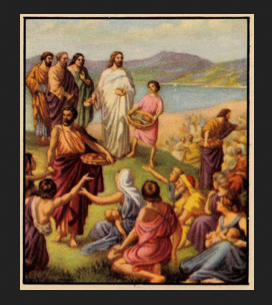
Jesus feeds the multitude - artist unknown
TODAY'S SPECIAL: Matthew 13-14; Psalm 87

TO CHEW ON:
"And when Jesus went out He saw a great multitude; and He was moved with compassion for them, and healed their sick." Matthew 14:14

Our reading today starts out with Jesus trying to get away from the crowds: "When Jesus heard it, He departed from there by boat…" The "it" is news that his friend and relative John (the Baptist) has just been killed (decapitated no less!) by Herod, instigated by Herod's concubine Herodias.

We can understand Jesus' need to be alone at such a time. But when He gets to land, a crowd is there to meet Him. However, instead of being annoyed at this (how I would have felt if my expectations of a quiet afternoon had been dashed like that) He is "moved with compassion."

["Moved with compassion" is splanchnizomai is from the word splanchna - bowels. The Hebrews regarded splanchna as the place where tender mercies and feelings of affection, compassion, sympathy, and pity originated - Dick Mills, Word Wealth, New Spirit-Filled Life Bible, p. 1317.]

Out of this compassion Jesus spends the afternoon healing the sick and, when it gets late, multiplying the five loaves and two fish to feed everyone before He sends them home.

Jesus performed other miracles as a result of splanchnizomai.
  • He fed another large crowd after a three-day healing and teaching 'conference' (Matthew 15:32).
  • He restored the sight of two blind men who sat beside the road calling out, even as the people around told them to shut up (Matthew 20:34).
  • He healed a leper (Mark 1:41).
  • He raised a widow's son back to life (Luke 7:13).
  • He gave this compassion to two parable characters: the Good Samaritan (Luke 19:33) and the father of the prodigal son (Luke 15:20).

I need more of this compassion in my life. Instead of seeing people as threats, or irritants, or losers, or rivals, or… I would like to see under and beyond behavior to the need of which it's a symptom—a need that's best filled by Jesus and what He offers.

What about you?

PRAYER: Dear Jesus, please give me a softer heart, that is moved by the things that move You. Amen.

PSALM TO PRAY: Psalm 87

**********
Unless otherwise noted all Scripture quotations are taken from the New King James Version®. Copyright © 1982 by Thomas Nelson, Inc. Used by permission. All rights reserved.


Bookmark and Share


Wednesday, August 29, 2018

Convincing the skeptic

Jesus eats with publicans and sinners - Alexandre Bida

TODAY'S SPECIAL: Matthew 11-12; Psalm 86

TO CHEW ON: " ' For John came neither eating nor drinking, and they say, "He has a demon." The Son of Man came eating and drinking, and they say, "Look, a glutton and winebibber, a friend of tax collectors and sinners!" But wisdom is justified by her children.' " Matthew 11:19

Have you noticed how, when a segment of the population disagrees with government's position on an issue (like developing land or extracting oil or ore from the earth) they demand a study. When that study comes back but doesn't support their position, they ask for another? It seems there is within us an unwillingness to move from strongly held beliefs and convictions no matter what arguments or proofs we're presented with.

That's what we see in the people of Jesus' time. They were having a hard time believing God had actually showed up.

They flocked out to see John who preached repentance in his unusual get-up and abrasive way (Matthew 3:4-7). But instead of linking him with the fulfillment of the prophecy (Matthew 11:10 compare Malachi 3:1), they said, "He has a demon."

They came to Jesus and listened to His words with amazement but when they saw Him socializing with the wrong set, they discounted Him as a party boy, glutton and drunkard.

Jesus summed up the situation with a little proverb: "But wisdom is justified by her children."

The Amplified renders it:
"Yet wisdom is justified and vindicated by what she does (her deeds) and by her children" - Matthew 11:19 AMP.

and The Message:
"Opinion polls don't count for much, do they? The proof of the pudding is in the eating" - Matthew 11:19 MSG.

I take that to mean, judge the wisdom of a teacher and his / her teaching (Jesus's John's, ours) by the fruit of that life and its influence.

This is encouraging to us as we seek to win family members and friends to Jesus. They will probably be swayed from skepticism more readily by the example of lives of love and service than by any of our intellectual apologetic arguments, no matter how clever or convincing.


PRAYER: Dear God, in the end, You by Your Holy Spirit, break down barriers of unbelief in the hearts of family members and friends. Help me to live a life that will help, not hinder, them along the path to belief. Amen.

PSALM TO PRAY: Psalm 86

 *********
Unless otherwise noted all Scripture quotations are taken from the New King James Version®. Copyright © 1982 by Thomas Nelson, Inc. Used by permission. All rights reserved.

Scripture quotations marked AMP are taken from the Amplified® Bible,
Copyright © 1954, 1958, 1962, 1964, 1965, 1987 by The Lockman Foundation
Used by permission." (www.Lockman.org)

Scripture quotations marked MSG are taken from The Message. Copyright © 1993, 1994, 1995, 1996, 2000, 2001, 2002. Used by permission of NavPress Publishing Group.

Tuesday, August 28, 2018

Insulting the guests

Jesus Eats With Publicans and Sinners - by Alexandre Bida

TODAY'S SPECIAL: Matthew 9-10; Psalm 85

TO CHEW ON: "And when the Pharisees saw it, they said to His disciples, 'Why does your Teacher eat with tax collectors and sinners?' When Jesus heard that, He said to them, 'Those who are well have no need of a physician, but those who are sick.' " Matthew 9:11,12

Jesus and His disciples were socializing with known sinners. This dinner party was in Matthew's own home (this is clear from the Mark 2:13-17 and Luke 5:27-32 versions of this story, where Matthew is called "Levi").

You've got to admire Matthew's humility when he reports Jesus' defense of why He's associating with, what his critics consider, riffraff.  Jesus says they are sick and need a doctor, sinners who need to repent, unrighteous who need mercy. He's basically describing Matthew and current company. How would you or I feel if a dinner guest said that about us and our guests?

But it seems Matthew had no problem with it. He had faced himself in this way. It had brought him to his moment of decision, led him to leave his job— a life change (Matthew 9:9).  Now he wanted his friends to be exposed to the same ideas and the Person who had helped him see himself.

I would suggest that it is similar for us. It's only when we are honest about our condition and realistic about who and what we are that we get free to leave the old life behind and embark with Jesus on the new.

We have to face that we don't "make mistakes," we sin. Our sinful acts aren't the odd exception, they are symptoms of our chronic condition. We need to repent, turn around, and come to Dr. Jesus for mercy. This is not some self-improvement program for us and our friends, but a spiritual healing, a rebirth.

PRAYER: Dear Jesus, in my society where "sin" and "repentance" are words I rarely hear, help me to understand the depth of human separation from You, the need to admit that we're all sinners and must turn around (repent) to re-establish our relationship with God. Amen.

PSALM TO PRAY: Psalm 85


 *********
Unless otherwise noted all Scripture quotations are taken from the New King James Version®. Copyright © 1982 by Thomas Nelson, Inc. Used by permission. All rights reserved.
Monday, August 27, 2018

Skewed priorities

"Swine Driven Into the Sea" by James Tissot

TODAY’S SPECIAL: Matthew7-8; Psalm 84

TO CHEW ON:
“And behold, the whole city came out to meet Jesus…” - Matthew 8:34

Just prior to our focus verse, we see Jesus do something truly amazing—liberate two demon-possessed men (Matthew 8:28-33). These men have, till now, spooked all passersby. No one even comes close to the tomb-caves where they live because they’re too scary.

With a word Jesus frees them from the demonic spirits that have been controlling them. He gives those spirits permission to enter a nearby herd of pigs. True to their destructive nature, the demons cause the pigs to stampede to their briny deaths in the sea.

Then the swine-herders rush back to the city with word of what has happened. The whole city comes out and we (at least I) expect them to welcome with open arms Jesus, this Man who works wonders, who frees enslaved brothers. We expect another Samaritan Woman saga, when the whole town, responding to the woman’s testimony, becomes receptive to Jesus (John 4:28-42).

But no. The end of our story isn’t like that. The last part of Matthew 8:34 is a whiplash of surprise: “And when they saw Him, they begged Him to depart from their region” (emphasis added).

Oh no. Lost pigs are obviously more important to them than found men. We ask, how could they be that way—begging someone who has freed these men to leave? Obviously their priorities are skewed.

Yet, am I, are we so different? Who wins when we sense that introducing others to Jesus by responding to their needs will impinge on our time, our plans, our bank accounts, our peaceful tidy homes?  

PRAYER:
Dear Jesus, please help my life to be an open door to You and people meeting You, not a closed door sending You and others away because I am self-centered.  Amen.

PSALM TO PRAY: Psalm 84

 *********
Unless otherwise noted all Scripture quotations are taken from the New King James Version®. Copyright © 1982 by Thomas Nelson, Inc. Used by permission. All rights reserved.


Sunday, August 26, 2018

The counterintuitive Be-Attitudes

man on ladder peeling back the sky
TODAY'S SPECIAL: Matthew 5-6; Psalm 83

TO CHEW ON: "Blessed are the poor in spirit,
For theirs is the kingdom of heaven."


The seven verses at the beginning of Jesus' Sermon on the Mount (Matthew 5:3-10) are called the "Beatitudes." The word comes the Latin word beatitudo. So much for my fancy that beatitudes was a modern word grafted together from be and attitudes, i.e. attitudes worth assimilating into one's state of being. [Beatitudo means blessedness from beatus - happy.]

On looking over the beatitudes, it strikes me that at least four are states which we would not readily seek out.

  • It's not trendy to be "'poor in spirit'" (Matthew 5:3)— "… those who recognize their spiritual poverty and, casting aside all self-sufficiency, seek God's grace" - Lyle Story, commentary on Matthew, New Spirit-Filled Life Bible, p. 1296.

  • Who wants to "'mourn'" (Matthew 5:4)?  Though our commenter assures us this doesn't refer to being bereaved but to  "… those who experience the sorrow of repentance" - Ibid.

  • We readily equate "meek" with "weak (Matthew 5:5) though again our commenter disabuses us of that notion, defining "'meek'" as "…controlled strength. The word carries the idea of humility and self-discipline" - Ibid.

  • Finally, do any of us relish the thought of persecution (Matthew 5:10)?

Our reading today reminds me again of how humanly unintuitive the Kingdom of Heaven is. Accustomed to operating in the natural we would hardly equate blessedness or a state of happiness with a majority of the beatitude qualities.

Two things come to mind:

1. We can't trust our instincts to pilot us to a place of God's blessing. Jesus said, "'My kingdom is not of this world.'" He said this as He stood meek before a puzzled Pilate. He went on to elaborate on his counterintuitive behaviour: "'If My kingdom were of this world, My servants would fight, so that I should not be delivered to the Jews; but now My kingdom is not from here'" - John 18:36.  

2. It's only as we familiarize ourselves with the Bible that we will know what Kingdom of Heaven principles are, and as we submit to them will experience the happy blessedness and that the beatitudes promise.

PRAYER: Dear God please help me to accept my own poverty of spirit. Please infuse me with a hunger and thirst for righteousness as I seek, with the help of the Holy Spirit, to incorporate these be-attitudes into my life. Amen. 

PSALM TO PRAY Psalm 83

***********
Unless otherwise noted, all Bible quotes are taken from the New King James Version (NKJV) Used with permission. The Holy Bible, New King James Version Copyright © 1982 by Thomas Nelson, Inc.


Saturday, August 25, 2018

When God is pleased

Dove descending on Jesus at His baptism - Artist unknown
Dove descending on Jesus at baptism - Artist unknown
TODAY'S SPECIAL: Matthew 3-4; Psalm 82

TO CHEW ON: "And suddenly a voice came from heaven, saying, 'This is My beloved Son, in whom I am well pleased.'" Matthew 3:17

When people came to John to be baptized it was in repentance. Repentance implied they had done something wrong from which they needed to turn. Jesus, however, was sinless. He didn't need to repent, so why did He need to be baptized?

John objected when Jesus asked him for baptism: "I need to be baptized by You," he said - Matthew 3:14.

But Jesus countered with "'Permit it to be so now, for thus it is fitting for us to fulfill all righteousness'" (Matthew 3:15). What did He mean by "fulfill all righteousness"?

Matthew Henry in his commentary on this verse says He "fulfills all righteousness" in two main ways:

1] It shows His grace.
"There was a propriety in ever thing that Christ did for us; it was all graceful (Hebrews 2:10; 7:26); and we must study to do not only that which behooves us but that which becomes us" (in plain words, do not only what is required but what is fittingly attractive).

2] It shows His ownership of the divine institution of baptism.
The Old Testament law contains many washing ceremonies. Matthew Henry: "Thus Christ filled up the righteousness of the ceremonial law which consisted of divers washings; thus He recommended the gospel ordinance of baptism to His church."

The beauty of Jesus' obedience, humility, and graciousness was enhanced by what followed. In a burst of unusual demonstrativeness heaven broke through. The Holy Spirit descended as a dove on Jesus and God the Father called in a thunderous voice that echoed through the Jordan's hills (or I imagine hills—like the hills that surround the Saskatchewan River where I was baptized): "'This is My beloved Son in whom I am well pleased.'" If there was any doubt in Jesus' mind that He was doing the right thing, it was now dispelled.

I submit that this is sometimes how God deals with us too. We have a choice. We consider the options and take the course of obedience. Often, at the moment we cast the die, there is no emotion to confirm us in our decision. But later, perhaps with a sense of surprise, we feel the divine smile, the warm, approving benediction. For our love for God and our obedience to Him are of one piece and prove that we are His (John 15:23-26).

Henry says of God the Father's declaration and us: "See how ready He is to own us in Him: He is my beloved Son not only with whom but in whom I am well pleased. He is pleased with all that are in Him and are united to Him by faith" -  Matthew Henry's Commentary on Matthew 3.


PRAYER: Dear God, thank You for this intimate glimpse into the relationship of the Godhead—Father, Son and Holy Spirit. Thank You for Jesus' example  and willingness to "fulfill all righteousness" in this humble way. Please help me to be as obedient. Amen. 

PSALM TO PRAY: Psalm 82


***********
 
Unless otherwise indicated, all scripture quotations are taken from the New King James Version (NKJV) Used with permission. The Holy Bible, New King James Version Copyright © 1982 by Thomas Nelson, Inc.


Friday, August 24, 2018

Spiritual dreams

"The Wise Men Come to Worship" by James Tissot

TODAY'S SPECIAL: Matthew 1-2; Psalm 81

TO CHEW ON:
"Then being divinely warned in a dream that they should not return to Herod, they departed for their own country another way." Matthew 2:12

A sidebar article in my Bible observes about dreams, "The NT opens with a burst of dreams, visions, angelic visitations and prophecies and closes with John's revelation…" James W. Ryle, "Dreams, New Spirit-Filled Life Bible, p. 1291,2.

The story of Jesus' incarnation is particularly full of dreams.

  • An angel comes to Joseph in a dream to tell him it is OK to marry Mary - Matthew 1:20.
  • In our reading today, an angel warns the wise men away from return to Herod - Matthew 2:12.
  • In the next verse of Matthew, we have another dream of Joseph's in which an angel tells him to flee from Herod to Egypt with Mary and baby Jesus - Matthew 2:13.
  • After Herod dies, an angel gives Joseph the news and tells him to settle his family in Israel - Matthew 2:19.
  • En-route another dream confirms his intuition about the danger of living in Judea and so he returns to Galilee - Matthew 2:22.

The article quoted from above goes on to say:
"…neither Jesus nor the apostles give any particular precept concerning the phenomena of dreams or visions. This is somewhat enigmatic in that, while the Bible does not teach about dreams and visions in any systematic manner, yet by citing so many significant examples it validates their existence and use by God as a means of communicating to people" - Ibid.  

What do you think—does God still speak to people in dreams today? Google that question and you'll raise many links to check out. Perhaps one of the simplest answers is on the Billy Graham Evangelical Association Answers page:
"God may communicate through dreams or visions even today, but we need to carefully check any such guidance we receive with Scripture and godly counsel to be sure it is from the Lord..." (read the entire answer).

PRAYER: Dear God, thank You for preserving Jesus' human life through dream warnings and messages. I know You can communicate to me in whatever way You choose. Help me to be listening. Amen.

PSALM TO PRAY: Psalm 81

The Bible Project VIDEO: Matthew (Part 1: 1-13) (Read Scripture Series)


*********
Unless otherwise noted all Scripture quotations are taken from the New King James Version®. Copyright © 1982 by Thomas Nelson, Inc. Used by permission. All rights reserved.


Thursday, August 23, 2018

When your belly is full of tears

TODAY'S SPECIAL: 2 Chronicles 35-36; Psalm 80

TO CHEW ON: "Return, we beseech You, O God of hosts;
Look down from heaven and see,
And visit this vine." Psalm 80:14


From the vantage point of hindsight we know the "vine's" story—the ups and downs of Israel's history. It's easy for us gloss over generations of slavery in Egypt, the back-and-forth between oppression and freedom of the judges' period, the waves of invaders that led to the exile of the Jews in at the end of the Old Testament.  Our Bible reading takes us through millennia in mere hours. We readily forget how horrible it must have been to live in any one of those dark times.

This psalm, however, seems like a cry from the middle of one of them:
"O Lord God of hosts,
How long will You be angry
Against the prayer of Your people?
You have fed them with the bread of tears,
And given them tears to drink in great measure" - Psalm 80:4,5 (emphasis added).

One of the powerful things about the psalms is how they express the experience and emotion we all go through, no matter when we live. Can't you just hear the Christians of Syria, hounded and killed by ISIS terrorists weeping these verses, or the family in Africa devastated by the  Ebola virus, or the family in North America cut apart by cancer, or…?

In this psalm there is only one resolution to whatever tragedy the pray-er is experiencing. It is God.

Our prayers can echo the psalmist's as we cry from whatever dark place we're in:
"Restore us ... Restore us ... Return we beseech You...
Restore us, O Lord God of hosts,
Cause Your face to shine,
And we shall be saved" - Psalm 80:3,7,14,19.

PRAYER: Dear God, please restore and return to those with their bellies full of tears who call on You today. Amen. 

PSALM TO PRAY: Psalm 80

 *********
Unless otherwise noted all Scripture quotations are taken from the New King James Version®. Copyright © 1982 by Thomas Nelson, Inc. Used by permission. All rights reserved.

Wednesday, August 22, 2018

Fighting life's battles

Image: Pixabay
TODAY’S SPECIAL: 2 Chronicles 32-34; Psalm 79

TO CHEW ON:
“‘Be strong and courageous; do not be afraid nor dismayed before the king of Assyria, nor before all the multitude that is with him; for there are more with us than with him. With him is an arm of flesh; but with us is the Lord our God to help us and to fight our battles.’” 2 Chronicles 32:7,8

Judah’s King Hezekiah gave the encouragement, above, to his subjects in the face of Sennacherib’s (king of Assyria) invasion of Judah. But before he said these things, he was busy doing what he could to fortify and protect his territory from the Assyrian threat.

  • He stopped the flow of water to the land (2 Chronicles 34:3,4).
  • He repaired the Jerusalem wall (2 Chronicles 34:5).
  • He manufactured and distributed new arms (2 Chronicles 34:5). 
  • He organized the army (2 Chronicles 34:6).

Then he gathered the people for the pep talk.

Not surprisingly, Sennacherib reaction to Hezekiah’s speech was to mock it and Hezekiah’s faith in God. Sennacherib sent a delegation to Jerusalem to challenge Yahweh and  instill fear (2 Chronicles 34:10-15).

Sennacherib’s mockery and threats brought Hezekiah and Isaiah (the prophet) to their knees: they “prayed and cried out to Him…” 2 Chronicles 34:20.

Then God intervened supernaturally: “… sent an angel who cut down every mighty man of valor, leader, and captain in the camp of the King of Assyria" (2 Chronicles 34:21).

I think Hezekiah here demonstrates some great life principles for us too. When we’re under attack or in trouble—physically, financially, socially or in whatever way we:
  • Do all we can. We follow doctors’ orders, put our financial house in order, attempt to make peace with our enemies, or whatever the situation dictates.
  • Encourage ourselves in God, refusing to give in to the fear and what-ifs of the situation, reminding ourselves that “there are more with us than there are with them.”
  • Pray. Though we've done all we can, in the end our trust is in God and His coming through for us. In His time He will, as He did for Hezekiah and his subjects.  

PRAYER: Dear Father, help me to remember that I have more than the “arm of flesh” with me; I have the Lord, God of heaven and earth. Amen.

PSALM TO PRAY:
Psalm 79

 *********
Unless otherwise noted all Scripture quotations are taken from the New King James Version®. Copyright © 1982 by Thomas Nelson, Inc. Used by permission. All rights reserved.

Thanks for reading! This year we are using The Bible Project "Timeless Reading Plan" to read through the Bible in 2018. If you'd like to read along in your own Bible, you can download a pdf of the reading plan HERE.

Related Posts Plugin for WordPress, Blogger...