Wednesday, August 19, 2015

Big prayers—old and new - 1

Solomon Dedicates the Temple - James Tissot
TODAY'S SPECIAL: 1 Kings 8:22-41

TO CHEW ON: "Yet regard the prayer of Your servant and his supplication, O Lord my God, and listen to the cry and the prayer which Your servant is praying before You today." 1 Kings 8:28

I love how explicit and detailed Solomon is in this public prayer at the dedication of the temple. As he prays about specific concerns of his and the nation's, we get a glimpse into his heart and his perception of how God dealt with the nation.

He prays that:
  • God will be a fair judge of people who take an oath before the temple alter (i.e. swear their innocence in the face of an accusation) 1 Kings 8:31-32.
  • When the Israelites lose their land because of sin,  God will restore it back to them after their confession in the temple - 1 Kings 8:33-34.
  • When there is no rain because of the peoples' sins,  God will hear the Israelites' prayers of confession as they "pray toward this place" and again teach them how to live and send rain - 1 Kings 8:35-36.
  • And he prays, just behind the bounds of today's reading, that when the land is plagued by whatever plague—blight, mildew, locusts, grasshoppers, siege by an enemy—their prayers and supplications will help each see "the plague of his own heart" as they pray toward the temple, and God will "hear ... and forgive and act" - 1 Kings 8:37-39.

What can we learn about life and prayer from Solomon's prayer here? Several things come to mind:

1. Solomon prayed for things that are still concerns for us, only in different ways. We too can pray for:
  • justice in our legal system. We can pray for judges, lawyers, legislators, and that those in political power will enact fair laws and see that they are enforced.
  • national safety and security. For us that might be expressed as prayers for safety from terrorist attacks, from gangs that deal in drugs, from anarchism and riots—anything that would threaten our national security.
  • peace in weather and nature. We can petition God for safety from extreme weather in the form of storms, floods, and forest fires; safety from earthquakes and tsunamis.
  • safety from plagues. For us that might be praying for protection from illnesses for which we have no cure (e.g. cancer), computer viruses and cyber attacks.

2. Solomon attributed the Israelites' times of past and future misfortune to their sin. We don't make that connection much any more, perhaps fearful of being labeled judgmental. But I think there is a connection. We can acknowledge it at least in private prayer, confessing our own sins and the sins of our nation as we let God draw us back to Himself through trouble.


PRAYER: O God, please make me aware of the plague of my own heart. Help me to come to You in confession and accept Your forgiveness. May I fear You all the days of my life. Amen. 

MORE: Confession
"O Lord, I confess my sin to you. In humility I admit my wrong. Against you, O God, and your standards of holiness I have fallen short. I acknowledge the ugliness of my own sin ..." - Ronald A. Beers, 365 Pocket Prayers, day 274 (p. 235).
(Read "Big Prayers—old and new - 2")


*************

The Holy Bible, New King James Version Copyright © 1982 by Thomas Nelson, Inc. - Used with permission.

Bible Drive-Thru


Tuesday, August 18, 2015

Overcome by glory

The priests brought in the ark 
to the most holy place" - Paul Hardy

The priests brought in the ark   to the most holy place" - Paul Hardy


TODAY'S SPECIAL: 1 Kings 8:1-21

TO CHEW ON: "And it came to pass, when the priests came out of the holy place, that the cloud filled the house of the Lord, so that the priests could not continue ministering because of the cloud; for the glory of the Lord filled the house of the Lord." 1 Kings 8:10-11

What a wonderful benediction fell on David and Solomon's temple project when God's glory filled it. The temple was so full, so thick with the shockingly awesome glory of God that the priests couldn't do their work.

We think of other times God's glory is mentioned in the Bible.
  • It appeared to the Israelites in the wilderness as a bright cloud by day, a fiery cloud by night - Exodus 16:7, 10.
  • It illumined the top of Mount Sinai when God met with Moses and the Israelites there (Exodus 24:17).
  • When the tabernacle was finished, God's glory filled it (Exodus 40:34), as it did the temple in today's reading.
  • Glory surrounded the angels who announced Jesus' birth - Luke 2:9.
  • Stephen saw the glory of God and Jesus as he gazed into heaven just before he died under a barrage of stones - Acts 7:55.
  • And here is the wonderful one: We are being transformed to reflect that same glory. As we see the glory of God through Jesus in the Bible and let the Holy Spirit change us, we "are being transformed into the same image from glory to glory" - 2 Corinthians 3:18.

Rick Warren gives us a great definition of God's glory in The Purpose Driven Life:
"What is the glory of God? It is who God is. It is the essence of his nature, the weight of his importance, the radiance of his splendour, the demonstration of his power, and the atmosphere of his presence. God's glory is the expression of his goodness and all his other intrinsic, eternal qualities" - page 53.

He goes on to list five things we can do to bring God glory:
1. Worship Him - Romans 6:13
2. Love other believers - 1 John 3:14.
3. Become like Christ - 2 Corinthians 3:18.
4. Serve others with our gifts - 1 Peter 4:10-11, 2 Corinthians 8:19.
5. Tell others about Him - 2 Corinthians 4:15 (from The Purpose Driven Life pp. 55-57).


PRAYER: Dear God, in the natural I live out the truth of the words: "For all have sinned and fall short of the glory of God." Please transform my life so that I will  give You glory and reflect Your glory. Amen.

MORE: Lord, Let Your Glory Fall − Matt Redman

**********

Unless otherwise noted all Scripture quotations are taken from the New King James Version®. Copyright © 1982 by Thomas Nelson, Inc. Used by permission. All rights reserved.

Bible Drive-Thru


Monday, August 17, 2015

Wisdom download

Solomon's Wise Judgment - Artist unknown
TODAY'S SPECIAL: 1 Kings 3:16-28

TO CHEW ON: "When all Israel heard the verdict the king had given they held the king in awe because they saw that he had wisdom from God to administer justice." 1 Kings 3:28


In his dream, God answered Solomon's prayer for wisdom with yes. However, Solomon probably woke up the next morning feeling no wiser. Most likely he went about his life with everything appearing the same as ever. However, something had happened that night. It became apparent when two mothers fighting over the same child came before him for his judgment on who should get the baby.

What a ticklish scene: two mothers, two babies, one dead, one alive, two different stories of who the child belonged to. All this with no objective witnesses and way before people discovered DNA. How could Solomon decide?

His verdict, gruesome as it was (to cut the live child in half so that each mother could have an equal part of it) tapped into the wisdom of the human heart and exposed the true mother because of her love. The true mother didn't want to the child to die, even if she didn't get to raise it.

God still gives wisdom.
  • He invites us to ask for it - James 1:5.
  • He gives it right on time - Matthew 10:19; Luke 12:11,12.
  • God's wisdom is wholesome, beneficial, and shows up in our conduct, works, and attitude - James 3:13-17.

PRAYER:
Dear God, please download Your divine, peaceable, other-preferring wisdom to me for every situation. Help me to differentiate between Your wisdom and the world's wisdom. Amen.

********
Unless noted otherwise, all Scriptures quoted s in this meditation are taken from THE HOLY BIBLE, NEW INTERNATIONAL VERSION®, NIV® Copyright © 1973, 1978, 1984, 2011 by Biblica, Inc.® Used by permission. All rights reserved worldwide.


Saturday, August 15, 2015

Formed in us

photo of a potter's hands forming wet clay into a pot
TODAY'S SPECIAL: Galatians 4:1-20

TO CHEW ON: "My little children, for whom I labor in birth again until Christ is formed in you." Galatians 4:19

We can learn a lot about intimacy with Jesus from today's reading. Early in the chapter Paul talks about how God redeemed the Galatians (and all of us who trust Jesus) from slavery (to sin) and adopted us. As His sons and daughters we can call Him "Abba Father" or Daddy.

In our focus verse Paul expresses his desire for them to achieve even greater intimacy as Christ is "formed" in them. An article in my Bible explains "formed":

["Formed, morphoo: To form. Schema and morphoo are in bold contradistinction. Schema (English "scheme") signifies external form or outer appearance. Morphoo and morphe, its related noun, refer to internal reality. Galatians 4:19 speaks of a change in character, becoming conformed to the character of Christ in actuality, not merely in semblance" - New Spirit-Filled Life Bible, p. 1636.]

A brief meander through the New Testament sheds light on how Christ is formed in us:
  • This formation is connected to the Holy Spirit entering our lives - John 14:16-20.
  • It demonstrates to the world that Christ's coming to earth was real and effective - John 17:23.
  • It is worked out in real time as we crucify (kill, ignore) the desires of our fleshly selves and use our bodies to further God's purposes - Galatians 2:20.
  • It is achieved by faith - Ephesians 3:17-19.
  • It is a mystery - Colossians 1:27.
  • It is tied to obedience - 1 John 3:24.
  • It is available to everyone - Revelation 3:20.

I ask, is Christ being formed in me today? In you?

PRAYER: Dear Daddy God, I welcome the formation of Jesus in me today through the Holy Spirit. Please bring these aspects of formation to mind as I go through my day. Amen.


MORE:  The Feast of Virgin Mary

Today is the day the church celebrates the mother of Jesus. She experienced Christ formed in her in an altogether different way than any other human ever will.

Here is the Collect that begins this day's liturgy:

O God, you have taken to yourself the blessed Virgin Mary, mother of your incarnate Son: Grant that we, who have been redeemed by his blood, may share with her the glory of your eternal kingdom; through Jesus Christ our Lord, who lives and reigns with you, in the unity of the Holy Spirit, one God, now and for ever. Amen.

*************
Unless otherwise noted all Scripture quotations are taken from the New King James Version®. Copyright © 1982 by Thomas Nelson, Inc. Used by permission. All rights reserved.


Bible Drive-Thru


Friday, August 14, 2015

Actions speak louder than words

Adonijah Petitions Bathsheba - Artist unknown
TODAY'S SPECIAL: 1 Kings 1:42-2:12

TO CHEW ON: "Then Solomon said, 'If he proves himself a worthy man, not one hair of him shall fall to the earth; but if wickedness is found in him, he shall die.'" 1 Kings 1:52.

The palace drama continues. Solomon becomes king. Would-be king Adonijah flees to the place of worship taking hold of the horns of the altar—an ancient custom that symbolized the seeking of sanctuary from execution.

Solomon assures him, no worries: "If he proves himself a worthy man, not one hair of him shall fall to the earth but if wickedness is found in him..."

That seems to be one of the characteristics of Solomon's wisdom—to give people the chance to clear or incriminate themselves (remember his judgment of the two women who claimed to be the mother of the same child - 1 Kings 3:16-28?).

All goes smoothly for Adonijah until he decides to test his personal theory that Solomon is really naive and innocent. He asks to wed Abishag, David's final virgin companion.

Though that request may seem harmless enough to us, in that culture it was loaded with significance. As my Bible's notes explain: "Abishag was a member of David's harem, which was considered his royal property and was to be passed on to his successor" (see 2 Samuel 12:8 and 16:20-22).- 2 Samuel 16:20-22 - New Spirit-Filled Life Bible.

It's the crack in Adonijah's character that we suspect Solomon knows is there all along. With this proof of Adonijah's treacherous heart, Solomon has grounds to do away with his rival.

The lesson for us in this is two-sided.
  • We do well to measure someone's trustworthiness and integrity by actions as well as words.
  • We need to apply this to ourselves as well. Do we say one thing but live another?   

PRAYER:
Dear God, please help me to have insight into my dealings with others, and to live with integrity so that my life matches my words. Amen.
 

MORE: Proverbs about duplicity

Solomon shared his wisdom about duplicity in several proverbs. Here are a few:


"People who wink at wrong cause trouble,
 but a bold reproof promotes peace.
The words of the godly are a life-giving fountain;
    the words of the wicked conceal violent intentions"
- Proverbs 10:10-11 NLT

"The integrity of the upright guides them,
    but the unfaithful are destroyed by their duplicity."
- Proverbs 11:3 NIV (1984)


"Smooth talk from an evil heart
   is like glaze on cracked pottery.
Your enemy shakes hands and greets you like an old friend,
   all the while conniving against you.
When he speaks warmly to you, don't believe him for a minute;
   he's just waiting for the chance to rip you off.
No matter how cunningly he conceals his malice,
   eventually his evil will be exposed in public."
- Proverbs 26:23-25 MSG.
**********
Unless otherwise noted all Scripture quotations are taken from the New King James Version®. Copyright © 1982 by Thomas Nelson, Inc. Used by permission. All rights reserved.

Scripture quotations marked NLT are taken from the Holy Bible, New Living Translation, copyright © 1996, 2004, 2007 by Tyndale House Foundation. Used by permission of Tyndale House Publishers, Inc., Carol Stream, Illinois 60188. All rights reserved.

Scripture quotations marked NIV are taken from THE HOLY BIBLE, NEW INTERNATIONAL VERSION®, NIV® Copyright © 1973, 1978, 1984, 2011 by Biblica, Inc.® Used by permission. All rights reserved worldwide.

Scripture quotations marked MSG are taken from The Message. Copyright © 1993, 1994, 1995, 1996, 2000, 2001, 2002. Used by permission of NavPress Publishing Group.
Bible Drive-Thru


Thursday, August 13, 2015

Do you keep your promises?

TODAY'S SPECIAL: 1 King 1:22-42

TO CHEW ON: "'Just as I swore to you by the Lord God of Israel, saying, "Assuredly Solomon your son shall be king after me, and he shall sit on my throne in my place," so I certainly will do this day.'" - David to Bathsheba - 1 Kings 1:30


Bathsheba reminds King David of a promise he has made to her:
"My lord, you swore by the Lord your God to your maidservant, saying, 'Assuredly Solomon your son shall reign after me, and he shall sit on my throne'" - 1 Kings 1:17.

Our focus verse is David's assurance to her: Yes, he will keep his word.

Keeping one's word, i.e. fulfilling a promise, was very important in another case, even though the promise was foolish and made without consulting God. Remember the story of the sneaky Canaanites from Gibeon who dressed in ragged clothes and came to Joshua after he defeated their neighbouring city of Jericho? Their tale of a long journey was proved, they said, by their mouldy bread, tattered wineskins, and worn out shoes. These things convinced Joshua they were from far away. Their request that his army spare them seemed innocent.

But the ink was hardly dry on the peace treaty when Joshua found out they were near neighbours and he had been tricked (Joshua 9:3-15). However, he kept his promise to them. So did other rulers—until Saul. He had killed them and that resulted in a famine in the land which was not stopped until the Gibeonites' deaths were avenged (read the gory story in 2 Samuel 21:1-140.

Keeping promises is part of God's character. He is reliable:

  • His thoughts and purposes will come about - Isaiah 14:24.
  • His promises reach over generations, as Zacharias reminds us in his prophetic prayer, prayed at the birth of his son John, where he praises God for fulfilling the oath He made to Abraham centuries earlier  - Luke 1:68-75.
  • This promise to Abraham was fulfilled in Jesus, the writer of Hebrews reminds us - Hebrews 6:13-17.

As God's children, we should be known for our trustworthiness and the faithfulness with which we keep our word. As Jesus said so simply: "'Let your "Yes" be "Yes," and your "No," "No"'" - Matthew 5:37, James 5:12

PRAYER: Dear God, help me to be better at thinking things through and consulting You before I commit to them. I can recall promises I've made rashly, and later reneged on or tried to get out of. I'm sorry. Help me to be known as someone who keeps my word. Amen.

MORE: Before you promise...

Luci Swindoll tells the story of her college days when she promised to go to a friend's house one Saturday morning for breakfast. For some reason neglected to show. The hurt she inflicted on her friend was a lesson to her in making and keeping promises. It resulted in what she calls her "A-List for being fully present in conversation":

"Be sure I listen.
Be sure I understand what's being communicated.
Be sure I'm clear about what's involved before I commit to something.
Be sure I can do what I say I will do.
Be sure I show up on time."

- Luci Swindoll, Simple Secrets to a Happy Life, Kindle Location 293.

*********
Unless otherwise noted all Scripture quotations are taken from the New King James Version®. Copyright © 1982 by Thomas Nelson, Inc. Used by permission. All rights reserved.

Bible Drive-Thru

Wednesday, August 12, 2015

Tempted to exalt yourself?

Nathan & Bathsheba before David
TODAY'S SPECIAL: 1 Kings 1:1-21

TO CHEW ON: "Then Adonijah, the son of Haggith exalted himself saying, 'I will be king'; and he prepared for himself chariots and horsemen, and fifty men to run before him." 1 Kings 1:5


Adonijah, David's oldest living son, thought the throne should be his. Given the frailty of his aged father, he no doubt expected the process to be quick and easy. Taking the matter into his handsome hands he "exalted himself, saying 'I will be king.'"

The Bible speaks—and not reassuringly—of self-exaltation. Some examples:
  • Satan exalted himself, declaring himself above God, before being thrown out of heaven - Isaiah 14:12-15.
  • Moses accused Pharaoh of exalting himself against the Israelites when he refused to let them go (Exodus 9:17) and we know what happened to him.
  • Though the words self exhalation aren't used, that's what Absalom, Adonijah's older brother had done when he tried to take over his father's throne - 2 Samuel 15:1-12. We have recently read of his inglorious end - 2 Samuel 18:9, 14.

Adonijah didn't reckon with the intervention of Nathan the prophet, who alerted Bathsehba, the mother of Solomon, to whom David had promised the throne. She went to David and very quickly the palace was in the thick of planning a legitimate coronation.

The temptation to exalt oneself is just as strong as ever. Though we don't do it to get a physical throne, the real need to be noticed in order to succeed in business or the arts in a noisy world easily morphs into self-exaltation.

More than ever we need wisdom to know when we've crossed the line between giving necessary information (advertising), and self-exaltation. May  the peace of God be the umpire in our hearts (Colossians 3:15 Amplified) as we resist the temptation to exalt ourselves, choosing instead the Kingdom-wise state of humility and faith that God will lift us up if and when it suits His purposes.

Jesus said, "Blessed are the poor in spirit for theirs is the kingdom of heaven" (Matthew 5:3). James echoes that thought: "Let the lowly brother glory in his exaltation but the rich in his humiliation, because as a flower of the field he will pass away" (James 1:9-10).

Do I, do you have the faith to wait for God to exalt us and our projects and causes?

PRAYER: Dear God, please help me to trust You to exalt me when needed and resist the temptation to exalt myself. Amen.

MORE: Anti-self-exaltation wisdom


"It is not good to eat much honey; So to seek one's own glory is not glory." - Proverbs 25:27

"Let another man praise you and not your own mouth; A stranger and not your own lips." - Proverbs 27:2
*********
Unless otherwise noted all Scripture quotations are taken from the New King James Version®. Copyright © 1982 by Thomas Nelson, Inc. Used by permission. All rights reserved.

Bible Drive-Thru


Tuesday, August 11, 2015

The antidote for GREED

What Madame Blueberry's learns

TODAY'S SPECIAL: Ephesians 5:3-20

TO CHEW ON:
"But among you there must not be even a hint of sexual immorality or of any kind of impurity, or of greed." Ephesians 5:3

It hits me as noteworthy that "greed," what we might consider a two-star sin in badness, sits next to five-star horriblenesses like sexual immorality and impurity.

"Greed" - "intense and selfish desire for something, especially wealth, power, or food" Dictionary definition, is hardly a stranger to us.

I'm spending some time with my grandkids as I write this. Yesterday I heard one of them asking his mom when he could go shopping for a certain big toy he wanted. She answered him by asking if he really needed that toy and suggesting he'd have to get rid of some of his other toys to make room for another one.

Later in the day we watched a Veggie Tales video, the one with Madame Blueberry (I had no idea of the theme of this  video when we picked it!). In it Larry the Cucumber and Bob the Tomato discuss Larry's desire for accessories for his mechanical jeep. They decide to visit Madame Blueberry, who lives in a beautiful tree house but is very unhappy because she is always comparing her things and her house to everyone else. (She has a shelf with pictures of all the stuff she wants, from new spoons to an air compressor. Later when salesmen from the new Stuff Mart up the street invite her to go shopping, she, Larry and Bob are out of the treehouse in a flash.)

On the way to Madame Blueberry's house, Larry and Bob happen upon a little girl who is celebrating her birthday with a humble piece of apple pie. The song they overhear her sing delivers a beautiful and memorable lesson for Larry, Bob, Madame Blueberry, kids and adults. (The veggies will recall this song later, when Mme. Blueberry's stuff becomes a huge disappointment.) Here are some of the lyrics:

I thank God for this day
For the sun in the sky
For my mom and my dad
For my piece of apple pie! ...

Because a thankful heart is a happy heart!
I'm glad for what I have
That's an easy way to start
Listen to the whole song...

Our passage paints a picture of life in the Spirit.
  • It's a life of "light" - Ephesians 5:8,9
  • Transparency and openness - Ephesians 5:13
  • Wisdom - Ephesians 5:13
  • Mouths full of encouraging, uplifting, God-praising words and songs - Ephesians 5:19
  • And the antidote to our very-bad greed—THANKFULNESS:  "... always giving thanks to God the Father for everything" - Ephesians 5:20.

PRAYER: Dear God, help me to practice thankfulness, first in my thoughts and then in my words. Amen.

********
Unless noted otherwise, all Scriptures quoted s in this meditation are taken from THE HOLY BIBLE, NEW INTERNATIONAL VERSION®, NIV® Copyright © 1973, 1978, 1984, 2011 by Biblica, Inc.® Used by permission. All rights reserved worldwide.

Monday, August 10, 2015

Offended, turned off, turning back

"Jesus Preaching In the Temple"
-Pierre Louis Van Schuppen

Jesus Preaching in the Temple by Pierre Louis Van Schuppen
TODAY'S SPECIAL: John 6:52-71

TO CHEW ON: "Therefore many of His disciples, when they heard this said, 'This is a hard saying; who can understand it?' .... From that time many of His disciples went back and walked with Him no more." John 6:60,66

The disciples' offense arose out of Jesus' controversial statements about eating His flesh and drinking His blood. They couldn't understand it and it turned them off Jesus - John 6:53-59.

We are not immune from being offended by Jesus and what the Bible teaches. Though it may be a different set of concepts that give offense, people are turned off and turn back as much as ever. Even us so-called believers.

Who of us, for example, hasn't felt a twinge of offense when we envision Jesus' teachings fleshed out in our lives in the areas of:
- non-resistance to an evil person - Matthew 5:39-42.
- loving our enemies - Matthew 5:44.
- the exclusivity of "the way" - Matthew 7:13-14.

Jesus' clear teaching about hell, a place of eternal torment (Matthew 18:9, 25:30; Luke 16:24) is in disfavor among some Christians these days.

So is the Bible's stance on some issues of morality. I recently became aware of the Episcopal Church's rejection of the English Standard Version of the Bible because of its plain speech condemning homosexuality in 1 Corinthians 6:9. (Trouble is, they've already approved the RSV, NIV, CEV and other versions where the language is just as clear - article here)

Jesus' reported words and the teachings of the early church's apostles leave lots of room for faith and trust in areas that we can't make sense of with our minds or that don't fit with our current culture. Let's not let a lack of cerebral understanding or the fear of being politically incorrect cause us to go back and walk with Him no more, as it did some of Jesus' first century disciples.

PRAYER: Dear God, please develop in me spiritual understanding that is not offended by things I must take by faith. Amen. 

**********
Unless otherwise noted all Scripture quotations are taken from the New King James Version®. Copyright © 1982 by Thomas Nelson, Inc. Used by permission. All rights reserved.

Bible Drive-Thru


Saturday, August 08, 2015

Four Elijah lessons

Elijan hears God's still small voice - Artist unknown
TODAY'S SPECIAL: 1 Kings 19:1-18

TO CHEW ON:
"Then a voice said to him, 'What are you doing here, Elijah?' He replied, 'I have been very zealous for the Lord God Almighty...' " 1 Kings 19:13,14.

I can understand Elijah's total exhaustion and discouragement. Even three years of famine and defeating the prophets of Baal hadn't won the people over to God. Now he was on the run from Jezebel again. Despite his 100% commitment to God the results were zero and he felt like a total failure.

Elijah's story and the way God dealt with him have lessons for us to learn when:

- We've completed a project.

I'm sure Elijah was glad the three-years of no rain was over and had ended in the grand climax that it did. He'd finished his assignment and finished well. But, as often happens when a project is finished, he experienced a big let-down—especially when the results were not what he'd hoped for.
Lesson: We need to anticipate the let-down that's typical after a project is done.

- We're physically exhausted.
Elijah's run from Jezebel sapped any remaining energy he had. Utterly depleted, his attitude was affected by his physical state of hunger, thirst, and fatigue. Sleep and the bread and water the angel served perked him up considerably.
Lesson: We need to take care of our bodies, eating, drinking, sleeping, and taking work breaks to stay physically and emotionally healthy. Knowing the body's vulnerability in this area also helps us be empathetic with others when they're feeling ill or just tired and hungry.

- We need to hear from God.

Elijah most likely expected to hear from God in the fire, wind, and earthquake. He didn't Instead God spoke in a "still small voice."
Lesson: We can have our ears tuned for that "still small voice" too. Perhaps we'll hear it in the lyrics of a children's song, the kind gestures of a friend or insights from a book we're reading—especially if that book is the Bible.

- We feel our lives have been a failure.

Twice when Elijah talked to God he expressed disappointment in the results of his life (1 Kings 19:4,14) God didn't contradict him or list his successes. Instead, He gave Elijah new assignments, assignments that told him the story wasn't finished and wouldn't be finished with him.
Lesson: We need to remember that we too are only a short chapter in God's story. It didn't start with us and won't end with us. We need to be okay with writing our chapter and leaving the continuation and ending to Him.

PRAYER: Dear God, please help me to use common sense to care for myself physically, and to judge my life's success by my obedience to You, rather than outward successes. Amen.
********
Unless noted otherwise, all Scriptures quoted in this meditation are taken from THE HOLY BIBLE, NEW INTERNATIONAL VERSION®, NIV® Copyright © 1973, 1978, 1984, 2011 by Biblica, Inc.® Used by permission. All rights reserved worldwide.

Friday, August 07, 2015

What God wills He will do

Sun shining through clouds
" 'I will raise him up at the last day' " - Photo - RBGStock.com
TODAY'S SPECIAL: John 6:36-51

TO CHEW ON:
" ' And this is the will of Him who sent Me, that everyone who sees the Son and believes in Him may have everlasting life and I will raise him up at the last day.' " John 6:40

When I became a Jesus-follower as a child of eight, my mother, anticipating doubts I might have, gave me Jesus' words in John 6:37 as a verse of assurance: " 'All that the Father gives me will come to Me. And the one who comes to Me, I will by no means cast out.' "

It uses one of the forms of "will"—a word we find eight times in today's reading (at least "will" is used in the NKJV). The repetition is enough to get one's attention!

The two forms of "will" used here are:
1. "Will" as a verb. It means to decide on, choose, resolve upon as an action or course, to determine. "Will" appears as a verb twice in John 6:37, and once in each of John 6:40 (the second "will"), and John 6:44.

2. "Will" as a noun. In the original text it's the Greek word thelema. 

1] What one wishes or has determined shall be done:
a] of the purpose of God to bless mankind through Christ.
b] of what God wishes to be done by us of commands and precepts.
2] Will, choice, inclination, desire pleasure.
In our reading we find this form of "will" used twice in John 6:38, once in John 6:39 and  John 6:40 (the first "will").


All these "will"s hold some wonderful promises for us:

1. The Father gives the Son individuals - "all" and "the one," which He (the Father) draws. In other words, God initiates the attraction between the individual and Jesus - John 6:37, 44.

2. When those individuals come to Jesus, He accepts them - John 6:37.

3. Jesus' will (wish, purpose, choice) is the same as God's. They want, choose and desire the same thing - John 6:38.

4. God (and Jesus) want all those He has given to the Son to be saved and resurrected (John 6:39).

5. God (and Jesus) want those who see and believe in the Son to have everlasting life (John 6:40).

6. These people will be raised or brought back to life on the last day, and live on through eternity - John 6:40,50,51.

This can be a comfort, a challenge, and an encouragement to us:

It is a comfort to know that our attraction to Jesus is not of our own initiative but God's, and that Jesus accepts all who come to Him; He doesn't turn anyone away (John 6:44, 37).

It's challenging in that our will continues to be part of this process. We have seen Jesus with the eyes of faith and have believed in Him, but need to continue to be taught by God, and to daily "eat" Jesus the bread (John 6:40, 44, 50).

It's encouraging because no matter how bad or good things are down here this life is not all there is. Ahead there is a "last day," a day of raising up, and a life that lasts forever (John 6:39, 40, 50, 51).

PRAYER: Dear God, thank You that You have willed to draw me and keep me. Help me to continue to believe in You and "eat" You as daily spiritual food. Amen.

 *********
Unless otherwise noted all Scripture quotations are taken from the New King James Version®. Copyright © 1982 by Thomas Nelson, Inc. Used by permission. All rights reserved.


Wednesday, August 05, 2015

Given over to lewdness

TODAY'S SPECIAL: Ephesians 4:17-5:2

TO CHEW ON: "...you should no longer walk as the rest of the Gentiles walk, in the futility of their mind, having their understanding darkened, being alienated from the life of God because of the ignorance that is in them, because of the blindness of their heart; who being past feeling have given themselves over to lewdness, to work all uncleanness with greediness." Ephesians 4:17-19

Michael Leehan was mad at  God. After a difficult childhood and a painful divorce he made a decision:

"One Saturday afternoon as I sat on my red corduroy couch, my heart filled with anger toward a God who seemed distant even cruel. My tiny snatches of knowledge about this God of the Bible had built the picture of a tyrant in my mind's eye: a God who is never satisfied, just waiting for one of His followers to step out of line ....

Hadn't God created a fear-based system with the threat of hell that forced people to bend their knees to Him, not out of love, but out of self-preservation? What did free will mean in all this? I was consumed by my tortured thoughts.

Finally, I said, 'God, I will not serve You. I will not serve a God of fear and punishment who forces His victims into submission. I will serve the dark side.' And I blurted out, 'Satan, come into my life. You are now my god. Use me, have me, and control me for your purposes.' ....

Immediately, a power swept over me"
- Michael Leehan, Ascent From Darkness, Kindle Location 486.

Leehan tells that story and what followed in his memoir Ascent From Darkness. His activities included multiple affairs, cutting (as in self-mutilation), and performing animal sacrifice. He particularly had it in for Christians and would do things like join Bible studies or attend church singles groups with the intention of sowing doctrinal confusion and seducing women.

Admittedly Michael Leehan is an extreme example of someone given over to lewdness.* But as I read his story, I got more than one 'Aha' moment as I saw traces of what he was and did reflected in the behaviors of unbelievers I know—indeed in my own behavior during the years I was backslidden.

Let's keep in mind the fact that Satan is still behind such rebellious attitudes and actions in whomever they occur. Let's not give ourselves over to any of them. And let's pray more fervently for our unsaved family members, friends and acquaintances, that they will be free to "learn Christ" - Ephesians 4:20, to "put off ... the old man" - Ephesians 4:22, and to "...put on the new nature (the regenerate self) created in God’s image, [Godlike] in true righteousness and holiness" - Ephesians 4:24, Amplified.

PRAYER: Dear God, it is easy to rationalize rebellious attitudes in myself and others as a natural human response to authority. Help me to recognize its roots in the enemy Satan. Please continually renew my mind. Amen.

MORE: Lewdness
[*Lewdness - aselgeia means "Total debauchery, unashamed indecency, unbridled lust, unrestrained depravity. The person with this characteristic has an insolent defiance of public opinion, sinning in broad daylight with arrogance and contempt" - Dick Mills, Word Wealth, New Spirit-filled Life Bible, p. 1768.]
*********
Unless otherwise noted all Scripture quotations are taken from the New King James Version®. Copyright © 1982 by Thomas Nelson, Inc. Used by permission. All rights reserved.

Bible Drive-Thru


Tuesday, August 04, 2015

Sin's bitter consequences

David's grief over Absalom - Artist unknown
TODAY'S SPECIAL: 2 Samuel 18:19-33

TO CHEW ON: "Then the king was deeply moved, and went up to the chamber over the gate, and wept. And as he went he said thus: 'O my son Absalom—my son, my son Absalom—if only I had died in your place! O Absalom, my son, my son!'" 2 Samuel 18:33

David's only reaction to his army's victory over Absalom is grief. In fact he is so overwhelmed with that one emotion that Joab, his army captain, lectures him about the effect this is having on the army's morale (2 Samuel 19:1-7).

The writer of my Bible's notes makes an astute observation about David's sorrow: "Part of his grief has to be the awareness that his sin ultimately had killed his sons" - Jerry Cook, notes to 2 Samuel, New Spirit-Filled Life Bible, p. 425.

How so?

Remember the words of prophet Nathan who pronounced this consequence of his sin with Bathsheba and the murder of her husband? "'Now therefore the sword shall never depart from your house, because you have despised Me, and have taken the wife of Uriah the Hittite to be your wife'" 2 Samuel 12:10.

Witness the fulfillment of that when:
  • Absalom killed his brother Amnon in revenge for Amnon defiling Absalom's sister Tamar - 2 Samuel 13:28-29.
  • Absalom himself was killed in battle - 2 Samuel 18:14.
  • After David's death, Solomon executed his half-brother Adonijah after Adonijah's sneaky attempt to wrest power back into his hands by asking for Abishag (who had been King David's companion) as his wife - 1 Kings 2:25.

If anything, I believe it is easier than ever for us to feel that we will escape sin's consequences, living as we do in the era of grace. But maybe we shouldn't be so sure about that. For though God forgives our sins and casts them away "as far as the east is from the west" (Psalm 103:12), we may still need to deal with their aftermath and consequences in health, wealth, relationships, reputation etc.

Realizing this is an incentive for us to live life from this moment on with more attention than ever to uprightness and integrity.

PRAYER: Dear God, please point out to me areas in my life where there will be bad consequences if I stay the course. Help me to clean up my act and life with integrity before you and others. Amen.

MORE: Consequences of forgiven sin
"...the aim of God-sent consequences of forgiven sin is not to settle accounts demanded by retributive justice. The aim of the God-sent consequences of forgiven sin are (1) to demonstrate the exceeding evil of sin, (2) to show that God does not take sin lightly even when he lays aside his punishment, (3) to humble and sanctify the forgiven sinner

Thus Hebrews 12:6 teaches that “the Lord disciplines him whom he loves, and chastises every son whom he receives.” This is immensely important to teach in a day when there is an imbalance of emphasis on the Father’s forgiving tenderness to the exclusion of the Father’s forgiving toughness. Thus many people have no categories to handle the consequences of the sins in their lives except to become less biblical and God-centered in their interpretation of life.

... We must not equate forgiveness with absence of painful impact. David’s life is a vivid illustration of this truth. May God give us the grace to learn it and live it."

- By John Piper, © 2012 Desiring God Foundation. Website: desiringGod.org (emphasis added).  Read all of Consequences of Forgiven Sin.
*********

Unless otherwise noted all Scripture quotations are taken from the New King James Version®. Copyright © 1982 by Thomas Nelson, Inc. Used by permission. All rights reserved.


Bible Drive-Thru

Monday, August 03, 2015

Pride's ironic fall

"Death of Absalom" 
by William Brassey Hole

TODAY'S SPECIAL: 2 Samuel 18:1-18

TO CHEW ON: "And they took Absalom and cast him into a large pit in the woods, and laid a very large heap of stones over him .... Now Absalom in his lifetime had taken and set up a pillar for himself which is in the King's Valley."  2 Samuel 18:17-18

Absalom's  story has several ironies in it.

His hair was a thing of wonder. The account goes that he was very handsome, praised for his good looks perhaps in large measure because of his thick head of hair which he cut annually to lighten its weight. Weighed, those shorn locks tipped the scale at 200 shekels—5 lbs. (2 Samuel 14:24-26).

How ironic, then, that it was his gorgeous hair that got caught in tree branches, putting him in the very undignified posture of "...hanging between heaven and earth..." and vulnerable to his father's soldiers.

After his death, Joab and the other soldiers heap over his body an inglorious pile of stones. The Bible account contrasts it with the monument he had made to himself:

"And they took Absalom and cast him into a large pit in the woods, and laid a very large heap of stones over him .... Now Absalom in his lifetime had taken and set up a pillar for himself which is in the King's Valley."  2 Samuel 18:17-18

Absalom's story speaks to me of the trap of pride and God's way of bringing back to bite us the very things we're most proud of. They remind me of the words of Absalom's little brother Solomon:

"Pride goes before destruction
And a haughty spirit before a fall" - Proverbs 16:18.

PRAYER: Dear God, please help me to see my life as You see it. Point out to me where I am proud and ripening for a fall. Amen.

MORE: Terebinth tree

Check out these images of Terebinth trees to understand the hazard such a tree would have been to someone riding too close to its dense, low-growing branches.

***********
Unless otherwise noted all Scripture quotations are taken from the New King James Version®. Copyright © 1982 by Thomas Nelson, Inc. Used by permission. All rights reserved.


Bible Drive-Thru


Saturday, August 01, 2015

Lessons from Ahithophel

Absalom, Ahithophel, and Hushai (Artist unknown)

TODAY'S SPECIAL: 2 Samuel 16:15-17:13

TO CHEW ON:
"Now the advice of Ahithophel, which he gave in those days, was as if one had inquired at the oracle of God. So was all the advice of Ahithophel, both with David and Absalom - 2 Samuel 16:23

Ahithophel is an interesting character:
- His name means "brother of folly."

- In contradiction to his name, however,  he is known for his unusual wisdom.  He was King David's chief counselor (1 Chronicles 27:33), and in our reading he is also a counselor to Absalom. The commentary All the Men of the Bible says of him: "There was no one who could hold a candle to Ahithophel in his day as an able and famous politician. … Such counsel was a proverb in Israel and David's time" (accessed through Biblegateway.com).

- He is also the grandfather of Bathsheba (2 Samuel 11:3 names Eliab as Bathsheba's father; 2 Samuel 23:34 names Ahithophel as Eliab's father). So there may be a personal reason why he does what he does when Absalom comes calling.

  • As Absalom schemes for power, at some point he secretly sends for Ahithophel, who comes over to his side - 1 Samuel 15:12.
  • David first discovers Ahithophel's defection from "someone" as he's fleeing from Jerusalem. David's prays, "O Lord, I pray, turn the counsel of Ahithophel into foolishness" - 2 Samuel 15:31.
  • Ahithophel is with Absalom when he gets to Jerusalem to take it over (2 Samuel 16:15).
  • He is the one who gives the advice that Absalom sleep with his father's concubines (who have been left in Jerusalem to take care of the palace).
- This is a sign of contempt.
- This action fulfills the judgment on David announced by Nathan the prophet (2 Samuel 12:11-12).
- This is also a motive-revealing move on Absalom's  part. The Reformation Study Bible says about this action: "To remove any thought in Absalom's followers of reconciliation with David, Ahithophel counsels Absalom to lie with David's concubines who have been left behind. This would make clear Absalom's desire for the throne. Whatever the motivation, such behavior was detestable to God (Leviticus 18)" - accessed through Biblegateway.com (emphasis added).
  • Ahithophel then gives good advice about how to capture David, which Hushai (David's friend who is pretending to be on Absalom's side) contradicts (2 Samuel 17:1-13). Absalom ends up taking Hushai's advice.
  • But the competition between Ahithophel and Hushai is an uneven match from the start, because God is against Ahithophel (2 Samuel 17:14). As we carry on past today's reading we discover Ahithophel's fate. He is so distraught when Absalom doesn't take his advice that he goes home and commits suicide - 2 Samuel 17:23.

We can learn from Ahithophel and his story that even the most worldly wise may be foolish in some departments.

1.Though Ahithophel possesses military wisdom, he lacks loyalty and thinks only of himself: "Ahithophel, the wise and trusted counsellor, however, was found unfaithful because he also thought of himself and not of David" - All the Men of the Bible.

2. Unlike David, who spares God's anointed, Ahithophel has no such principles. He proves this when he joins Absalom, who is intent on harming God's anointed (David). He is on the opposite side of the One who whose opinion really matters (2 Samuel 17:14). And so God causes Absalom to favor the less-wise advice of Hushai.

Still today no person or scheme can thwart God and His plans. Let's take comfort from this as we pray for our nations, and our national, provincial (or state), and civic leaders, especially in times of decision. (Here in Canada our next federal election is only months away, in October 2015.)


PRAYER:
Dear God, thank You that no "wisdom" from people can mess up your plans and defeat the people You have in place to accomplish Your purposes. Amen.

 *********
Unless otherwise noted all Scripture quotations are taken from the New King James Version®. Copyright © 1982 by Thomas Nelson, Inc. Used by permission. All rights reserved.


Friday, July 31, 2015

"Let Him do to me as seems good to Him."

David flees Jerusalem - Artist unknown
TODAY'S SPECIAL: 2 Samuel 15:13-37

TO CHEW ON: Then the king said to Zadok, “Carry the ark of God back into the city. If I find favor in the eyes of the Lord, He will bring me back and show me both it and His dwelling place.  But if He says thus: ‘I have no delight in you,’ here I am, let Him do to me as seems good to Him.”

If you follow North American politics, you will recognize the predicament in which David finds himself here. The tide of public opinion has turned against him as a leader and someone else is now on the upswing. In David's case his rival, son Absalom, has been secretly cultivating public approval for a while (2 Samuel 15:5,6).

When David gets word that Absalom is about to make a play for the throne, he seems to accept it without question or resistance.
- He and his supporters leave town  (2 Samuel 13:14).
- He tries to send his mercenary officer Ittai and men to join Absalom (though they don't go - 2 Samuel 13:19-20).
- He sends the priest Zadok and the Levites, who are carrying the ark, back to the city. He doesn't presume that God's favor is with him and it appears he doesn't want to get this religious icon tangled up in an uncertain battle.

But then a little spark of resistance bursts into flame. He asks Zadok and the Levites to be his eyes and ears in the city and send him word about what's happening (2 Samuel 13:27-28). When he  meets his wise counselor Hushai, who has come to join the refugees, more kingly craftiness kicks in (or maybe these are divine "aha" moments). He suggests to Hushai that instead of joining them, he play the part of a turncoat and try to counteract the wisdom of Ahithophel, who is genuinely on Absalom's side (2 Samuel 13: 33-37). Will it work? We'll find out in the next couple of days.

What strikes me about this part of the story is how David expresses complete faith in God. He interprets even Absalom's treachery in terms of God working, showing disapproval or approval of his kingship.  

I think we would do well to view our circumstances more consistently through the lens of God in control of them, like David does here, instead of blaming ourselves, other people, or even chance for what's happening to us.

PRAYER: Dear God, it's hard to tease apart my actions and their consequences from Your will. Help me to consistently view the happenings in my life (whether I feel I or someone else caused them or not) as filtered through Your wisdom about me and Your love for me. Amen.

 *********
Unless otherwise noted all Scripture quotations are taken from the New King James Version®. Copyright © 1982 by Thomas Nelson, Inc. Used by permission. All rights reserved.


Wednesday, July 29, 2015

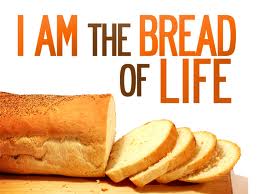
The bread of God

"I am the bread of life"
TODAY'S SPECIAL: John 6:22-35

TO CHEW ON:
" ' For the bread of God is He who comes down from heaven and gives life to the world.' … and Jesus said to them, 'I am the bread of life. He who comes to Me shall never hunger, and he who believes in Me shall never thirst.' " John 6:33,35

The crowd is determined to not let this wonder-working rabbi get away—this man who can turn a meager five loaves and two fish into a meal for five thousand. The following morning when His boat is empty, they hunt him down eventually finding Him across the lake near Capernaum.

A discussion follows about how God sent daily manna to their forefathers, and how can they do the work of God? Jesus answers that they do the work of God by believing in Him.

When they further press Him to name a work He will do to impress them even more, He makes the startling claim: " 'I am the bread of life. He who comes to Me shall never hunger, and he who believes in Me shall never thirst' " - John 6:35. He is pretty much saying, I am that miracle, that greater work. Come to Me, believe in Me and you'll experience something that's even better than wilderness manna.

How was Jesus the bread of life for them? How is He this for us? He explains it in the rest of John 6:
  • He is the source and means of our eternal life, accomplished through His death:
" ' And this is the will of Him who sent Me, that everyone who sees the Son and believes in Him may have everlasting life' " - John 6:33.

and

" 'I am the living bread which came down from heaven. If anyone eats of this bread, he will live forever, and the bread that I shall give is My flesh which I shall give for the world' " - John 6:51.
  • This is a spiritual eating and drinking, enabled and available by the Holy Spirit even after Jesus returns bodily to heaven:
" ' What then if you should see the son of Man ascend where He was before?
It is the Spirit who gives life; the flesh profits nothing. The words I speak to you are spirit and they are life'
" - John 6:62-63.


How do we eat this bead in our daily lives? A sidebar article in my Bible states:

"Feed on Jesus the Bread of Life. Do this practically through regularly celebrating communion and reading the Word of God" - Leslyn Musch, Truth-In-Action-Through John - New Spirit-Filled Life Bible, p. 1483 (emphasis added).

As we do these things—regularly read the Bible and remember Jesus' death as we eat the bread and drink the wine of the Lord's Supper—we will discover that like the physical manna, this spiritual food:

- Is there for us as we make room in our lives to gather it.

- Still needs to be gathered regularly. Just like we don't do well if we eat irregularly, so we don't flourish spiritually with hit-and-miss feedings.


PRAYER:
Dear Jesus, please sharpen my appetite for You, the bread of God. Amen.

 *********
Unless otherwise noted all Scripture quotations are taken from the New King James Version®. Copyright © 1982 by Thomas Nelson, Inc. Used by permission. All rights reserved.


Monday, July 27, 2015

Testing, testing...

TODAY'S SPECIAL: Exodus 16:1-16

TO CHEW ON: "Then the Lord said to Moses, 'Behold, I will rain bread from heaven for you. And the people shall go out and gather a certain quota every day that I may test them whether they will walk in my law or not.'" Exodus 16:4

In today's reading we see that the very mundane instructions for the gathering and handling of manna were were not options or suggestions but a God-designed test. What God was testing here was whether the people took Him and His instructions seriously.

[Test - nasah  means to put to the test, prove, tempt. The basic idea is to put someone to the test to see how he will respond - Dick Mills, "Word Wealth" New Spirit-Filled Life Bible, p. 747.]


Other places this word us used shows various ways God may test us.

"Nasah" is the word used of what God did to Abraham when He asked Him to sacrifice Isaac - Genesis 22:1.

God sent a nasah-test in the form of the ten commandments followed by fearful trumpet sounds and an electrical storm. This was to impress the people with how seriously they should take these commands and Moses' instructions about staying off Mount Sinai - Exodus 20:18-20.

Nasah is also the word used to describe what Moses accused the Israelites of doing to God at Rephidim when they demanded water as a proof of His presence - Exodus 17:1-7. Later, in his final instructions, Moses told them testing God was something they should not do - Deuteronomy 6:16.

Again in his Deuteronomy sermon, Moses reiterated how the desert wanderings were a test: "And you shall remember that the Lord your God led you all the way these forty years in the wilderness, to humble you and test you, to know what was in your heart, whether you would keep His commandments or not" - Deuteronomy 8:2 (emphasis added).

Which brings me to the question, what things in our lives may be God's tests?

It could be an Abraham-sized test like an accident or tragedy happening to a loved one or to us as a test of whether our faith is in God or someone or something else. Or perhaps it's a little manna-sized test—an item on the grocery cart missed by the checkout lady to test honesty; a string of rainy days to test contentment; someone cutting us off in traffic to test love ("...love suffers long ... does not behave rudely ... is not provoked" - 1 Corinthians 13:4,5).

Rich Warren defines life: "The Bible offers three metaphors that teach us God's view of life: Life is a test, life is a trust, and life is a temporary assignment."

Of the test part he says:
"Character is both developed and revealed by tests, and all of life is a test. You are always being tested. God constantly watches your response to people, problems, success, conflict, illness, disappointment, and even the weather! He even watches the simplest actions such as when you open a door for others, when you pick up a piece of trash, or when you're polite toward a clerk or waitress" - Rick Warren - The Purpose Drive Life, p. 42, 43.   

PRAYER: Dear God, it sure changes the complexion of life when I view the details of my day as tests. Help me to pass today's tests. Amen.

MORE: More about life's tests
"When you understand that life is a test, you realize that nothing is insignificant in your life. Even the smallest incident has significance for your character development. Every day is an important day, and every second is a growth opportunity to deepen your character, to demonstrate love, or to depend on God. Some tests seem overwhelming, while others you don't even notice. But all of them have eternal implications" - Rick Warren, Op. cit., p. 43.

*********
Unless otherwise noted all Scripture quotations are taken from the New King James Version®. Copyright © 1982 by Thomas Nelson, Inc. Used by permission. All rights reserved.


Bible Drive-Thru


Sunday, July 26, 2015

Jesus' descent

Golgotha - from The Children's Friend - Part 5

TODAY'S SPECIAL: Ephesians 4:1-16

TO CHEW ON: "He who descended is also the One who ascended far above all heavens, that He might fill all things." Ephesians 4:10

Where was Jesus in the hours between His death and resurrection?

Paul suggests one possibility here as he explains a quote from Psalm 68:28, applying it to the ascended Christ:  "Now this, 'He ascended'—what does it mean but that He also first descended into the lower parts of the earth? ..."(verse 9).

What that descent meant has been a source of discussion. Peter, preaching in Acts 2 from the text of Psalm 16:8-11 says:
"…he (David, the writer of the psalm) foreseeing this (the resurrection) spoke concerning the resurrection of the Christ, that His soul was not left in Hades, nor did His flesh see corruption" (Acts 2:31). 
Isn't Peter implying that Christ visited Hades? Was that what we call hell? It was some aspect of the underworld in any case.  Peter refers to this again in 1 Peter 3:19-20.

Another view is that Jesus' descent refers to His coming to earth from heaven. Paul describes the extent of that lowering beautifully in Philippians 2:5-11:
"… Christ Jesus, who being in the form of God, did not consider it robbery to be equal with God but made Himself of no reputation, taking the form of a bondservant, and coming in the likeness of men.  And being found in appearance as a man, He humbled Himself and became obedient to the point of death, even the death of the cross..." - Philippians 2:5-8.

Still another view is that Jesus suffered in hell. Of that view the writer of my Bible's notes on Ephesians says, "… there is no biblical support for the notion that Jesus suffered in hell, only that He descended to hell to release the righteous dead into eternal glory, proclaiming the adequacy of the Atonement and validating the testimony of the prophets" - Jack W. Hayford, notes on Ephesians,  New Spirit-Filled Life Bible, p. 1650.

Surely He was enjoying Paradise, for at least part of the time. After all, He said to the believing thief on the cross, "Today you will be with Me in Paradise" - Luke 23:43.

Whatever, wherever, it was enough! No part of earth or hell has been unaffected by His death and resurrection. As Paul says it in our focus verse:
"He who descended is the [very] same as He who also has ascended high above all the heavens, that He [His presence] might fill all things—the whole universe, from the lowest to the highest" - Ephesians 3:10 (Amplified Bible).

PRAYER: Dear God, thank You for Jesus and Your plan for my atonement, which was enough. Amen.

MORE: It Is Finished - Gaither Vocal Band

***********


The Holy Bible, New King James Version Copyright © 1982 by Thomas Nelson, Inc. - Used with permission.

Amplified Bible (AMP) Copyright © 1954, 1958, 1962, 1964, 1965, 1987 by The Lockman Foundation - Used with permission.

Bible Drive-Thru


Saturday, July 25, 2015

Rulers serve

spaghetti served with tongs
TODAY'S SPECIAL: Mark 10:35-45

TO CHEW ON: "… whoever desires to become great among you shall be your servant. And whoever of you desires to be first shall be slave of all." Mark 10:43,44

James and John's idea of ruling was to sit in a high place next to Jesus and share the glory of His position.

Jesus looked at the job of a ruler quite differently. To Him it was drinking the cup—of betrayal, mocking, beating, nailing—and experiencing the baptism of death to resurrection. Being a ruler or leader was all summed up in the word 'servant.'

[What is a servant? My dictionary defines it as "A person hired to assist in domestic matters, sometimes living within the employer's house." The Greek word used here is diakonos  that means servant, servant of a king, waiter, deacon. Other places it occurs it is translated deacon, servant, minister.]

What do servants do?
  • A household servant does all kinds of jobs from washing toilets to driving the boss to the embassy.
  • If a servant lives in-house, he is accessible at all hours. He may have his defined workday but if there's an emergency, the master will get him up.
  • A good servant works with the right attitude: willing, eager, enthusiastic, always doing the job to the best of his or her ability, not only when the master is watching.
Keri Wyatt Kent in her book about New Testament words says in her "Serve/Service" entry:
"For the Christian, service is not an occasional activity, somehow separate from the rest of our lives. As Bob Dylan famously sang, 'You gotta serve somebody.' Whether we're aware of it or not, each of us has decided to orient our life around someone or something. That decision colors all our other choices" - Keri Wyatt Kent, Deeper Into the Word - New Testament, p. 188 (emphasis added).

We do well to ask, who am I serving—Jesus or someone else? Maybe it's myself. If we settle in our hearts that we're serving Jesus, we might ask, what sort of servant am I?
  • Am I available for any job—high or low?
  • Am I always available?
  • Do I serve with the right attitude?

PRAYER: Dear Jesus, thank You for Your example of extreme servanthood. I want to be Your good servant. Help me to grow in this. Amen.

MORE: Bob Dylan singing "Gotta Serve Somebody"

Lyrics to "Gotta Serve Somebody"

***********

The Holy Bible, New King James Version Copyright © 1982 by Thomas Nelson, Inc. - Used with permission.

Bible Drive-Thru


Related Posts Plugin for WordPress, Blogger...