Saturday, April 18, 2015

Table presence

TODAY'S SPECIAL: Luke 24:28-49

TO CHEW ON: "And they told about the things that had happened on the road, and how He was known to them in the breaking of bread." Luke 24:35


"Come Lord Jesus, be our guest
May this food to us be blessed.  Amen."

This childhood grace came true in the flesh for two disciples. Unbeknownst to them, Jesus was their traveling companion on the road to Emmaus. At the end of the seven-mile walk, they invited this interesting stranger to stay with them.

It was in the breaking of bread that they recognized Him. What was it that twigged—the lift of His eyes when he gave thanks? The way He tore the bread and dipped it into the sauce? The way He chewed? The fact that these disciples recognized Him during their meal tells us they had shared meals with Him before.

Henri Nouwen talks about the meaning of this incident:

"The table is the place of intimacy. Around the table we discover each other. It's the place where we pray. It's the place where we ask: 'How was your day?' ...


'The table, too, is the place where distance is most painfully felt. It is the place where the children feel the tension between the parents, where brothers and sisters express their anger and jealousies...


'Around the table, we know whether there is friendship and community or hatred and division. ...it is also the place where the absence of that intimacy is most painfully revealed" - Henri Nouwen, With Burning Hearts, pp. 74,75 (paragraphing added to ease online reading).

Mr. Nouwen's musings bring me to the question, is the table in my home a place of blessing or pain? Do I truly expect Jesus to be my guest? Is He present with me, with us, in this most ordinary, mundane, and needful activity of life?

PRAYER: Dear Jesus, thank You for sharing with us Your life on earth in these ordinary ways (and inspiring Matthew, Mark, Luke and John to record them). Please be with me in my sitting and walking, at the table and doing the dishes, when I work at my computer or read my book. Please join me in all my activities of daily living. Amen.

MORE: Nouwen again...

"Jesus accepts the invitation to come into the home of his traveling companions, and he sits down at table with them. ...Then something new happens. Something scarcely noticeable to an untrained eye. Jesus is the guest of his disciples, but as soon as he enters into their home, he becomes their host! And as their host, he invites them to enter into full communion with him" - Henri Nouwen, With Burning Hearts, p. 77.
**********
Unless otherwise noted all Scripture quotations are taken from the New King James Version®. Copyright © 1982 by Thomas Nelson, Inc. Used by permission. All rights reserved.

Bible Drive-Thru


Friday, April 17, 2015

Deal with anger

TODAY'S SPECIAL: Psalm 4:1-8

TO CHEW ON: "Be angry, and do not sin.
Meditate within your heart on your bed, and be still." Psalm 4:4


What makes you angry? People who cut you off in traffic? People who make you wait? Rudeness? Young people? Old people? People who have different beliefs from yours in religion, in social customs, in politics?

There are probably, in each of our lives, dozens of flash points every day—places where we get rubbed against the grain and could easily erupt into anger.

Psalm 4:4 gives us one way to deal with anger [the word used here is ragas which means to tremble, quake, quiver, be agitated, perturbed, disquieted]. It is to meditate [amar: to say, speak, utter, think, command, promise] and be still [damam: be silent, still, struck dumb].

The picture is of someone who is still shaking mad at bedtime. Perhaps it's the psalmist himself. He does seem to be talking to himself here. Instead of lashing out—what he probably feels like doing—he answers his anger, thinks twice, and reasons himself into silence and stillness.

Here are some more places Bible writers speak of dealing with anger. Let's notice the actions words:

"Cease from anger and forsake wrath; Do not fret—it only causes harm" - Psalm 37:8.

"He who is slow to anger is better than the mighty
And he who rules his spirit than he who takes a city" - Proverbs 16:32.

"But now you yourselves are to put off all these: anger, wrath…" Colossians 3:8.

"But then, my beloved brethren, let every man be swift to hear, slow to speak, slow to wrath" - James 1:19.

Do you see the common thread that runs through all these verses? There's a sense that this is something over which we have control. We can rein ourselves in. We don't have to let anger run away with us and take us to that hot speech, door banging, pot throwing place. Why? As David reminds us, anger only causes harm and God has us and our situation in hand: "…put your trust in the Lord. … For You alone, O LORD make me dwell in safety" - Psalm 4:5,8.

PRAYER: Dear God, please heighten my awareness of things that anger me. Help me to rule my spirit with Your Spirit. Amen.

 *********
Unless otherwise noted all Scripture quotations are taken from the New King James Version®. Copyright © 1982 by Thomas Nelson, Inc. Used by permission. All rights reserved.


Thursday, April 16, 2015

Is sin just an opinion?

Truth spelled in Scrabble letters
TODAY'S SPECIAL: 1 John 3:1-10

TO CHEW ON: "Whoever commits sin also commits lawlessness, and sin is lawlessness." 1 John 3:4

More and more our society is losing its connection to moral absolutes. Justin P. McBrayer (a Colorado professor of philosophy) writes recently in the Opinionator column of the New York Times: "What would you say if you found out that our public schools were teaching children it is not true to say that it's wrong to kill people for fun or cheat on tests? Would you be surprised?"

He goes on to describe his visit to his son's Grade 2 classroom where two definitions hung over the bulletin board:

"Fact: Something that is true about a subject and can be tested or proven.
Opinion: What someone thinks, feels or believes."

These two definitions, he points out, leave no room for things that are true even if no once can prove them and things that we believe which can also be proven, like historical facts. He found assignments where kids were asked to categorize statements as facts or opinions. When sorting statements such as  "Copying homework assignments is wrong" and "Cursing in school is inappropriate behaviour" the correct answer was that they were opinions. His conclusion:

"In summary, our public schools teach students that all claims are either facts or opinions and that all value and moral claims fall into the latter camp. The punchline: there are no moral facts. And if there are no moral facts, then there are no moral truths" - reported by Dr. Albert Mohler in "The Briefing 03-20-15," original article"Why Our Children Don't Think There Are Moral Facts").

This, of course, is a far cry from what the Bible teaches. Today's reading from 1 John 3 repeats the word "sin" in various forms ten times. Sin, by its very definition, assumes that moral facts (truths) exist:

[Sin - hamartia: to miss the mark; to err, be mistaken; to wander from the law of Gd; violate God's law.]

What is sin, according to the Bible?
  • The verse we're focusing on defines sin as lawlessness or rebellion against God's law - 1 John 3:4.
  • Unrestrained talk and foolishness are both called sin - Proverbs 10:19; 24:9.
  • Contempt for others is sin - Proverbs 14:21.
  • Whatever is not done from faith is sin - Romans 14:23.
  • Failing to do something good when we have the ability/opportunity to do it is sin - James 4:17.
  • All unrighteousness is sin - 1 John 5:17.

Though governing our lives by these standards may put us increasingly out of step with a world that insists God's standards are mere opinions, I'd rather find myself in the company that John describes at the beginning of the chapter: "called children of God," "like Him," full of the "hope" of seeing Him. As a result I need to line up my life with His standards of purity (1 John 3:1-3) no matter what others think of them.

PRAYER: Dear God, help me grow in my sensitivity and abhorrence to the things You consider sin and to live for the day I see You. Amen.

 *********
Unless otherwise noted all Scripture quotations are taken from the New King James Version®. Copyright © 1982 by Thomas Nelson, Inc. Used by permission. All rights reserved.


Wednesday, April 15, 2015

Guards against deception

Reading a letter - Treasures of the Bible (Early Church)

TODAY'S SPECIAL: 1 John 2:18-29

TO CHEW ON: "These things I have written to you concerning those who try to deceive you." 1 John 2:26

Though no author name is given, scholars believe the book of 1 John was written John, Jesus' disciple. It was written to the churches around Ephesus where he spent his latter years. One of his main concerns in this letter was to warn about false teachers and error. The specific error that threatened the church at this time was Gnosticism.

Gnosticism was the belief that spirit was good and matter was evil. A corollary of this belief was that a true god would never appear in a body made of evil matter. As a result believers in Gnosticism denied Jesus' incarnation insisting that His body was only apparent. And if He had no real body, the resurrection was also meaningless.

As we read 1 John with that in mind, we can see how from the very beginning, John tries to counteract these false teachings. Referring to Jesus, he begins:
"That which was from the beginning, which we have heard, which we have seen with our eyes, which we have looked upon, and our hands have handled concerning the Word of Life" - 1 John 1:1 (emphasis added).

In other words, I was with Jesus and He was indeed real!

In our reading today John names two things these early Christians can do to keep from being deceived by heretical teaches:

1. Listen to the teachings of Jesus genuine apostles - 1 John 2:24.
These were people like Jesus' twelve disciples who had been taught directly by Jesus, had seen His miracles, and had heard Him refute the teachings of the scribes and Pharisees. They were the ones who were present at Pentecost when the Holy Spirit fell on each one, imparting boldness and insight. John confidently says to those he and the other apostles have taught: "Therefore let that abide in you which you heard from the beginning" - 1 John 2:24.

2. Open themselves to the anointed teaching and understanding imparted by the Holy Spirit - 1 John 2:27.*

How / When / Why does the Holy Spirit teach us?
  •  His teaching is part of our daily provision. Nehemiah, when explaining Israel's history to Jerusalem's returned exiles juxtaposes the instruction of the Spirit with God supplying daily manna and water - Nehemiah 9:20.
  •  The Spirit will teach us what to say when we're in trouble for our faith in Jesus - Mark 13:11; Luke 12:12.
  •  He will teach and bring to mind "all things" about Jesus - John 14:26.
  •  He will help us as we study the Bible "... comparing spiritual things with spiritual" - 1 Corinthians 2:13,  or as the Amplified translates it: "... combining and interpreting spiritual truth with spiritual language..." 1 Corinthians 2:13 AMP.  In this area, I believe, the Holy Spirit teaches us to spot false doctrines and religious teaching that contradicts the Bible, i.e. avoid deception. 
  •  The Holy Spirit's teaching is heard by those whose ears are tuned to hear Him - Revelation 2:7.

I believe John's two guards against deception—becoming familiar with the teaching of the apostles as it is recorded in God's word and opening ourselves to being taught by the Holy Spirit—are still relevant to us today.

In the God's word department, think about the advantages we have over these early Christians. They had only parts of the apostles' eye witness accounts through personal contact and writing. We have the entire New Testament (in many versions and translations).

In the area of being taught by the Holy Spirit, let's get into the habit of listening for that still small voice that brings daily encouragement (like manna and water), that helps us remember Bible verses and songs, that gives us words to speak in discussions about our faith, that helps us see the connections in God's story, and that alerts us to teaching that is false.

PRAYER: Dear Holy Spirit thank You for the Bible and the Your teaching. Help me to consistently tune my ears to Your voice. Amen.

*About John's statement "… you do not need that anyone teach you…" the writer of my Bible's study notes explains:
"To receive spiritual knowledge under the guidance of the Holy Spirit is to know truth in a way that human instruction cannot provide. The text is not an argument against the ministry of teaching (Romans 12;7; Ephesians 4:1) but an emphasis that only the Holy Spirit is able to bring revelation to the human heart (Ephesians 1:17,18)" Peter E. Prosser, New Spirit-Filled Life Bible" p. 1786.


 *********
Unless otherwise noted all Scripture quotations are taken from the New King James Version®. Copyright © 1982 by Thomas Nelson, Inc. Used by permission. All rights reserved.

Scripture quotations marked AMP are taken from the Amplified® Bible,
Copyright © 1954, 1958, 1962, 1964, 1965, 1987 by The Lockman Foundation
Used by permission." (www.Lockman.org)


Tuesday, April 14, 2015

Growth stages

TODAY'S SPECIAL: 1 John 2:3-17

TO CHEW ON: "I write to you fathers because you have known Him who is from the beginning. I write to you young men because you have overcome the wicked one. I write to you children because you have known the Father." 1 John 2:13

In the middle of some heavy teaching about how important it is to love each other and how when you hate someone you're living in darkness, John interjects this little section that seems to say, "And guess what folks. This is for all of you!"

The parenthesis section of verses 12-14 give us some great little insights into the different stages of the Christian life.

Little children:
Pick up the excitement of the new believer in John's word.
  • It's excitement over sins forgiven: "I write to you little children because your sins are forgiven."
  • It's excitement about a new relationship: "I write to you little children because you have known the Father."
When, in another place, John scolds a church for having left their "first love," I think we can rightly assume he's talking about this stage. It's the stage of having a crush on God/Jesus—only it's much more profound and lasting than human infatuation.

Young men/women:
A sidebar article in my Bible describes this stage:
"But as we feed on the milk of the Word (1 Peter 2:2) we see that there is more to salvation than the forgiveness of sins. We grow beyond our infancy into young adult lives of challenge and victory as people who live daily by faith (2 Corinthians 5:7)" - Kenneth Ulmer,  in "Growth In Stages," New Spirit-Filled Life Bible, p. 1785.


Father/mothers:
This is the stage of the long-term settled relationship. These folks are so tight with God, have been through so much with Him that John says, simply, they know Him.

Know (ginosko) means:
1] To learn to know.
2] to know, understand, perceive, have knowledge of.
3] Jewish idiom for sexual intercourse.

In other words, it's knowing that encompasses all stages from introduction to the deepest intimacy. The relationship only gets richer, more secure, more satisfying!

I ask, which one of these stages am I in? (Though I'm thinking, there is a little bit of each stage in my relationship with God.) What about you?

Another good question to ask is, are we making progress to new levels of growth?

PRAYER: Dear Father God, thank You for our relationship that lasts a lifetime. Help me, even today, to grow stronger and bigger and more mature in You. Amen.

*********
Unless otherwise noted all Scripture quotations are taken from the New King James Version®. Copyright © 1982 by Thomas Nelson, Inc. Used by permission. All rights reserved.


Bible Drive-Thru


Monday, April 13, 2015

A bold prayer

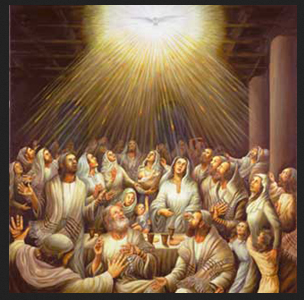
The Holy Spirit and the Early Church - Artist unknown
TODAY'S SPECIAL: Acts 4:23-37

TO CHEW ON: "And when they had prayed, the place where they were assembled together was shaken; and they were all filled with the Holy Spirit, and they spoke the word of God with boldness." Acts 4:31

The early church had just suffered its first setback. After healing the lame man at the temple gate, Peter had preached Jesus to the receptive crowd and many had believed in Him. This greatly bothered the Jewish rulers, who thought that with the crucifixion, they would be done with this Jesus troublemaker.

The Sadducees, priests and temple captain arrested Peter and John, kept them in jail overnight and the next day brought them before the Sanhedrin. There the rulers, elders, and scribes, along with the High Priest, grilled Peter and John, commanded them to stop teaching in Jesus' name or else, and let them go.

They returned to their friends and reported what happened. However, the reaction of the early church is probably not what we would expect. Let's listen to their voices raised in prayer to learn how a Spirit-filled church prays in the face of opposition:

1. They begin with praise—focusing on God's greatness - Acts 4:24.

2. They remind themselves, and God, of His word and promises by quoting scripture - Acts 4:25,26.

3. They speak their agreement with God's will and His sovereign purposes: "… to do whatever Your hand and Your purpose determined before to be done" - Acts 4:27-28.

4. They request, not that the persecution will stop or that the persecutors will be silenced (like I would) but that they will face these threats with boldness.

5. They pray for more healings, signs, and wonders to prove Jesus' power and reality.

The result of their prayer: "… the place where they were assembled was shaken  (literally, I wonder, in an earthquake-type event?) and they were all filled with the Holy Spirit, and they spoke the word of God with boldness."

[Boldness - parrhesia  "Outspokenness, unusual utterance, freedom of speech, with frankness, candour, cheerful courage, and the opposite of cowardice, timidity or fear. Here it denotes a divine enablement that comes to ordinary and unprofessional people exhibiting spiritual power and authority … Parrhesia is not a human quality but a result of being filled with the Holy Spirit" - Dick Mills, Word Wealth, New Spirit-Filled Life Bible, p. 1497.]

PRAYER: Dear Lord, I need this boldness not only when I face opposition, but for everyday life. Please fill me with Your Spirit in this way. Amen.

 *********
Unless otherwise noted all Scripture quotations are taken from the New King James Version®. Copyright © 1982 by Thomas Nelson, Inc. Used by permission. All rights reserved.


Sunday, April 12, 2015

Holy Boldness

TODAY'S SPECIAL: Acts 4:1-22

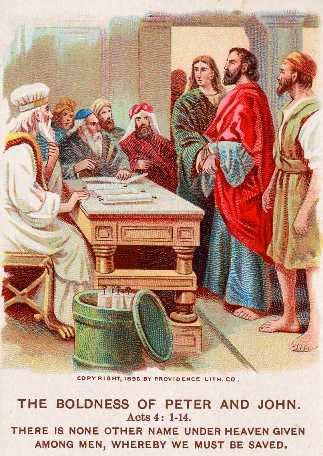
The Boldness of Peter and John - Artist unknown
TO CHEW ON: "Now when they saw the boldness of Peter and John, and perceived that they were uneducated and untrained men, they marveled. And they realized they had been with Jesus." - Acts 4:13

What a contrast these men are to the picture of the disciples huddled behind closed doors "… for fear of the Jews" that John describes from a few weeks earlier (John 20:19). Their boldness is evident all over the place in our reading:
  • They teach this new thing—that in Jesus there is resurrection from the dead—without qualification or apology - Acts 4:2.
  • When arrested Peter answers boldly, "filled with the Holy Spirit" - Acts 4:8.
  • The rulers put the pieces together: the disciples' uncharacteristic boldness + their uneducated state = amazing. But then an "aha" moment. Doesn't this remind them of someone? "They realized they had been with Jesus"—whose teaching was also characterized by boldness (Matthew 7:29).  
  • Even the rulers' threats and ultimatums have no effect - Acts 4:19,20.

A brief look at others who show holy boldness in the Bible helps us learn more about such God-given confidence:
  • It comes as a result of following convictions and leaving the fallout in God's hands, as Shadrach, Meshech and Abednego discover - Daniel 3:16.
  • It comes to Joseph of Arimathea when the situation is desperate and unless someone steps up, this friend and teacher will have no respectful burial at all - Mark 15:43.
  • The Day of Pentecost and the coming of the Holy Spirit on all believers is a watershed moment in the story of holy boldness - Acts 2:1-42.
  • The disciples get a new dose as a result of prayer - Acts 4:31.
  • It makes new believer Paul careless about his very life and well-being - Acts 9:29.
  • Later, in Ephesus,  it causes him to minister boldly, persuasively and persistently. When opposition to his meetings arises, he doesn't quit but moves them from the synagogue to a lecture hall and continues to preach his controversial message for two more years - Acts 19:8-10.
  • When he is in Rome, he keeps witnessing about and explaining the gospel despite his  chains (Acts 28:20,31).
  • Paul says that one of the wellsprings of his boldness is the realization that the message of the gospel isn't his project and spreading it isn't from his own initiative but it is a message that God Himself has entrusted to him - 2 Thessalonians 2:2-4.

Are you happy with your boldness quotient? I know I'm not happy with mine. These Bible examples of holy boldness give us much to consider and pray about as we go before God to seek His insights on why there is so much timidity in our lives.

PRAYER: Dear God, I know I need more holy boldness. Please help me understand the roots of my timidity and deal with them. Amen.

 *********
Unless otherwise noted all Scripture quotations are taken from the New King James Version®. Copyright © 1982 by Thomas Nelson, Inc. Used by permission. All rights reserved.


Saturday, April 11, 2015

Believe

Doubting Thomas - Artist unknown
TODAY’S SPECIAL: John 20:19-31

TO CHEW ON: “Then He said to Thomas, ‘Reach your finger here and look at My hands; and reach your hand here, and put it into My side. Do not be unbelieving but believing.’” John 20:27


Skeptics - we all have them in our lives. These are people whose response to our incredible good news is a sarcastic, “Yeah, right.” People whose questioning attitude leads us more gullible types to parts of the issue we hadn’t thought of or cared to face: “Are you sure they’re legit? So how much time is this going to take? And they’re going to pay you what?”

I can just see Thomas after hearing the account of the Emmaus disciples, his voice high with incredulity, “And you believed it was Jesus just because of the way He looked when He prayed?” Here he responds to the report of a Jesus sighting with “Unless I see the nail prints in His hands, the hole in His side and touch them, I will not believe.”

Belief is an interesting thing, in that built into its very definition is faith.
1. To accept something as true or real.
2. To credit with veracity.
3. To accept the truth, existence, worth etc. of something.
4. To have confidence or place one’s trust in something.

Thomas wanted a very tiny leap of faith. He wanted very little space between what his senses assured him was true and his belief system. Jesus complied and appeared to the disciples when Thomas was there. He invited Thomas to assure himself of His identity with his own eyes and hands. In His invitation, Jesus also chided him, 'Do not be unbelieving, but believing.'It’s as if He was saying, “Even with this proof you will need some measure of faith. It is your choice to believe.”

All of us, whether people of religious faith or not base our lives on beliefs. All of us have to some extent insisted on a measure of touching and seeing before we accept something as true. If we have chosen to believe the God of the Bible, whether we’ve seen Him at work close range or second-hand, the challenge to us remains'Do not be unbelieving, but believing.' It’s a matter of informed and deliberate choice. In what or whom have you chosen to believe?

PRAYER: Dear Jesus, I believe in You – in Your word, the Bible, in Your death and resurrection for me, and the hope of a future with You. Amen.

MORE: Charles Price in his television program “Living Truth” gave a 45-minute lecture on Thomas and doubt based on this very incident. The You-Tube below is a teaser for that talk. Below that are instructions on how to get the entire talk as a transcript.

Struggling With Doubt That Leads To Life In Jesus Christ - Charles Price Truth Bytes


Download a transcript of Charles' Price's entire message on doubting Thomas HERE (pdf file).

The Living Truth website also offers the possibility of selecting weekly telecasts to watch online HERE.


Do your 8-12-year-olds have daily devotions? Point them to Bible Drive-Thru.

Friday, April 10, 2015

Recognizing Jesus

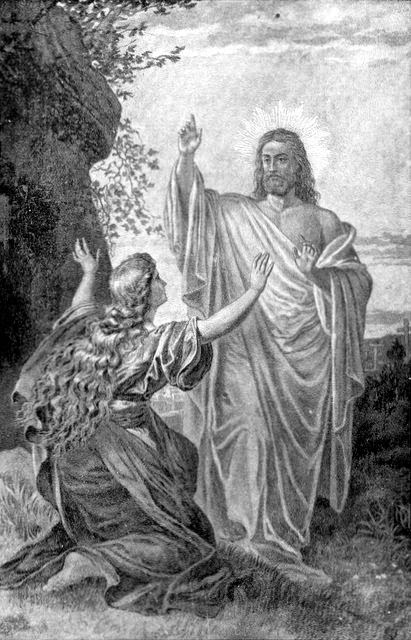
Mary Magdalene Sees Jesus Risen
- Artist unknown
From Treasures of the Bible

Mary Magdalene Sees Jesus Risen - Artist unknown
TODAY'S SPECIAL: John 20:1-18

TO CHEW ON: "Now when she had said this she turned around and saw Jesus standing there, and did not know it was Jesus." John 20:14

I have always been puzzled by Mary's failure to recognize Jesus. Didn't she know Him well? Hadn't she observed Him at close quarters as one of the women who served His itinerant ministry? Why this failure to recognize him?

The IVP New Testament Commentary says of her uncomprehending reaction:

"Such can be the blinding effect of profound emotions. In this case, her inability to recognize him also seems to be due to the character of Jesus' resurrection body, since such failure is typical of encounters with him (cf. Matthew 28:17; Mark 16:12; Luke 24:16, 37; John 21:4)" - IVP Commentary of the New Testament accessed through "Study This" on Biblegateway.com.

This is by no means the only time Jesus wasn't recognized, though. A failure to recognize who He really was in His person and work was a common reaction to Him while He was on earth.
  • Isaiah predicted this blindness - Isaiah 53:3.
  • Though the disciples were guilty of this same reaction for much of the time Jesus was with them (John 14:9), they eventually got it. Look at what John says in His gospel, written some 50 years after Jesus' death and resurrection: "He was in the world, and the world was made through Him and the world did not know Him" - John 1:10.
  • The Jewish leaders of Jesus' time who looked on Him as their rival clung tenacious to their unawareness - John 9:1-34.
  • Jesus predicted that bad things would happen to His followers because people in authority didn't and wouldn't recognize Him and His Father - John 16:1-4.

The above could and does impact Christians in the world today. So do two other things about recognizing Jesus:
  • People can see that we have seen and know Him by the bent of our lives. In his letter to early Christians, John says:
"Whoever abides in Him does not sin.* Whoever sins has neither seen Him nor known Him" - 1 John 3:6 (emphasis added).
"No one who lives in him keeps on sinning. No one who continues to sin has either seen him or known him" - 1 John 3:6 NIV.
  • Jesus may come to us even now in many ways through the needs of our fellowmen (Matthew 25:34-40). Do we recognize Him here?

PRAYER: Dear Jesus, please open my eyes to see You in the needy people all around me. Soften my heart to respond as surely as I would if it were You in person. Amen.

 ________________

* "…does not sin…"  or "no one who lives in him keeps on sinning…" does not mean that the person who is in Christ never sins. The IVP Commentary is helpful here: "What is meant, then, by the statement no one who lives in him keeps on sinning is quite simple: sin is not the identifying characteristic of those who live in him." (Emphasis added.)


 *********
Unless otherwise noted all Scripture quotations are taken from the New King James Version®. Copyright © 1982 by Thomas Nelson, Inc. Used by permission. All rights reserved.

Scripture quotations marked NIV are taken from THE HOLY BIBLE, NEW INTERNATIONAL VERSION®, NIV® Copyright © 1973, 1978, 1984, 2011 by Biblica, Inc.® Used by permission. All rights reserved worldwide.

Thursday, April 09, 2015

Propitiation

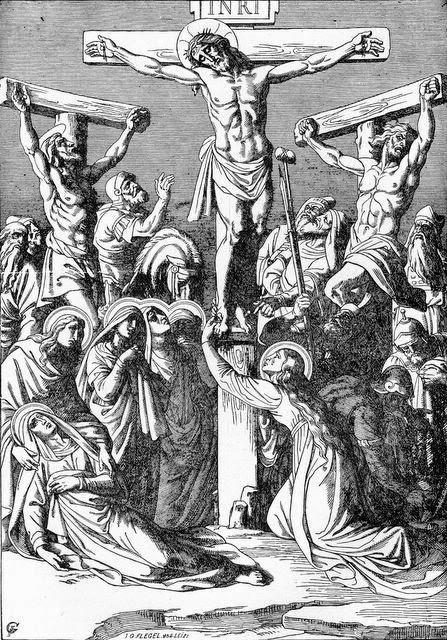
Jesus Crucified Between Two Thieves   - Artist unknown
Jesus Crucified Between Two Thieves 
- Artist unknown 
From Treasures of the Bible

TODAY'S SPECIAL: 1 John 1:1-2:2

TO CHEW ON: "And He Himself is the propitiation for our sins, and not for ours only but also for the whole world." 1 John 2:2

In our time when we love to focus on the grace, mercy, and love of God, it's easy to lose sight of one of His other attributes—His righteousness. That is the attribute of God that has Him responding with white-hot anger to sin. His perfect justice demands that sin be punished.

We see illustrations of this in the Old Testament.
  • When Achan sinned by taking beautiful things from Jericho, he was punished by stoning. Only then "… the Lord turned from the fierceness of His anger" - Joshua 7:26.
  • When Israel flirted with idol worship, God allowed other nations to brutalize her (Ezekiel 16:40,41) and "… so I will lay to rest My fury toward you, and My jealousy shall depart from you" - Ezekiel 16:42.
  • When Israel returned to God in repentance, Hosea describes God's quickness to take back the repentant one: "… For my anger has turned away from him" - Hosea 14:4.
 But these were all only stop-gap measures. God's fallen creation—all of us—can't keep from sinning. What's a perfectly merciful, perfectly righteous God to do, a God  whose perfect justice demands that the wages of sin (death - Romans 6:23) be paid?

Our focus verse today gives us the answer. This is what He did:
"...And if anyone sins, we have an Advocate with the Father, Jesus Christ the righteous. And He himself is the propitiation for our sins, and not for ours only but also for the whole world" - 1 John 4:1,2

That word propitiation is key here.

[This particular word for propitiation (hilasmos) is used only twice in the Bible, here and in 1 John 4:10. it  "describes Christ through His sacrificial death as appeasing the wrath of God on account of sin. It also pictures His death as expiatory, providing a covering for sin. By means of the atoning death of Christ, God can be merciful to the sinner who believes in Him and reconciliation is effected" - Dick Mills, Word Wealth, New Spirit-Filled Life Bible, p. 1788.]

Here's another shorter definition of propitiation: "A sacrifice that bears God's wrath to the end and in so doing changes God's wrath toward us into favour" - Wayne Grudem, Systematic Theology, p. 575.

Isn't that incredible! God sent His own Son—Jesus—to take His white-hot anger against our sin. He (Jesus) paid the penalty—death—in our stead.  The words of John in 1 John 4:10 express perfectly how this act keeps God in sync with His love and mercy—those attributes of His we prefer to dwell on:

"In this is love, not that we loved God, but that He loved us and sent His Son to be the propitiation for our sin."

PRAYER: Thank You, Jesus, for bearing the fury of God's righteous wrath over my sin, in my stead. Amen.

 *********
Unless otherwise noted all Scripture quotations are taken from the New King James Version®. Copyright © 1982 by Thomas Nelson, Inc. Used by permission. All rights reserved.


Wednesday, April 08, 2015

Peter's spiritual download

Apostles Baptized with the 
Holy Spirit - Artist unknown
 from Treasures 
of the Bible (Church Age)

Aposltes Baptized with the Holy Spirit - Artist unknown
TODAY'S SPECIAL: Acts 8:34-48

TO CHEW ON: " ' To Him all the prophets witness that through His name whoever believes in Him will receive remission of sins.' " Acts 10:43


For the multitudes of Jesus' followers and even His disciples, the road to understanding who He really was, was long and bumpy. He acted like the political deliverer they were expecting—healed people, fed people, was full of wonderful wisdom. But  He was from Galilee. They knew His mother (knowledge which included His questionable beginnings) and His family.  He was so human. How could He be Messiah?

Then He began doing disturbing things like claiming He was the fulfillment of prophecy (Luke 4:16-19; Isaiah 61:1,2) and supplementing His healings by telling people their sins were forgiven (Mark 2:5,9,10; Luke 7:48; John 8:11).

We can see that for Peter now, explaining this to Cornelius and his family, things finally all fit together. The confusion over who he was following, the thinking that Jesus was a political messiah had been replaced by the conviction that Jesus was the spiritual Messiah the prophets had predicted. The One who:
- would bear our sins - Isaiah 53:4
- would make a blood atonement - Isaiah 53:5
- would be our substitute - Isaiah 53:6,8
- would accept our guilt and punishment - Isaiah 53:7
- would justify many from their sins - Isaiah 53:10,11

How did he get from the confused state the disciples appeared to still be in at the time of Jesus' ascension (Acts 1:6), to this bedrock assurance? Was it years of study? A semester at seminary? Weeks of retreat and seclusion?

No. I would submit it all came clear on the day the Spirit fell in the disciples in the Jerusalem upper room—the Day of Pentecost.

The stories of the disciples' actions and preaching from that day forward have an entirely different tone about them than the ones that precede that day. From Pentecost on there is a clarity, boldness, passion, and fearlessness they never had before. I believe the Holy Spirit came with a supernatural download of insight. He put it all together.

I believe we need the same thing. Unless we have the Holy Spirit's enlightenment, what we know of Jesus—both intellectually and in experience—will  have that same tentative, questioning, fearful aura of the disciples' pre-Pentecost witness. They did have the Spirit (John 20:22) but not in the same measure as they had Him (or perhaps better said, He had them) after Pentecost.

May we invite Him to fill our lives with the same insight, clarity, and power of witness that Peter demonstrates here.

PRAYER: Dear Holy Spirit, please fill my life with Your presence and power. Give me insight and clarity about who Jesus is.

 *********
Unless otherwise noted all Scripture quotations are taken from the New King James Version®. Copyright © 1982 by Thomas Nelson, Inc. Used by permission. All rights reserved.


Sunday, April 05, 2015

Trustworthy

"Women at the Sepulchre" by Harold Copping
TODAY'S SPECIAL: Mark 16:1-8

TO CHEW ON: "'But go tell His disciples—and Peter—that He is going before you into Galilee; there you will see Him, as He said to you.'" Mark 16:7.

The angel who welcomed the women at Jesus' empty tomb had obviously been listening in on Jesus' conversations with His followers. The little phrase at the end of our focus verse "...as He said to you" was like a rebuke that reminded them 'He told you all this would happen. You could have expected it.'

Did Jesus indeed predict His resurrection while He was still alive? Yes, many times, according to the Gospel writers:

  • "From that time Jesus began to show His disciples that He must ... be raised on the third day" - Matthew 16:21.
  • "...and the third day He will rise again" - Matthew 20:19.
  • "'But after I have been raised, I will go before you to Galilee'" Matthew 26:32.
  • "He commanded that they should tell no one the things they had seen till the Son of Man had risen from the dead" - Mark 9:9.
  • "Jesus answered and said to them, 'Destroy this temple and in three days I will raise it up'" - John 2:19.

So why were they so surprised? Perhaps they forgot? Perhaps Jesus' words had been so far from fitting into their scheme of what they thought possible, they never really heard them in the first place?

Jesus' words are still trustworthy. Just as what He said about Himself rising from the dead came about, so we can be confident that the things He said that have not yet happened will happen. As in:
- He will return (Matthew 24:27-28; Acts 1:11).
- There will be a day of judgment, reckoning, and rewards (Matthew 25:14-46).
- The earth and its systems will pass away (Matthew 13:47-50; 24:35).

Have we really heard these things? Do we believe them? Does our belief affect the way we live? Or will the angels need to someday break through our shock and incredulity with "It has happened as He said to you"?

PRAYER: Dear Jesus, You arose from the dead as You said You would. Help me to hear, believe, and adjust my life to the things You have said that have not yet happened. Amen.

MORE: He is risen. He is risen indeed!

Today is the day millions celebrates the resurrection of Christ from the dead. (Liturgy for Easter Day.)

The Collect prayer that begins the liturgy:
Almighty God, who through your only-begotten Son Jesus Christ overcame death and opened to us the gate of everlasting life: Grant that we, who celebrate with joy the day of the Lord's resurrection, may be raised from the death of sin by your life-giving Spirit; through Jesus Christ our Lord, who lives and reigns with you and the Holy Spirit, one God, now and for ever. Amen.

We join with Steve Green in singing the triumphant "Christ the Lord is Risen Today".


********
Unless otherwise noted all Scripture quotations are taken from the New King James Version®. Copyright © 1982 by Thomas Nelson, Inc. Used by permission. All rights reserved.

Bible Drive-Thru


Saturday, April 04, 2015

Secret disciple

"Joseph of Arimathea" 
by James Tissot

Joseph of Arimathea by James Tissot
TODAY'S SPECIAL: Mark 15:40-47


TO CHEW ON: "Joseph of Arimathea, a prominent council member who was himself waiting for the kingdom of God, coming and taking courage, went to Pilate and asked for the body of Jesus." Mark 15:43

Joseph of Arimathea is an interesting character in the story of Jesus' passion. Our focus verse tells us five things about him.

1. "Joseph of Arimathea"
His name and address. Matthew also mentions that he was rich (Matthew 27:57) and Luke describes him as a "good and just man" (Luke 23:50).

2. He was "a prominent council member."
This is the council that Mark mentions several times in his account. After Jesus' arrest, the soldiers delivered him to the council who "sought testimony against Jesus to put him to death but found none" - Mark 14:55. It was in the council meeting that the beatings began (Mark 14:65). And it was the council that the chief priests, elders, and scribes consulted before they led Jesus to Pilate (Mark 15:1).

3. He "was himself waiting for the kingdom of God."
Matthew says more particularly "who himself had become a disciple of Jesus" (Matthew 27:57). John sheds even more light when he describes Joseph as a secret disciple "for fear of the Jews" (John 19:38).

4. "...coming and taking courage..."
Despite his wealth, prominence, and reputation, asking Pilate for Jesus' body demanded courage from Joseph. John's mention of Joseph's fear of the Jews makes us suspect he also needed courage to face them when he finally showed himself loyal to Jesus in this way. He wasn't alone, though. Nicodemus, another secret disciple, joined him in caring for Jesus' body (John 19:38-42).

5. He "asked for the body of Jesus."
He procured Jesus' body and then used his own resources to prepare and bury it in a new tomb, never used, but that he had prepared for himself (Mark 15:45-46; Matthew 27:59-60; Luke 23:53).


Some thoughts about Joseph of Arimathea and us:

1. Even the council had its disciples.  

Still today God has "spies" in the most unusual places.

2. One can only imagine the anguish Joseph went through as he listened to the council discuss Jesus' case. Should he stand up for Jesus or not? What would happen to him if he did? Then, when Jesus was crucified and died, how he must have berated himself. Maybe if he had spoken up, he could have made a difference. 

Are we ever secret disciples? Have we considered what that means in terms of regret, guilt, and final consequence (Mark 8:38; 2 Timothy 2:12)?

3. I love how Joseph finally gave the best that he had, even though it appeared to be too late. He filled a practical need by caring for Jesus with his resources.

His act makes me ask, how can I help? It may be in ways that don't appear remotely spiritual.


PRAYER: Dear Jesus, Joseph of Arimathea is a sobering character to me. Help me to be a public, not a secret disciple. Amen.

MORE: Joseph of Arimathea - a poem

John Piper has written a lengthy and imaginative poem about Joseph of Arimathea.

Here is one stanza from Part 2, where we see Joseph removing Jesus from the cross:

Then Joseph stood and raised his plain

And heavy ladder high, and placed

It on the bloody beam, and braced

It just above the Savior's pale

Gray arm. He bound with rope the frail,

Limp body of the Lord on beam

And post. And then, against a scream

From Jesus' mother, stifled in

Her hand, he slowly cut through skin

And ligament beside the spikes

With heads made flat by many strikes

From Roman mallets. Then he clenched

The knife between his teeth and wrenched

Each hand of Jesus off its rough

And jagged nail through tendons tough,

But careful not to break a bone.

- By John Piper. © Desiring God. Website: desiringGod.org

Read entire: Joseph of Arimathea - Part 1 | Joseph of Arimathea - Part 2

***********
Unless otherwise noted all Scripture quotations are taken from the New King James Version®. Copyright © 1982 by Thomas Nelson, Inc. Used by permission. All rights reserved.

Bible Drive-Thru


Friday, April 03, 2015

Why we can call this day "good"

The Crucifixion - Alexandre Bida
TODAY'S SPECIAL: Mark 15:1-41

 TO CHEW ON: "So when the centurion who stood opposite Him saw that He cried out like this and breathed His last, he said, 'Truly this Man was the Son of God.' " Mark 15:39

As we read the detailed account of the hours leading up to the cross and the hours Jesus spent on the cross, we get the sense of several things:
  • How typically human this whole drama was.
The religious leaders had manipulated things their way—finally. The crowd was as wishy-washy as crowds typically are. The soldiers gloried in their power and got themselves a few laughs even as they meted out Roman punishment.

  • How inevitable this whole drama was.
We got glimmerings of that inevitability yesterday as we heard the resignation in Jesus' voice when He prayed through (Mark 14:36). In today's reading He was silent in His own defense (Mark 15:2-5). As the scene played out, He fulfilled prophecy (as Mark points out: Mark 15:28).

  • How pivotal this event was.
Jesus' words from the cross, His quick death without the aid of numbing myrrh or wine, and the temple veil torn in two from top to bottom (no human hand could do that!) were all sources of incredulity. Even that hardened Roman soldier looking on recognized that this was no ordinary man being crucified (Mark 15:39).

These many years later we are still seeking to get our minds around how that moment changed everything. Bible writers have probed it too, both prophetically and in hindsight. Here are some of the accomplishments of Jesus' death—and resurrection three days later:

  • Jesus  bore our sin, became sin for us - Isaiah 53:12; Romans 5:6; Hebrews 2:9.
  • He laid down His life for our lives as He said He would - John 10:11.
  • In dying He made possible the crop of Christ-followers that has sprung up over successive generations, and around the world - John 12:24.
  • His death and resurrection conquers life and death - Romans 14:9.
  • He fulfilled Scriptures showing that this chain of events was no fluke but in God's plan from the beginning - Genesis 3:15; 1 Corinthians 15:3.
  • His death gives those He died for the motivation to live for Him - 2 Corinthians 5:15.
  • His death makes it possible for us to stand before God "blameless and above reproach" - Colossians 1:22.
  • His death results in His glory as the world's Redeemer - John 12:23; Revelation 5:9.

No wonder we call this "good" Friday!


PRAYER: Dear Jesus, thank You for going through with this! I know how only eternity will reveal the true weight of what You accomplished that day on Calvary. For all that I understand of it now, I thank you, thank you, thank you!

MORE: Good Friday

Today the church celebrates Good Friday. The Good Friday liturgy begins with this Collect:

Almighty God, we pray you graciously to behold this your family, for whom our Lord Jesus Christ was willing to be betrayed, and given into the hands of sinners, and to suffer death upon the cross; who now lives and reigns with you and the Holy Spirit, one God, for ever and ever. Amen.


 *********
Unless otherwise noted all Scripture quotations are taken from the New King James Version®. Copyright © 1982 by Thomas Nelson, Inc. Used by permission. All rights reserved.


Wednesday, April 01, 2015

Doing what we can

Mary & Jesus - Artist unknown
TODAY'S SPECIAL: Mark 14:1-11

TO CHEW ON: " 'She has done what she could.' " Mark 14:8

His teaching speaks like no other words I've ever heard. He brought my brother back to life. I love Him. How can I show Him how much?… I know!

These may have been some of the thoughts Mary* had before she rummaged around in some storage basket for the sealed jar of precious spikenard. When she found it she  hurried to Simon's house where Jesus was a guest at dinner, entered the room where they were eating, somehow managed to break the seal on the jar and pour that precious, perfumed oil on Jesus' head. How impulsive! How crazy!!

But to Jesus, Mary's love, poured out in her feminine language of perfume was more significant than a mere wild (and God-inspired) act. "She has done what she could" Jesus said. Her action touched Him and He imbued it with lasting and worldwide significance (Mark 14:9).

The Bible speaks of other times when people's acts were more significant than they realized:

  • The widow who gave the two mites—all she had—to the temple offering got Jesus' attention and a place in the Bible as an example to follow - Mark 12:44.

  • Andrew brought Peter to Jesus—the disciple who Jesus called a "rock" and who became one of the early church's founding apostles - John 1:42.

  • Barnabas went after Paul to disciple and work with him—another act the significance of which we see every time we open our New Testament (Acts 11:25-26).

  • Those who have given the hungry food, the thirsty a drink, the stranger a bed, and the sick and prisoners a visit will discover their simple acts were the key to inheriting the kingdom. For by doing these things for others, they were indeed done for Jesus (Matthew 25:34-36,40). Who knew!?

Let's take the hint, from these examples, that it's important to do what we can. We can't stop human trafficking, but we can tuck a check into an envelope to help fund a project that gives women a chance to earn money in honorable ways. We can't end homelessness but we can support local organizations that provide meals and shelter for the homeless and a way out of their addictions. We can't uncomplicate the lives of our family members, friends, and neighbors but we can offer to babysit, bring over a meal, drive them to appointments.

It may not seem like much, but when Jesus touches our acts of doing what we can, we  have no idea of their actual significance.

PRAYER: Dear Jesus, please open my eyes to ways I can serve You by doing what I can for those around me. Amen.

*The woman is not named in Mark's account, but is identified in John's account of the same incident - John 12:1-8.

 *********
Unless otherwise noted all Scripture quotations are taken from the New King James Version®. Copyright © 1982 by Thomas Nelson, Inc. Used by permission. All rights reserved.


Tuesday, March 31, 2015

Forgive plain and simple

TODAY'S SPECIAL: Mark 11:20-33

TO CHEW ON: "And whenever you stand praying, if you have anything against anyone, forgive him, that your Father in heaven may also forgive you your trespasses." Mark 11:25

Some time ago I heard a local talk show host speak with great indignation against the idea that the way to handle Jerry Sandusky, the former football coach and child predator, was to forgive him. I only heard a snippet of his argument so I don't know whether the call was for law enforcement to let him go free for his crimes, or for the individuals wronged by him to forgive. But the man's rant got me thinking.

What is the way, the Jesus way, to handle people who have wronged us in a deep, life-altering manner—the investment counselor who has absconded with our life savings, the father or mother who never loved us, the coach, teacher, or family member who stole innocence?

Jesus' words are unequivocal: "...if you have anything against anyone, forgive him, that your Father in heaven may also forgive you your trespasses."

Of course on a societal level, the government should enforce its laws against criminals and see that the penalty is paid. An orderly society demands that people live by standards and that law-breakers be dealt with. The Bible supports that - Ezra 7:26; Matthew 22:21; Romans 13:1; 1 Peter 2:13,14.

However, personally, according to Jesus, we need to forgive. It sounds unfair and unrealistic, another example of the upside-downess of the Kingdom of God lifestyle. Leslyn Musch says about this passage (along with Matthew 6:14,15):
"Understand that God forgives us our sins as we forgive others who have sinned against us. Adopt the forgiveness of others into your prayer life as a daily discipline" - Leslyn Musch, Truth-In-Action Through the Synoptics, New Spirit-Filled Life Bible, p. 1439.

PRAYER: Dear God, something inside me balks at giving forgiveness—until I look at what You've forgiven me. Help me to measure every act of forgiveness on my part against Your forgiveness of me. Amen.

MORE: Forgiveness in action

Josh MacDowell tells the story of his struggle to forgive several people who had wronged him in his book Undaunted. Here is his account of how he forgave the man who abused him as a child (ellipses enclosed in square brackets indicate words left out of the quote, other ellipses are in the quote):

"It didn't happen immediately; in fact, it took several months and a lot of counseling with Pastor Logan. [....]

"He lived in a drab apartment in Jackson, Michigan. I knocked on the door, he opened it, and I walked inside. [....] I looked at the greying, worn-looking man with troubled eyes and started in without preliminaries: 'Wayne, what you did to me was evil. Very evil! But I've come to know Jesus Christ as Savior and Lord. And I've come here ... to ... tell you ...' My carefully rehearsed words failed me. I prayed for strength and realized that what I had to say had to come from my heart, not my head.

"I sighed deeply. 'Wayne, all of us have sinned, and no one measures up to God's standard of perfection. We all need redemption and, well, I've come here to tell you something you need to hear.' He looked at me his pale eyes unblinking.

"For a moment, I wished it weren't true, but it was, and I had to say it out loud. 'Christ died for you as much as He did for me. I forgive you, Wayne.'

"[....] I walked out to the parking lot and got into my car. Where is the emotion? I asked myself, starting up the engine. Where is the euphoria I should feel having stared down the demon—and the demons—of my past? [....] And then it hit me. There was peace in my heart. A peace unlike anything I had experienced before. I had chosen to forgive an enemy out of obedience to God's command, and I had the steady, full peace the Bible describes as surpassing human understanding" - Josh MacDowell, Undaunted pp. 140-142 (Kindle edition).


*******
Unless otherwise noted all Scripture quotations are taken from the New King James Version®. Copyright © 1982 by Thomas Nelson, Inc. Used by permission. All rights reserved.
Bible Drive-Thru


Monday, March 30, 2015

The Lord has need of it

The Donkey at Bethphage - James Tissot
The Donkey at Bethphage - James Tissot, 1886-96
TODAY'S SPECIAL: Mark 11:1-19

TO CHEW ON: "And if anyone says to you, 'Why are you doing this?' say, 'The Lord has need of it,' and immediately he will send it." Mark 11:3

Jesus' curious instructions to His disciples to just 'take' someone's colt have always fascinated me. He could have told them to buy it, which would have been less controversial. But instead, it was to be a loan or an outright gift.

The unquestioning and generous response of the donkey's owner is beautiful. Did he know that when the disciples said, "The Lord has need of him" they were referring to Jesus? Do you suppose that later he witnessed Jesus' ride into Jerusalem on 'his' colt? What a thrill that would have been.

I ask myself, would I have been as willing to let the disciples just take possession with the simple explanation, "the Lord has need of it"? Would you?

Perhaps a better question to ask is, are we as welling to give the Lord what He asks for when He comes with a claim on the stuff we consider ours—our time, our friendships, our hospitality, the use of our car for a trip to the airport, help with grocery shopping?

Did the disciples ever return that colt with the explanation of what they had used it for? Whether they did or not, I hope that generous man had the satisfaction of knowing that the release of his possession into Jesus' use was a significant and essential part of God's plan.

I wonder, If we felt that the fulfillment of God's plan was connected to whether or not we give Him what He asks of us, would we be as possessive and protective of what we feel is ours?


PRAYER: Dear Jesus, I love the unquestioning generosity in the owner of this colt. Help me to be just as generous when You come to me with "I need it"—whatever 'it' is. Amen.

MORE: Palm Sunday

Yesterday was Palm Sunday, the day we celebrated Jesus' triumphal entry into Jerusalem (our reading today). Here are a few Palm Sunday facts (gleaned from my Bible's Mark study notes by J. Lyle Story, New Spirit-Filled Life Bible, p. 1371).

  • When Jesus rode into Jerusalem in the way He did, he was fulfilling the prophecy of Zechariah 9:9.
  • The fact that the colt had never been ridden (Mark 11:2) was significant since objects used for sacred purposes must never have been used for any other reason (Numbers 19:2; Deuteronomy 21:3; 1 Samuel 6:7).
  • Spreading clothes on the road (Mark 11:8) was the customary way for a king's subjects to pay homage to him (2 Kings 9:13).
  • "Hosanna" means save now. It came to be a customary shout of praise, like 'Hallelujah.'

Bible Drive-Thru


Sunday, March 29, 2015

Extravagant Mary-love

"Mary Anoints Jesus" - Jeremy Taylor
Image from Pitts Theology Library.

Mary anounts Jesus - Jeremy Taylor
TODAY'S SPECIAL: John 12:1-19

TO CHEW ON: "But Jesus said, Let her alone. It was that she might keep it for the time of My preparation for burial—She has kept it that she might have it for the time of My embalming." John 12:7 (Amplified)

It's interesting to me that Mary even had in her possession this "very expensive" jar of spikenard. [Spikenard was the "fragrant essential oil obtained from Nardo-stachys jatamansi—a perennial related to valerian but having more pleasantly scented roots. It is a native to North India where it is still used as a perfume for the hair. In biblical times spikenard was imported in sealed alabaster boxes which were opened only on special occasions" - New Bible Dictionary, p. 1210.]

Jesus explained that she had planned to open it after His death and use it in the preparation of His body. So why did she open it early?

Perhaps she wanted Jesus to know she had heard and believed what He'd been saying about dying. (She may have been one of the women who traveled with Him, taking care of His needs [Mark 15:11] and thus heard Him speak on many occasions.)

Or perhaps it was another way of thanking Jesus for raising her brother Lazarus from the dead.

Or maybe she just wanted to show Jesus how much she loved Him while He was still alive.

Her gift at that dinner gathering was impossible to ignore because its fragrance filled the house. It was socially gauche in its extravagance. It seems people didn't often act out their love in such graphic ways, especially women.

Jesus wasn't embarrassed. He gently and graciously welcomed her gift. His defense of her stands in stark contrast to the disapproval and criticism of Judas and the others.

Mary's lovely action speaks to us on two levels.
1. She is a good example of someone who expressed her gratitude and love before it was too late and the object of her love was dead. We can do that with each other, not saving up our loving words and actions for the funeral tea but saying and giving while our loved ones are still with us.

2. Mary's great love needed extravagant expression. Is our love for Him so deep it would move us to do something so lavishly crazy? Perhaps we too should be less inhibited in expressing that love. Like then, our demonstrativeness may prompt criticism. But Jesus, who knows our hearts, will not only understand but welcome and be blessed by the honest outpouring of your heart's devotion and mine. 

PRAYER:
Dear Jesus, help me to have a Mary-love for You that gives the best and costliest now. Amen.

MORE: Sunday of the Passion - Palm Sunday

Today the church celebrates Palm Sunday—the day Jesus rode into Jerusalem on a donkey, to the adulation of the crowd. The liturgy for today begins with this Collect:
Almighty and everliving God, in your tender love for the human race you sent your Son our Savior Jesus Christ to take upon him our nature, and to suffer death upon the cross, giving us the example of his great humility: Mercifully grant that we may walk in the way of his suffering, and also share in his resurrection; through Jesus Christ our Lord, who lives and reigns with you and the Holy Spirit, one God, for ever and ever. Amen.


Phillips, Craig and Dean have written the beautiful "Pour My Love On You" that captures the spirit of Mary's act and ignites a similar response in our own hearts.  


***********

The Holy Bible, New King James Version Copyright © 1982 by Thomas Nelson, Inc. - Used with permission.

Bible Drive-Thru


Saturday, March 28, 2015

Shades of humility

"The Lord's Blessing"
by Kathy Lawrence

"The Lord's Blessing" by Kathy Lawrence
TODAY'S SPECIAL: Philippians 2:1-11


TO CHEW ON: "Let nothing be done through selfish ambition or conceit, but in lowliness of mind let each esteem others better than himself...Let this mind be in you which was also in Christ Jesus..."  (2:3-5)

Humility. I think we'd all agree it's a quality that's attractive in other people, yet easy to transgress in ourselves. A close look at our reading today along with a few other Bible bits will help us discover shades of biblical humility and give us ideas on how we can nurture it in ourselves.

  • Other-centered
Paul alludes to one of the big reasons it's hard to be humble in Philippians 2:4 — because each one of us is at the centre of our own universe (as Adrian Plass says it: "Everyone is I"). We take a big step down the road to humility when we "look out not only for our own interests, but also for the interests of others."

  • Childlike
In Matthew 18:4 Jesus talks about humbling oneself as a child. A childlike attitude toward God is rooted in the reality of His power and bigness, and our dependence on Him.

  • Live for the praise of the One who matters
If we have trouble being humble, James 4:10 tells us to put ourselves before God — the One whose opinion really counts. From this place we say, I don't know best, but You do. I'll take whatever lot in life or assignment You give. I'll let You decide.

  • Defer to the deserving
Peter in 1 Peter 5:5 gives common sense advice when he says tells us to defer to those who deserve honour — like wise elders. But then he quickly enlarges the net: "all of you be submissive to one another and clothed with humility."

  • Free from the need to prove anything
Back at our Philippians passage, I love how a sidebar article in my Bible describes Jesus' humility (Philippians 2:5-8):

"Christlike humility is manifested in the freedom of God's Son to affirm the fullness of all God has placed in Him, without needing to flaunt, prove, or push it through self-advancement. Jesus' complete absence of any need to 'clutch' for power or attention is manifest humility. It is the royal spirit that the King of heaven Himself displayed in servantlike graciousness" - Fuchsia Pickett, New Spirit-Filled Life Bible, p. 1662.

That's what I want — freedom from a need to flaunt, prove, push for self-advancement, clutch for power or attention. I want my life to display that "royal spirit" Jesus lived by His "servantlike graciousness," don't you?


PRAYER: Dear Jesus, please help me to live the humility that You modelled. Show me where I need to humble myself so that I won't need Your disciplinary hand to humble me. Amen.

********
Unless otherwise noted all Scripture quotations are taken from the New King James Version®. Copyright © 1982 by Thomas Nelson, Inc. Used by permission. All rights reserved.



Bible Drive-Thru


Related Posts Plugin for WordPress, Blogger...